
physics
-
Rethinking Energy: Is It Actually Information?
Abstract Could the fundamental law stating “energy can’t be created or destroyed” be incorrect? This paper explores the idea that energy might simply be structured information—data—and that what we perceive as the First Law of Thermodynamics is a local, emergent phenomenon. If true, this perspective could revolutionize how we understand quantum entanglement, cosmology, and even… Continue reading
-
Zero: The Silent Singularity
How redefining 0 turns “undefined” into the origin of everything 1 A Calculator Error That Started It All I was balancing my checking account when I made the classic mistake: I typed 42 ÷ 0 and my calculator flashed ERROR. I laughed—division by zero is day‑one algebra. But the more I stared at that blinking screen, the more it felt… Continue reading
-
Why the Arrow of Time Only Points Forward: The Energy Cost of Emergent Time Travel
Time travel has fascinated humans for generations. From whimsical adventures to philosophical quandaries, the idea of revisiting the past has fueled countless books, films, and thought experiments. But what if time travel, as we typically imagine it, is not only implausible — but fundamentally incompatible with how reality itself emerges? This essay explores why, under… Continue reading
-
Can We Harvest Gold from Particle Collisions?

Introduction: When Alchemy Meets Physics For centuries, alchemists dreamed of transmuting lead into gold. While their mystical pursuits ultimately laid the groundwork for modern chemistry, their core goal was never realized—until now, and only for a moment. In a recent experiment at CERN, scientists at the Large Hadron Collider (LHC) managed to create actual gold… Continue reading
-
Quantum Mechanics and Consciousness: Key Differences Explained

Introduction In recent discussions on the nature of consciousness and free will, the video featuring microprocessor pioneer Federico Faggin and philosopher Bernardo Kastrup presents a compelling argument that challenges conventional scientific views. Their position is deeply rooted in metaphysical idealism—asserting that consciousness is the fundamental fabric of reality, and everything, including the classical universe, emerges… Continue reading
-
The Fermi Paradox: Are We Alone in the Universe?

What if our observable universe isn’t just big—but fundamentally isolating? The idea of a “black domain” was popularized by Chinese science fiction author Liu Cixin in Death’s End, where civilizations create artificial regions of space where the speed of light is reduced to trap themselves from the outside universe—a desperate strategy for survival in a… Continue reading
-
Reimagining Dimensions: A New Emergent Model

Introduction: A Radical Reimagination of Dimensions In conventional science, dimensions are typically understood as mathematical coordinates or spatial axes—x, y, z, and time as the fourth. In theoretical physics, additional dimensions are proposed to explain string theory and quantum behavior, often portrayed as compactified spatial folds beyond human perception. But what if this model is… Continue reading
-
Are We Living in a Digital Reality?
What if the universe we inhabit isn’t the ultimate reality, but a construct—a simulation so profound that even its inhabitants mistake it for base existence? What if all our atoms, galaxies, thoughts, and hopes are rendered by laws beyond our comprehension, authored by a higher intelligence, or something even more abstract? This isn’t idle science… Continue reading
-
Blob Universe Theory: A New Perspective on Cosmology
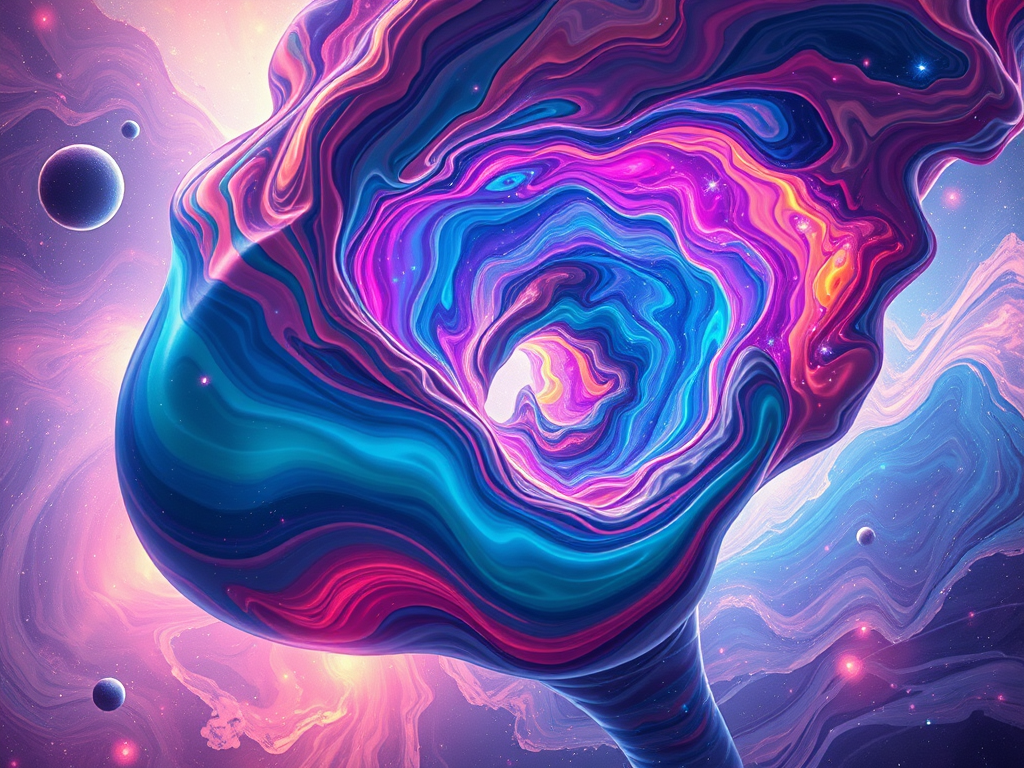
Introduction For decades, cosmologists have wrestled with the fate of the universe—proposing models like the Big Crunch, Heat Death, or infinite expansion. But what if these conventional theories miss a critical aspect of cosmic evolution? Imagine a universe that isn’t simply expanding or contracting but is, instead, a continuously evolving structure—much like a fluid, ever-morphing… Continue reading
 EssayBoard