
Introduction
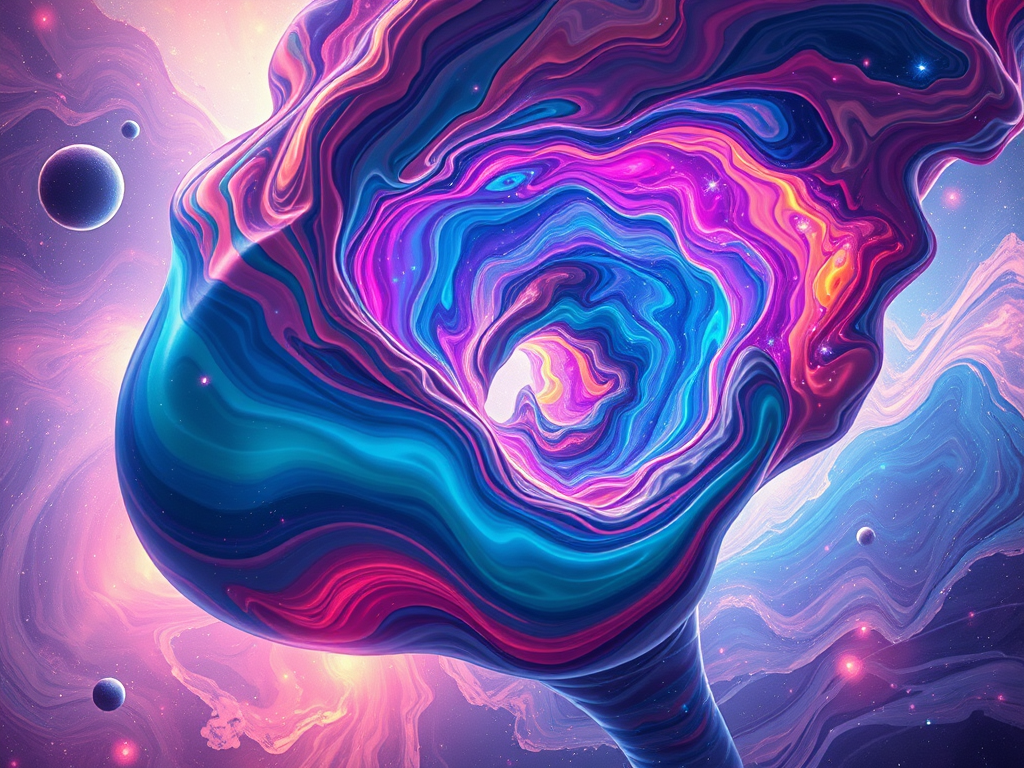
For decades, cosmologists have wrestled with the fate of the universe—proposing models like the Big Crunch, Heat Death, or infinite expansion. But what if these conventional theories miss a critical aspect of cosmic evolution? Imagine a universe that isn’t simply expanding or contracting but is, instead, a continuously evolving structure—much like a fluid, ever-morphing blob. The Blob Universe Theory offers a fresh perspective: it posits that our universe is a dynamic, reconfiguring system where the very laws of physics might be emergent properties that change over time.
1. What Is the Cosmic Blob?
In traditional cosmology, we assume a static set of physical laws governing a fixed or predictably evolving cosmos. The Blob Universe Theory challenges that by suggesting:
- Evolving Structure: The universe behaves like a “blob”—a fluid-like entity that continuously reshapes itself. Think of it as a cosmic canvas where new forms, forces, and even dimensions can emerge.
- Emergent Physics: Just as water exhibits different properties when frozen or vaporized, the familiar forces of gravity, electromagnetism, and quantum mechanics might be temporary, context-dependent manifestations of the blob’s current state.
- Underlying Mechanisms: Analogous to phase transitions in materials, shifts in the blob’s structure could be driven by underlying interactions or energy fluctuations, hinting at deeper, still-unknown physical laws.
2. Reinterpreting the Big Bang: Collisions and Reconfigurations
The conventional view casts the Big Bang as a singular event—a one-off explosion from an infinitely dense point. The Blob Universe Theory, however, offers an alternative explanation:
- Blob Collisions and Mergers: Instead of a unique creation event, the Big Bang could represent the result of a collision or merger between cosmic blobs, or the tearing and reformation of a larger cosmic membrane.
- Continuous Cosmic Reconfiguration: These interactions might be recurring. In this model, Big Bang–like events aren’t isolated—they occur as part of an ongoing cosmic cycle, where localized reconfigurations spawn new regions of space-time.
- Observable Signatures: Such a dynamic process might leave distinct imprints, perhaps observable as unique fluctuations in the cosmic microwave background or in gravitational wave data.
3. The Morphing Cosmos: Evolving Beyond Our Current Laws
If the universe is not static but an ever-changing blob, then the future might bring transformations that challenge our very understanding of reality:
- Temporary Laws of Physics: What if the constants and laws we take for granted are merely snapshots of the blob’s current configuration? As the blob morphs, these laws could evolve—potentially giving rise to physics that we cannot yet imagine.
- Changing Dimensions and Time: Time itself might be an emergent property of the blob’s state. In a radically reconfigured phase, even the concepts of space and time could be redefined, leading to phenomena that defy current comprehension.
- New Cosmic Phases: Entire cosmic structures—galaxies, particles, and dimensions—might rearrange or dissolve as the blob transitions into new states, much like water transforming between ice, liquid, and vapor.
4. The Cosmic Fade-Out: A Gradual Transition
One of the most intriguing possibilities raised by the Blob Universe Theory is that the universe might not end in a dramatic collapse or runaway expansion, but rather, it could gradually fade out:
- A Slow Dissolution: Instead of an explosive finale, the fabric of space-time might slowly lose coherence and energy. Think of it as a gradual “turning off” of the cosmic hologram.
- Implications for Reality: From within the system, this fade-out could appear unremarkable—a quiet, almost imperceptible transition rather than a cataclysm. However, this process would signal the breakdown or transformation of the physical laws that currently define our universe.
- Observational Hints: Identifying subtle changes in the behavior of cosmic forces or energy distributions might provide clues about this gradual transition, offering a way to test the theory.
5. Implications and Future Directions
The Blob Universe Theory invites us to rethink not only how our universe began but also how it might evolve:
- Rethinking Cosmic Evolution: If the universe is a dynamic, ever-morphing blob, then what we perceive as fixed laws and constants might be fleeting properties of a larger, continuously changing system.
- Testable Predictions: By identifying potential signatures—such as unique patterns in cosmic background radiation or unexpected gravitational wave events—we can explore ways to support or challenge this model.
- A New Framework for Understanding Reality: This theory challenges us to consider that reality itself might be more fluid and transient than previously thought, opening up exciting avenues for both theoretical and observational research.
Conclusion: Embracing the Cosmic Metamorphosis
The Blob Universe Theory challenges mainstream cosmology by offering a vision of the cosmos as a continuously evolving, reconfiguring entity. It suggests that:
- The Big Bang might be just one of many cosmic reconfigurations.
- The laws of physics may be emergent and temporary.
- The universe could gradually fade or transform into states beyond our current understanding.
Rather than asking how the universe will “end,” we might be better served by asking: What will the universe become?
What do you think? Could our cosmos be an ever-changing blob, continuously reshaping the rules of reality? Share your thoughts and join the conversation on this radical new perspective!

 EssayBoard
Leave a comment