
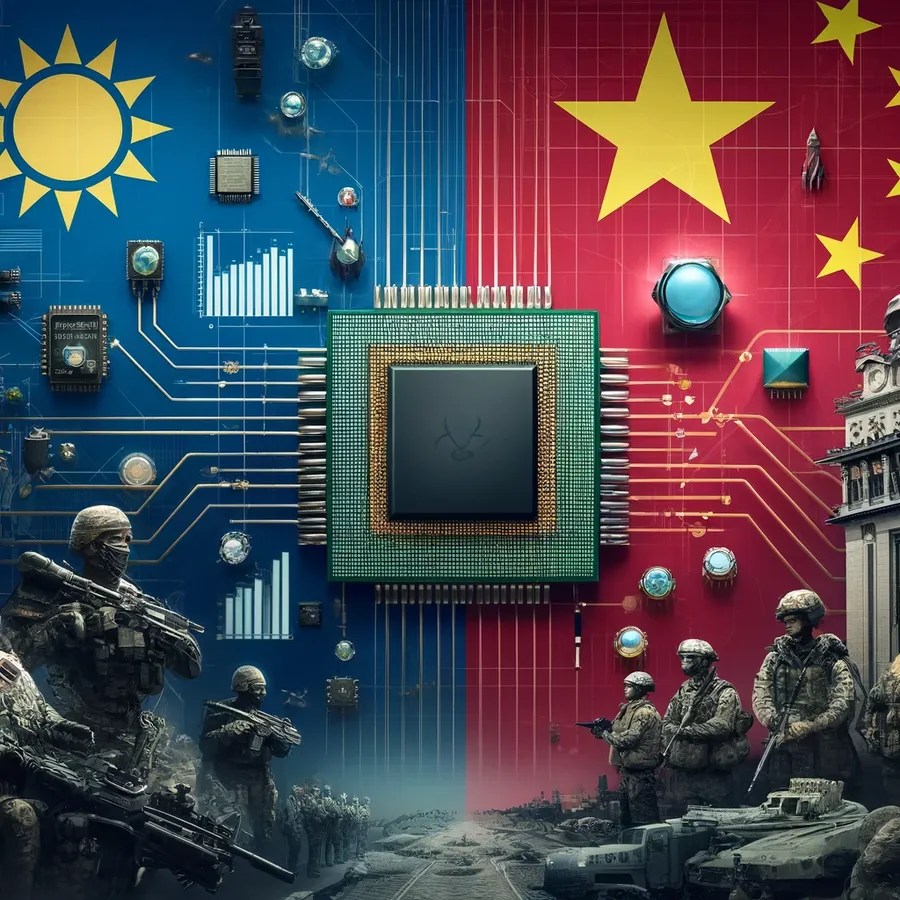
In the rapidly evolving geopolitical landscape, Taiwan stands at a precarious juncture. Historically a powerhouse in semiconductor manufacturing, Taiwan’s future now faces significant challenges as China leverages its strategic advantages and technological advancements. The question on many minds is whether Taiwan is doomed as China turns up the heat, especially with the United States’ focus divided by crises in Ukraine and Gaza.
China’s Strategic Advantage and Taiwan’s Vulnerability
China’s approach to technological advancement often involves leapfrogging existing technologies. This strategy allows China to bypass traditional development stages and achieve leadership in emerging fields quickly. A prime example is the electric vehicle (EV) industry. While Western nations invested in refining internal combustion engine (ICE) technologies, China focused on developing a robust EV sector. Today, China leads globally in EV production, with companies like BYD and NIO offering competitive models that dominate markets worldwide (The Diplomat).
China is now applying this leapfrogging strategy to the semiconductor industry. Significant investments in next-generation technologies such as photonics and 3D stacking promise to outperform traditional semiconductor technologies. For instance, China’s first photonic chip production line is set to be ready in 2023, which could significantly boost its capability in this field. Photonic chips offer higher speeds and lower power consumption compared to traditional electronic chips, potentially making Taiwan’s semiconductor industry, dominated by TSMC, less critical on the global stage (Global Times) (ECNS).
The Impact of a Divided U.S. Focus
With the U.S. deeply involved in supporting Ukraine against Russian aggression and dealing with the crisis in Gaza, its ability to counterbalance China’s ambitions in Asia is strained. This divided focus could embolden China to increase pressure on Taiwan through economic, diplomatic, and military means. China’s strategy might involve non-military tools such as economic sanctions, cyber attacks, and diplomatic pressure to isolate Taiwan without triggering a full-scale conflict.
The economic impact of such actions could be severe for Taiwan, especially if China convinces other countries to cease trade with Taiwan. Given that China is the largest trading nation globally, its influence is significant. If China can offer faster, more advanced photonic chips, it could persuade global business partners to switch allegiance, undermining Taiwan’s technological and economic standing (The Diplomat) (ECNS).
Technological Leapfrogging: China’s Ace in the Hole
China’s investment in photonic chips and other cutting-edge technologies represents a significant leapfrog over traditional semiconductor technology. The potential to render Taiwan’s semiconductor manufacturing capabilities less relevant is a strategic advantage. Photonic chips, which use light rather than electrical signals, offer computation speeds and transmission rates vastly superior to current semiconductor technologies. This leapfrogging could make Chinese technology the new global standard, much like how China has dominated the EV market (Phys.org) (ECNS).
Moreover, China’s domestic production capabilities are advancing rapidly. By 2023, China aims to have a fully operational photonic chip production line, which could lead to mass production and widespread adoption. This would significantly diminish the global reliance on Taiwan’s semiconductor output and shift the technological balance in China’s favor (Global Times) (ECNS).
The Geopolitical Landscape: China’s Luck
China’s rise is also facilitated by favorable geopolitical circumstances. The U.S., traditionally the counterbalance to Chinese ambitions, is currently distracted by conflicts in Ukraine and Gaza. This distraction allows China to pursue its goals with less resistance. Furthermore, China’s Belt and Road Initiative has strengthened its economic ties with numerous countries, increasing its influence and ability to isolate Taiwan economically (The Diplomat) (ECNS).
China’s strategic initiatives, combined with the U.S.’s divided focus, create a perfect storm that could lead to Taiwan’s economic and technological isolation. The U.S. recognizes the risks of over-reliance on Taiwanese semiconductors and is working to diversify its supply chains. However, this process takes time, and the rapid pace of China’s technological advancements could outstrip these efforts (The Diplomat) (ECNS).
Taiwan’s Diminishing Strategic Importance
As China advances its technological capabilities, Taiwan’s strategic importance in the global supply chain is diminishing. The development of photonic chips and other advanced technologies reduces the world’s reliance on traditional semiconductors. If China successfully implements these technologies, it could render Taiwan’s current technological edge obsolete.
Furthermore, China’s economic might enables it to exert significant pressure on Taiwan. By leveraging its position as the world’s largest trading nation, China can influence global trade practices and persuade other countries to limit their economic interactions with Taiwan. This could lead to Taiwan’s economic isolation and significantly weaken its global standing (The Diplomat) (ECNS).
Conclusion: A Grim Outlook for Taiwan
In conclusion, the combination of China’s strategic technological advancements, favorable geopolitical circumstances, and economic influence paints a grim picture for Taiwan. As China turns up the heat, Taiwan’s vulnerabilities are laid bare. The rapid development of photonic chips and other leapfrogging technologies threatens to undermine Taiwan’s semiconductor industry, a cornerstone of its economy. With the U.S. unable to focus entirely on containing China, Taiwan faces an uphill battle to maintain its relevance and security.
The next five to ten years will be critical for Taiwan. The world will be watching closely as Taiwan navigates these challenges, balancing between the pressures of a rising China and the shifting geopolitical landscape. While Taiwan’s fate remains uncertain, the current trajectory suggests that it could be significantly disadvantaged, if not doomed, by China’s relentless strategic advances.
Sources:
- “China’s electric vehicle strategy: Staying ahead of the curve,” McKinsey & Company, link.
- “China’s first photonic chip production line to be ready in 2023,” Global Times, link.
- “World’s first ultra-fast photonic computing processor using polarization,” Phys.org, link.
- “China’s Semiconductor Breakthrough,” The Diplomat, link.
- “CHIPS Act: A Step Forward for U.S. Semiconductor Competitiveness,” Semiconductor Industry Association, link.
- “The Future of AI: Trends to Watch in 2023 and Beyond,” Forbes, link.
- “U.S. Arms Sales to Taiwan: Strategic Implications,” Council on Foreign Relations, link.
- “The Importance of Taiwan’s Security to the United States,” The National Interest, link.

 EssayBoard
Leave a comment