
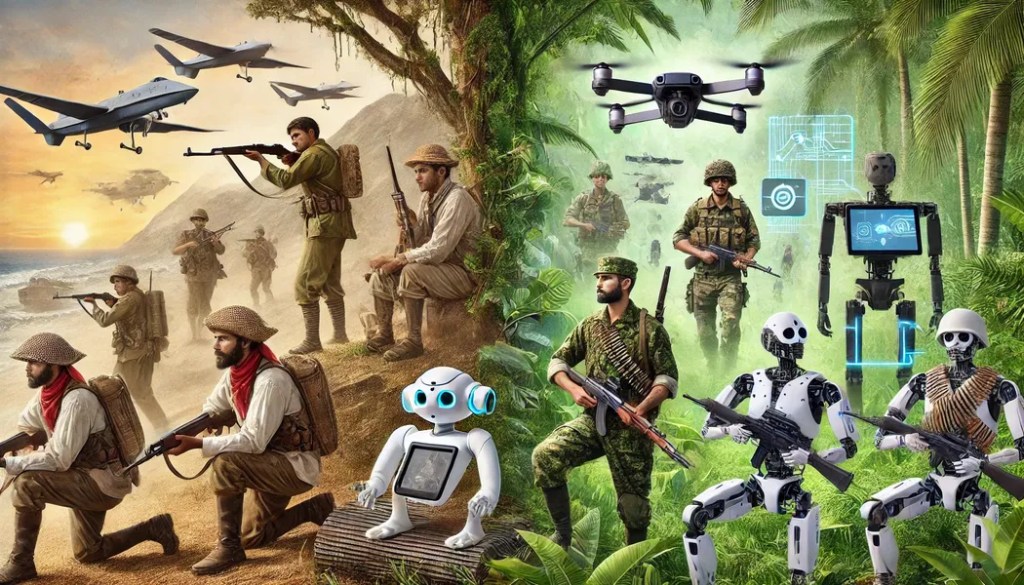
Historical Overview
Guerrilla warfare, a method of irregular warfare where small groups use military tactics like ambushes and sabotage to fight larger traditional military forces, has a long and varied history. Its origins can be traced back to ancient times when Sun Tzu wrote about the importance of flexibility and surprise in “The Art of War.” Similarly, the Iberian tribes used guerrilla tactics against the Roman Empire, employing hit-and-run strategies to resist conquest (East Asia Forum) (vietnamnews.vn).
Throughout history, guerrilla warfare has been adopted by numerous leaders and movements. Quintus Fabius Maximus used a strategy of attrition against Hannibal during the Second Punic War. The Hussite Wars in the 15th century saw Jan Žižka employing innovative guerrilla tactics against the Holy Roman Empire. In the American Revolutionary War, figures like Francis Marion, known as the “Swamp Fox,” used guerrilla tactics against British forces (vietnamnews.vn) (East Asia Forum).
The Spanish guerrilleros during the Peninsular War against Napoleonic France gave the tactic its modern name. Mao Zedong’s strategies during the Chinese Civil War and T.E. Lawrence’s use of guerrilla tactics in World War I further developed these principles. Each of these instances showcases how smaller, less equipped forces can effectively challenge more powerful adversaries through unconventional means (East Asia Forum).
The Future of Guerrilla Warfare: Robotics, Drones, and AI
As technology advances, so too does the nature of warfare. The future of guerrilla warfare is likely to see significant changes with the integration of robotics, drones, and AI. These advancements promise to enhance the effectiveness of guerrilla tactics, making them more lethal and difficult to counter.
Robotic Warfare
Autonomous robots equipped with AI capabilities are set to play a crucial role in future guerrilla warfare. These robots can perform a variety of tasks, from surveillance and reconnaissance to direct combat. Equipped with advanced sensors and weaponry, they can operate in environments that are too dangerous or inaccessible for human soldiers.
- Patrolling and Surveillance: Autonomous robots can conduct continuous surveillance, providing real-time data and monitoring enemy movements.
- Combat and Support: Armed robots can engage in direct combat, using AI to target enemy combatants accurately. They can also transport supplies and perform medical evacuations (vietnamnews.vn) (East Asia Forum).
Drones and Swarm Technology
Drones have already demonstrated their potential in modern warfare, and their capabilities are continually expanding. Future drones will be more autonomous, stealthy, and capable of operating in swarms.
- Swarm Tactics: Drones operating in swarms can overwhelm enemy defenses through coordinated attacks. These swarms can communicate and adapt in real-time, making them highly effective.
- Stealth and Precision: Stealth drones equipped with AI can navigate complex environments and deliver precise attacks on high-value targets, minimizing collateral damage (East Asia Forum) (vietnamnews.vn).
AI Integration
AI is the backbone of these advancements, enabling robots and drones to operate autonomously and make decisions on the fly.
- Target Identification and Decision-Making: AI can identify and prioritize targets, optimizing attack strategies in real-time.
- Adaptive Algorithms: Machine learning allows these systems to learn from past engagements, improving their effectiveness over time.
The Scary Prospect: Bioweapons Delivered by Drones
One of the most terrifying prospects is the use of bioweapons delivered by stealth drones. These drones could distribute biological agents with precision, reaching areas that are difficult for traditional forces to access.
- Stealth Delivery: Stealth drones can operate undetected, making surprise bioweapon attacks possible.
- Targeted Attacks: AI allows for the precise targeting of specific areas or populations, potentially causing devastating effects with minimal effort (East Asia Forum) (vietnamnews.vn).
Ethical and Legal Implications
The use of such advanced technologies in guerrilla warfare raises significant ethical and legal concerns. The deployment of autonomous weapons and bioweapons challenges existing international laws and conventions.
- Autonomous Weapons: The potential loss of human control over lethal decisions raises ethical questions about accountability and the rules of engagement.
- Bioweapons: The use of biological agents is prohibited under the Biological Weapons Convention (BWC). Deploying bioweapons via drones would constitute a severe violation of international law (East Asia Forum) (vietnamnews.vn).
Predictions and Future Conflicts
The rapid pace of technological advancement suggests that these future guerrilla warfare tactics could be seen within this decade. Conflicts in regions with high technological capabilities and asymmetric warfare scenarios are likely candidates for the deployment of such tactics.
- Potential Hotspots: Conflicts involving technologically advanced nations or regions with ongoing asymmetric warfare, such as the Middle East or Eastern Europe, could see the early adoption of these tactics.
- Superpower Involvement: The US and China, both leaders in AI and drone technology, are likely to develop and deploy these tactics, either directly or through proxy forces. The US has already been experimenting with drone swarms through DARPA’s OFFSET program, while China has been advancing its AI and drone capabilities for military applications (vietnamnews.vn) (East Asia Forum).
Superpowers and Proxy Wars
Superpowers like the US and China will play pivotal roles in shaping the future of guerrilla warfare. Both nations are investing heavily in AI, drones, and robotics for military purposes.
- US Strategies: The US is likely to integrate these technologies into its existing military framework, enhancing its capabilities in both direct and proxy conflicts. Programs like OFFSET are a testament to the US’s commitment to developing advanced drone swarms and autonomous systems (East Asia Forum).
- China’s Approach: China is also making significant strides in AI and drone technology. Its Belt and Road Initiative (BRI) could serve as a platform for deploying these technologies in regions where China seeks to expand its influence, potentially arming proxy forces with advanced guerrilla warfare capabilities (vietnamnews.vn).
Conclusion
The evolution of guerrilla warfare from ancient tactics to future technologies underscores the dynamic nature of conflict. The integration of robotics, drones, and AI promises to make guerrilla tactics more effective and deadly, while also raising significant ethical and legal concerns. As these advancements continue, the nature of warfare will be fundamentally transformed, with superpowers like the US and China leading the way in developing and deploying these technologies. The potential for bioweapon attacks delivered by stealth drones adds a terrifying dimension to this future, highlighting the need for robust international regulations and ethical considerations to prevent misuse. As we look ahead, the rapid pace of technological development suggests that these changes could occur within this decade, fundamentally altering the landscape of global conflict.

 EssayBoard
Leave a comment