
How Space Elevators, Lagrange Points, and Asteroid Mining Could Flip the Energy Economics of Space—And Why It’s Still a Long Shot
Prologue: The Cargo Ship Paradox
Imagine a cargo ship. It leaves Shanghai loaded with containers, burns thousands of tons of fuel crossing the Pacific, and arrives in Los Angeles. After unloading, it turns around and sails back—empty. The energy that propelled it home contributes nothing. That wasted kinetic energy, every voyage, is simply poured into the ocean.
Now imagine the same ship returning not empty, but laden with something valuable—and that the descent itself generates electricity, enough to help power the next voyage. This is the mental model that has quietly been reshaping how a small group of engineers, physicists, and contrarian thinkers view our future in space. They argue that we have been thinking about space access backward: not as a one‑way rocket equation, but as a gravity‑assisted loop.
For decades, the space elevator was dismissed as a beautiful dream—a ribbon of carbon nanotubes stretching from the equator to geostationary orbit, lifting payloads for pennies a kilogram. When reusable rockets like SpaceX’s Falcon 9 and Starship began slashing launch costs, many experts declared the elevator obsolete. Why build a multi‑billion‑dollar structure when you can just fly again?
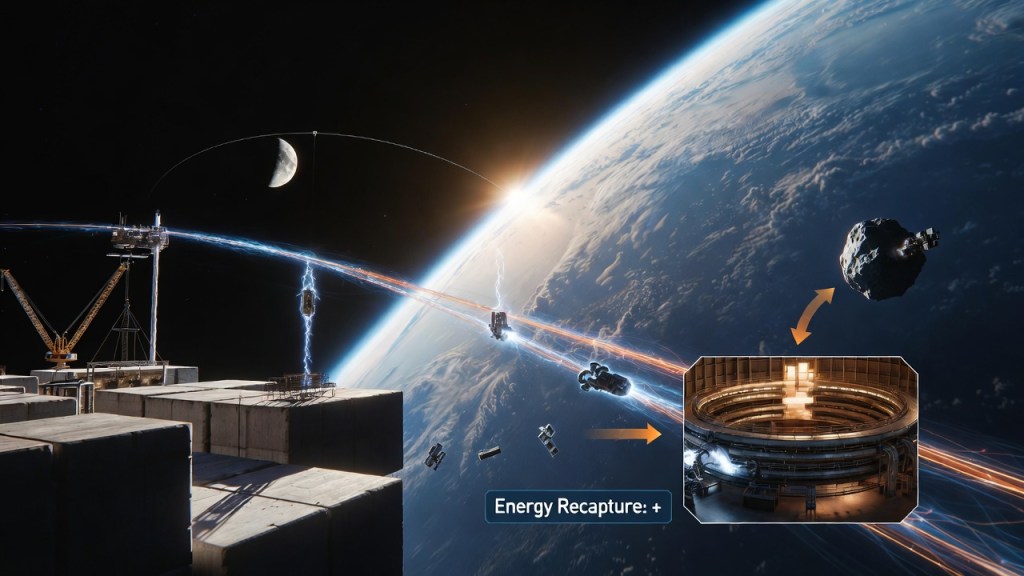
But that argument misses a deeper truth. Rockets, even reusable ones, throw away energy. A returning booster dumps its kinetic and potential energy into heat, sonic booms, and braking burns. No energy is recovered. The elevator, by contrast, can be designed as a gravity battery. A descending climber—loaded with material from orbit—can run its motors in reverse, feeding electricity back into the grid. The same principle that lets electric cars recover energy downhill can be scaled to a 36,000‑kilometer tether.
This is not science fiction. It is already being demonstrated on Earth, by a handful of companies building what are essentially micro‑elevators: giant cranes that lift concrete blocks and then lower them to generate power. The world’s first grid‑scale “gravity storage” plant, built by Energy Vault in China, uses 35‑ton blocks, regenerative winches, and software to store and release energy with round‑trip efficiency approaching 75%. The physics is simple: moving mass in a gravitational field is a form of energy storage.
Now scale that physics to space. A space elevator—or better, a network of elevators—could become the circulatory system of a self‑powering space economy.
The Architecture: Lagrange Points as Industrial Hubs
The key to making this work lies not in a single tether from Earth’s surface to orbit, but in a system of tethers anchored at Lagrange points—those gravitational sweet spots where Earth and Moon or Earth and Sun balance each other. The Earth‑Moon L1 point, for instance, sits roughly 85% of the way to the Moon. A “lunar space elevator” could run from the Moon’s surface to EML1, shuttling lunar regolith up to a zero‑gravity factory. Meanwhile, a “terrestrial space elevator” could run from Earth’s equator up to a point near geostationary orbit, or even all the way to Earth‑Sun L1.
But why send mass up at all? Because the most valuable raw materials in the solar system—platinum‑group metals, water ice, structural metals—are already in space, in near‑Earth asteroids. And they can be moved to Lagrange points using almost no energy, by exploiting natural “gravitational highways” known as invariant manifolds. A small nudge can send an asteroid fragment drifting into a stable orbit around L1 or L4, where it waits to be processed.
Now consider the energy loop:
- Upward climbers on the lunar elevator carry lunar soil or asteroid‑derived materials to the L‑point factory. They consume electricity, either beamed wirelessly or conducted through the tether.
- At the factory, raw mass is refined into high‑value products: aluminum beams, solar panels, propellant, water, oxygen.
- Downward climbers on the Earth elevator carry those finished goods back toward the planet. As they descend, their motors act as generators, feeding electricity into terrestrial storage systems (like those gravity storage units on the ground).
The descending climbers are never empty. They are loaded with products that have economic value, and their descent simultaneously produces electrical power. The more mass we process in orbit, the more power we can generate on the way down—a closed‑loop system where space infrastructure becomes a net energy producer rather than a net consumer.
The Roadmap: From Concrete Blocks to Cosmic Infrastructure
No one expects a full Earth‑to‑geostationary elevator to be built next year. The materials challenge is immense: we need a tether with a tensile strength at least 50 times that of steel, capable of spanning 36,000 kilometers without snapping. Carbon nanotubes and graphene are promising, but we cannot yet manufacture them in the required lengths.
Yet the stepping stones are already visible.
- Lunar space elevator: A tether from the Moon’s surface to EML1 requires only 50,000 kilometers of ribbon—a manageable length, and the lower gravity (1/6 g) makes the tensile requirements far less demanding. Several studies estimate the cost of building such a system at under a billion dollars—less than a single Space Launch System rocket. A lunar elevator could be deployed using materials launched from Earth with existing rockets, or even from lunar resources once a small outpost exists.
- Lagrange point factories: The European Space Agency and NASA have already studied in‑space manufacturing. China’s Tiangong space station includes experiments in materials processing under microgravity. The next step is a dedicated factory at L5 or L1, fed by lunar regolith and captured asteroids.
- Asteroid retrieval: NASA’s OSIRIS‑REx and Japan’s Hayabusa2 have shown we can rendezvous with asteroids, sample them, and return material. Scaling that to moving small asteroid fragments into lunar orbit is a matter of engineering, not magic.
- Terrestrial gravity storage: Already commercial. This provides the “ground side” of the energy loop—a way to store the power generated by descending climbers and feed it into the grid.
Each of these pieces can be built independently, using today’s technology or near‑term advances. They are not waiting for a perfect space elevator; they are the necessary subsystems that will make an elevator economically viable when the materials finally arrive.
The Uncomfortable Questions (or, What Could Go Wrong)
A vision this grand demands skepticism. If we are serious about turning it into a roadmap, we must face the hardest questions head‑on.
1. Do we have the materials?
The Achilles’ heel of any space elevator is the tether. Carbon nanotubes and graphene have tensile strengths in theory that would suffice, but no one has ever manufactured a single defect‑free nanotube longer than a meter, let alone 36,000 kilometers. Even microscopic flaws reduce strength by orders of magnitude. And once in space, the tether would be bombarded by radiation, atomic oxygen, and micrometeoroids. The cumulative probability of a catastrophic cut from debris is frighteningly high. Without a material breakthrough, the elevator remains a dream.
2. Does the energy math actually work?
The idea of net energy generation depends on two things: that the mass descending (processed goods) is greater than the mass ascending (supplies, equipment), and that the gravitational potential energy released is not eaten up by inefficiencies. But the first elevator would require an enormous upfront energy investment just to build—energy that may never be recovered. Moreover, climbers descending from Lagrange points (like Earth‑Moon L1 or L2) have far less gravitational energy than those descending from geostationary orbit. The net energy balance is far from guaranteed.
3. Are Lagrange points really stable parking lots?
L1, L2, and L3 are unstable equilibrium points. A spacecraft or tether anchor placed there must use station‑keeping thrusters regularly to avoid drifting away. That requires propellant, which adds recurring cost and complexity. The stable points are L4 and L5, but they are farther away, making any tether from Earth or the Moon much longer and harder to build.
4. How do we get asteroid mass for free?
Moving an asteroid fragment to a Lagrange point via low‑energy transfers is slow (years) and still requires a spacecraft to capture and nudge it. The capture maneuver itself requires propellant, which must be launched from Earth or produced in space. The “almost no energy” claim is a simplification; the real cost is in time, hardware, and the infrastructure needed to process the raw mass once it arrives.
5. Won’t reusable rockets just keep getting cheaper?
Rockets are evolving faster than any elevator can be built. SpaceX’s Starship aims for $100 per kilogram to low Earth orbit—a number that would make even the most optimistic elevator cost estimates (including capital amortization) look uncompetitive. Rockets also offer flexibility: they can reach any orbit, any inclination, on any schedule. An elevator offers only one orbital altitude and inclination (equatorial), and it’s a single point of failure. In a world where launch costs continue to plummet, the business case for a billion‑dollar tether becomes harder to justify.
6. Who pays for it, and who protects it?
The cost of a space elevator would dwarf any existing infrastructure project. No single nation or company is likely to fund it without guarantees of exclusive control, yet the tether would cross the sovereign airspace of many equatorial nations. Political and legal hurdles are immense. And in a world with hypersonic weapons and anti‑satellite capabilities, a stationary, visible tether would be a strategic vulnerability—an inviting target for any adversary.
7. Can we really bootstrap?
The bootstrap narrative assumes that the first elevator can be built with Earth‑launched materials and then produce enough value to build more. But the first elevator itself requires a tether that we don’t yet know how to make. Even the more feasible lunar elevator would require deploying a 50,000‑kilometer ribbon from Earth or the Moon—a herculean task that would dwarf the Apollo program. Using lunar materials to build the second elevator presupposes a mature lunar mining industry that doesn’t exist.
8. What about the trade imbalance?
The cargo ship analogy hides a crucial fact: maritime shipping is incredibly energy‑efficient per ton‑mile. The empty return voyage is a consequence of trade imbalances, not a failure of technology. In space, the trade imbalance may be even more extreme. The vast majority of mass launched from Earth (people, supplies, equipment) would never return. Unless we find a way to make the Earth‑to‑orbit direction lighter than the orbit‑to‑Earth direction, the net energy balance will remain negative.
Why Bother? The Case for Pursuing Anyway
Given these obstacles, why continue to talk about space elevators at all?
Because the payoff is so large that even a slim chance of success is worth exploring. The potential benefits—near‑zero marginal cost to orbit, the ability to export energy from space, and the opening of the solar system’s resources—would transform human civilization. And every one of the challenges listed above is a technical or economic problem, not a violation of the laws of physics. History is filled with technologies that were dismissed as impossible until the right breakthrough arrived.
Moreover, the individual pieces of the puzzle—lunar elevators, Lagrange point factories, asteroid retrieval, gravity storage—are being developed independently, often for other reasons. Even if a full Earth elevator never materializes, these subsystems could still create a vibrant cis‑lunar economy. A lunar elevator alone, for instance, could slash the cost of moving material from the Moon to space, enabling the construction of large structures without launching everything from Earth.
The cargo ship took centuries to evolve from a wooden tub to a floating city. The space elevator network will likely take decades. But the physics, the economics, and the incentive are aligned. The only thing missing is the will to begin—and the willingness to confront the hard questions honestly.
Epilogue: The Gravity Well Reconsidered
“The Earth is the cradle of humanity, but one cannot live in a cradle forever.”
— Konstantin Tsiolkovsky, father of astronautics.
A cradle, yes. But perhaps, with the right architecture, the cradle can also be a flywheel. Every time we send mass up, we store energy. Every time we bring mass down, we harvest it. The gravity well is not a trap; it is a reservoir waiting to be tapped.
The road is long, and the obstacles are real. But the first step is not to build a tether. It is to stop thinking of gravity as a cost and start thinking of it as a resource.
This article is intended as a thought experiment, not an investment thesis. The companies mentioned are illustrative of technologies already in development; no endorsement is implied. This article is written with the help of AI.

 EssayBoard
Leave a comment