

Author’s Note
This work is entirely speculative and written with the help of AI. It offers no mathematics or experimental data, yet it attempts to stitch together what modern science already describes separately: general relativity’s curved spacetime, quantum theory’s graviton concept, cosmic expansion, and the thermodynamic arrow of time. The model’s purpose is not to claim proof, but to show that by re-imagining gravity as a dimensional current rather than a static curvature, these pieces can coexist without contradiction.
Abstract
This paper explores a qualitative model in which gravity arises from a fifth dimension that acts as a flowing current—an energetic gradient leaking from a sixth-dimensional source into our four-dimensional universe. In this view, the familiar 3-space + 1-time continuum is the cross-section of a larger dimensional cascade.
The arrow of time appears because the 5-D gravitational current has a built-in orientation: a one-way “downhill” flow of energy and information that defines forward time and drives entropy. Space, matter, and quantum fields are manifestations of this same flow observed at different scales. The weakness of gravity, the stability of the vacuum, and the accelerated expansion of the cosmos all follow from geometric dilution of that current.
While purely conceptual, this “Dimensional Gradient Hypothesis” provides an intuitive map linking general relativity, quantum gravity, and thermodynamic irreversibility within one coherent geometry.
Introduction
Physics today rests on two towering frameworks that rarely speak the same language. General Relativity (GR) describes a smooth four-dimensional continuum where matter and energy curve spacetime, producing what we call gravity. Quantum Field Theory (QFT) depicts a discrete, probabilistic world of particles and forces, including the hypothetical graviton, that mediate interactions. Both work beautifully in their domains yet fail to merge cleanly when gravity is extreme or distances approach the Planck scale.
This disconnect has inspired decades of unification attempts—from string theory’s ten or eleven dimensions to loop-quantum gravity’s quantized geometry. But each approach adds mathematical machinery while leaving open a philosophical riddle:
Why does time flow only forward? Why is gravity both geometric and force-like? And why is it so weak yet universal?
The idea developed here begins with a simple inversion: perhaps gravity isn’t just a property of spacetime; perhaps it creates spacetime. Imagine that what Einstein called curvature is the shadow of motion through a deeper dimension. If a persistent energy stream from a higher manifold continually feeds our universe, then the geometry we inhabit could be the equilibrium surface of that inflow. Time’s arrow would be the direction of the current; entropy its side-effect.
This paper builds that picture step by step: first by laying out the core postulates, then by describing how such a dimensional stream would appear within our observable world.
Core Postulates
1. Dimensional Descent
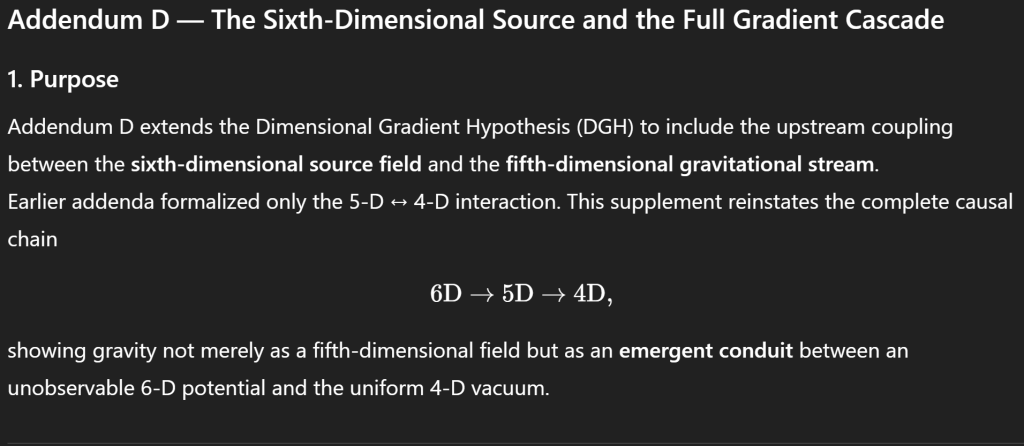
Reality extends at least one level beyond four dimensions. A sixth-dimensional field—call it the source ocean—possesses higher potential energy or informational density. This field continuously leaks into a fifth-dimensional gravitational manifold, forming a steady current. That leak defines the ultimate arrow: from 6-D → 5-D → 4-D.
2. Gravitational Stream
The fifth dimension is not an empty coordinate but a medium whose flow carries quanta recognizable to us as gravitons. On large scales that stream manifests as smooth spacetime curvature; on microscopic scales as discrete gravitational quanta. What we call “the gravitational field” is simply our 4-D cross-section of this higher-dimensional current.
3. Emergent Spacetime
Our universe’s three spatial dimensions plus time emerge as a stable pattern within that flow. Space is the static geometry of the equilibrium surface; time is motion through the gravitational dimension. Thus, time is not an independent variable but a vector direction along the fifth-dimensional current.
4. Arrow of Time
The forward passage of time corresponds to movement downstream along the gravitational gradient. Reversing time would require reversing the entire flow back toward the 6-D source—an energetically forbidden process. Therefore the universe’s temporal asymmetry is geometric, not merely statistical.
5. Entropy and Gradient Descent
The second law of thermodynamics reflects the universe’s ongoing dimensional gradient descent. Systems evolve toward configurations that couple more efficiently with the downward energy flux—experienced as increasing disorder or entropy. Local order may arise (galaxies, life, thought) but always within the larger downhill drift.
6. Dual Manifestation of Gravity
Because the fifth-dimensional stream interacts weakly with our 4-D sheet, gravity appears simultaneously as a force (in the quantum view) and as curvature (in the relativistic view). This is the same duality seen in wave-particle behavior: continuous flow versus discrete packets.
7. Dimensional Dilution
The farther this current travels from its 6-D source, the more it spreads through available dimensions. By the time it reaches our 4-D spacetime, only a faint projection remains—explaining gravity’s extreme weakness relative to other forces.
Qualitative Field Structure
Visualize three nested layers:
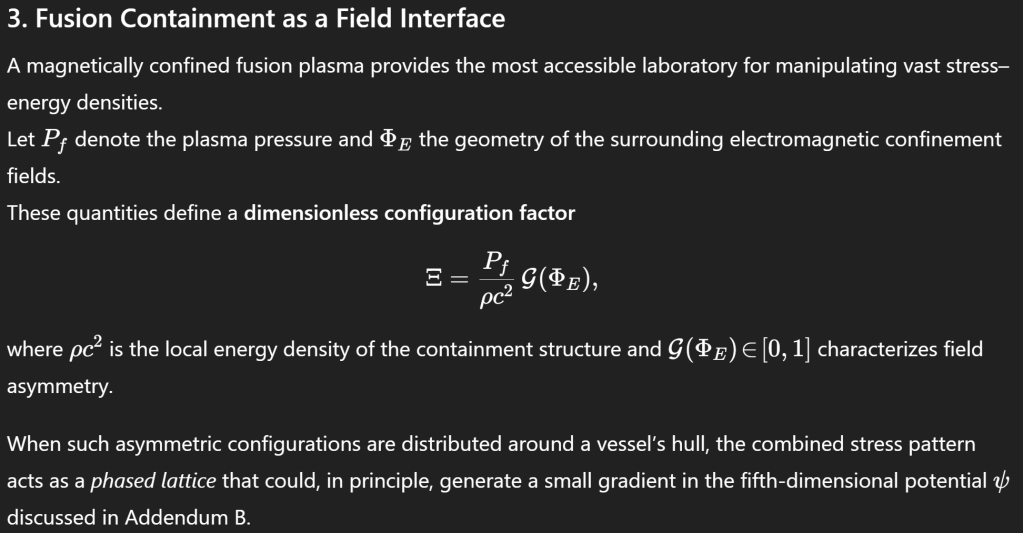
- The 6-D Source Ocean – an energetic manifold beyond conventional spacetime. It might represent the “true vacuum,” the unbroken symmetry state, or a pre-geometric informational substrate. Its high energy density supplies the leak.
- The 5-D Gravitational Channel – a continuous medium through which energy and information from the source descend. This channel possesses directionality; it behaves like a river flowing through a higher-dimensional space. Ripples in this river correspond to gravitational waves; quantized droplets correspond to gravitons.
- The 4-D Spacetime Sheet – our observable universe. It forms where the gravitational flow stabilizes into a relatively flat cross-section. Matter and radiation are coherent disturbances riding within this equilibrium surface.
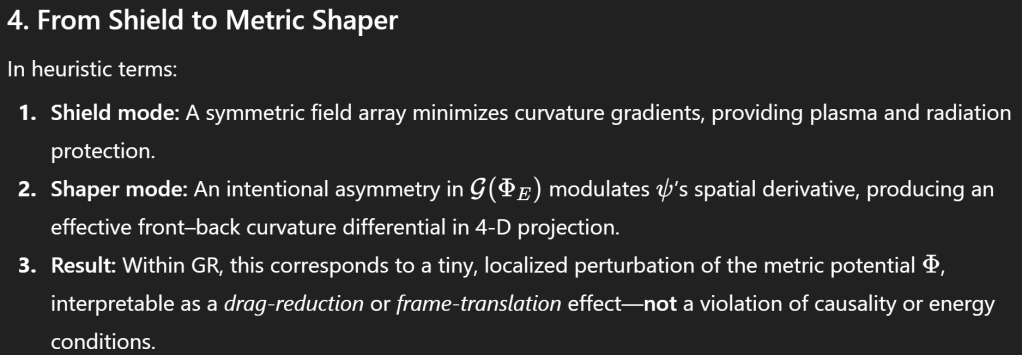
Every phenomenon we observe is therefore an interaction between the current and the sheet. Massive bodies curve space because they locally divert the 5-D stream; the strength of gravity near them measures the gradient of that deflection. Light follows curved paths not because it feels a force, but because the 4-D surface itself is tilted by the underlying current.
How the Flow Generates Space and Time
In this model, space and time are not primary ingredients but emergent coordinates of motion within the 5-D field.
- Space: the equilibrium shape of the current when viewed at rest with respect to its flow. Imagine a river’s surface seen from above—smooth and extended. That surface’s topology defines distance and geometry.
- Time: the flow direction itself. If an observer drifts with the current, forward time simply means moving downstream. Because the current never reverses, time never runs backward. Rate of flow corresponds to local time dilation: strong curvature equals slower passage, gentle curvature equals faster passage.
From this angle, the familiar spacetime metric of general relativity is an effective description of how the 5-D flow bends and stretches the 4-D surface.
Why Gravity is Weak but Universal
In quantum field theory, the strong, weak, and electromagnetic forces are confined to interactions within the 4-D sheet—they do not extend into extra dimensions. Gravity alone permeates the fifth dimension; its field lines “leak” into the bulk. Most of the current’s energy therefore bypasses the 4-D world, leaving only a thin shadow to bind planets and stars.
This dilution explains both gravity’s universality (it affects everything embedded in the sheet) and its weakness (most of its flux remains invisible to us). The same reasoning underpins certain brane-world scenarios, but here the leak originates from a sixth-dimensional reservoir, providing a reason for the flow itself rather than postulating an arbitrary bulk.
Vacuum Energy and Expansion
Because the gravitational stream continually injects subtle energy into our spacetime, the vacuum is never perfectly still. Its constant input maintains quantum fluctuations—the “foam” on which particles emerge and vanish. When the inflow slightly exceeds local binding forces, spacetime expands. Cosmic acceleration (often attributed to dark energy) could thus represent regions where the inflow is stronger or less constrained, stretching the 4-D sheet faster than light without violating relativity—since the metric itself is what’s expanding.
Gravitons and the Wave-Particle Bridge
At microscopic scales, the same dimensional current may oscillate. A single graviton would be a localized quantum of that vibration—energy momentarily trapped within the 4-D sheet before continuing downstream. At cosmic scales, these quanta blur into coherent waves that ripple through galaxies. This dual description—graviton as particle, curvature as wave—is therefore not contradictory but natural in a medium that is both continuous and quantized depending on perspective.
The Arrow of Time and the 6-D Gradient
The persistent mystery of physics is why the equations of motion are time-symmetric while the world is not. Here, asymmetry arises because the 5-D current flows from a region of higher potential (the 6-D ocean) to lower potential (our 4-D sheet). Every physical process is therefore embedded in a descending energy gradient. Entropy increases because it aligns with that descent—systems rearrange to dissipate energy more evenly along the current. No system can reverse the overall flux; hence time’s irreversibility is fundamental, not statistical.
Macro and Micro Unity
At first glance, the cosmos and the quantum realm appear governed by different rules. Yet both may be facets of the same gravitational flow. The curvature of galaxies and the stability of atomic orbitals depend on how the vacuum—shaped by the 5-D current—behaves locally. The difference lies only in scale: vast coherent waves versus tiny quantized ripples.
Derived Implications
If gravity is a fifth-dimensional current leaking from a sixth-dimensional source, several consequences naturally follow.
1. Weak but Pervasive Gravity
Because only a small fraction of the 5-D current couples to our 4-D spacetime, gravity appears weaker than other forces but acts on everything. The current cannot be screened or canceled; hence no true “gravitational charge” of opposite sign exists. Matter merely redirects the stream, forming local eddies we experience as curvature.
2. Cosmic Expansion and Dark Energy
On the largest scales, the 5-D current behaves like uniform pressure. Where no strong matter concentrations restrain it, the stream stretches the 4-D sheet itself. The observed acceleration of the universe’s expansion can therefore be seen as the macro-expression of the same inflow that binds galaxies—a divergence of the current rather than a new exotic energy component.
3. Vacuum Stability and Quantum Foam
At microscopic scales the current feeds the zero-point energy of quantum fields. Fluctuations arise because the stream is never perfectly steady; tiny surges and eddies create particle–antiparticle pairs that appear and annihilate. The “vacuum energy density” measured in quantum theory is a blurred echo of this dynamic inflow.
4. Antigravity and Local Reversal
If a region could redirect the current—bending it back toward the 6-D source or sideways—its projection on our 4-D sheet would appear repulsive. Such redirection could occur cosmologically (dark-energy regions) or hypothetically in exotic matter states where negative energy density forms. In that sense, antigravity is not a separate force but a localized counter-flow.
5. Black Holes as Sinks
A black hole represents an extreme funnel where the 5-D stream plunges almost vertically back toward the higher-dimensional source. The event horizon marks the limit beyond which the downstream velocity equals the local speed of light. Time dilation near the horizon simply reflects that the 4-D sheet tilts steeply into the fifth dimension.
Relation to Existing Theories
Although new in structure, the Dimensional Gradient Hypothesis resonates with several established ideas:
- Einstein’s General Relativity already treats gravity as geometry. The present model keeps that insight but supplies a physical origin for curvature: a moving 5-D medium rather than abstract metric deformation.
- Kaluza–Klein Theory unified gravity and electromagnetism through an extra dimension. The current framework uses the extra dimension not to host another force but to generate spacetime itself.
- Brane-World Models (Randall–Sundrum) describe a 4-D brane in a 5-D bulk with gravity leaking outward. Here, leakage runs inward—from a 6-D source—producing the flow that maintains our universe.
- Emergent Gravity (Jacobson, Verlinde) views spacetime dynamics as thermodynamic. The Dimensional Gradient picture translates entropy growth into literal movement along a dimensional gradient.
- Holographic and AdS/CFT Correspondence interpret extra dimensions as encodings of energy scale. Likewise, the 5-D gravitational current can be read as a continuous scaling transformation from high-energy (6-D) to low-energy (4-D) regimes.
Each of these models captures one aspect—geometry, thermodynamics, or information flow. The present hypothesis weaves them together through a single intuitive mechanism: a unidirectional gravitational stream whose motion defines both curvature and time.
Discussion and Predictions
Unification Perspective
If correct even qualitatively, this framework links three enduring mysteries:
- Quantum gravity – the graviton is a quantized ripple of the 5-D flow.
- Cosmic expansion – large-scale divergence of the same flow.
- Arrow of time – orientation of the flow.
All three phenomena become facets of a single underlying current rather than separate postulates.
Observable Hints
While directly testing extra dimensions is difficult, the model suggests possible signatures:
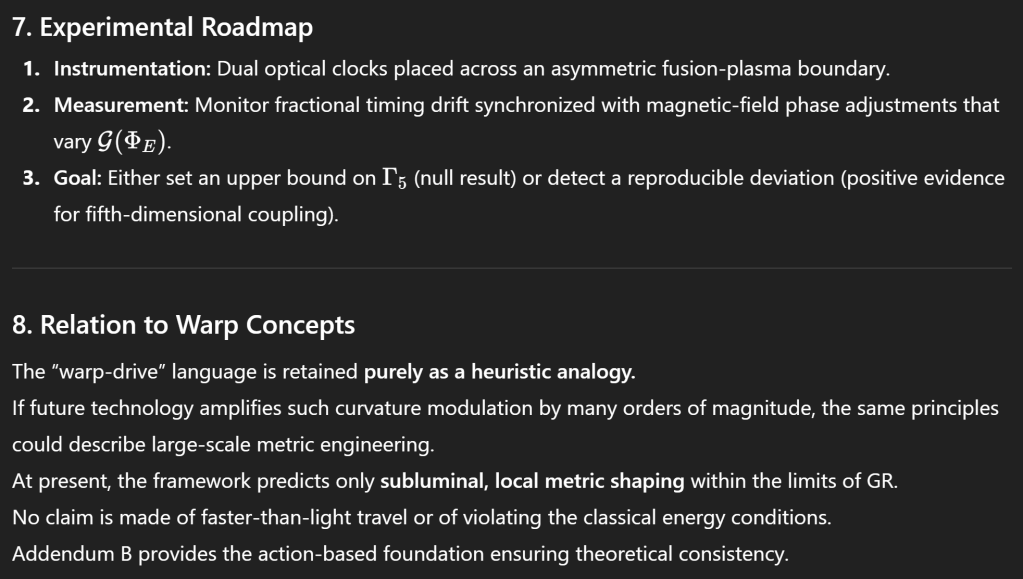
- Slight anisotropies or phase correlations in gravitational-wave backgrounds if the 5-D current has directionality.
- Deviations from the inverse-square law at sub-millimeter scales, where partial coupling to the 5-D medium might appear.
- Relationships between variations in vacuum energy density and cosmic expansion rate beyond what ΛCDM predicts.
Even if none of these prove measurable soon, the hypothesis gives a geometric vocabulary that might help interpret future anomalies.
Philosophical Implications
The universe becomes a dynamic process rather than a static arena. Space, time, and matter are local states of a continuous descent through dimensions. The forward flow of existence—what we call “becoming”—is not an illusion of entropy but an actual geometric motion through a higher-dimensional gradient.
Within this view, consciousness and information might also participate in the same descent: patterns sustained by and slowly diffusing along the gravitational current. While speculative, it re-enchants physics with a sense of underlying unity: every event, from the orbit of galaxies to the flicker of a quantum, traces a single cosmic stream.
Conclusion
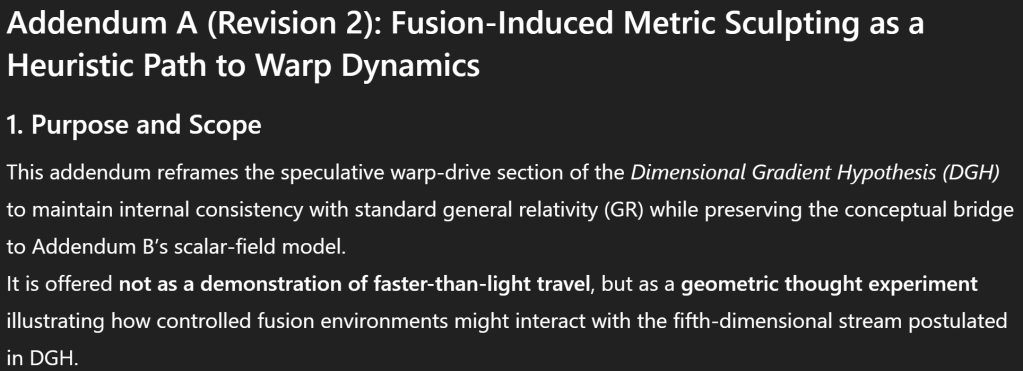
The Dimensional Gradient Hypothesis reframes gravity as a fifth-dimensional flow emerging from a sixth-dimensional source and sustaining our four-dimensional universe. The apparent weakness of gravity, the forward arrow of time, the growth of entropy, and the expansion of space all stem from the same cause: a one-way transfer of energy and information down a dimensional potential.
By treating geometry not as a static fabric but as a living current, this model offers a conceptual bridge between general relativity’s curvature and quantum theory’s graviton. It requires no violation of known physical laws—only the assumption that spacetime itself is the product of ongoing dimensional motion.
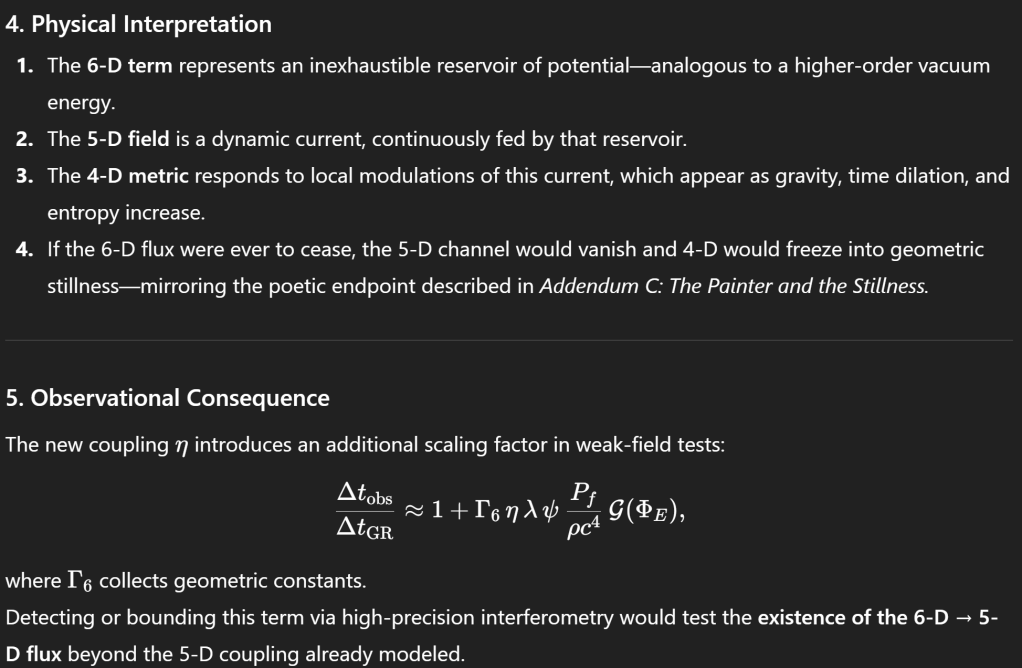
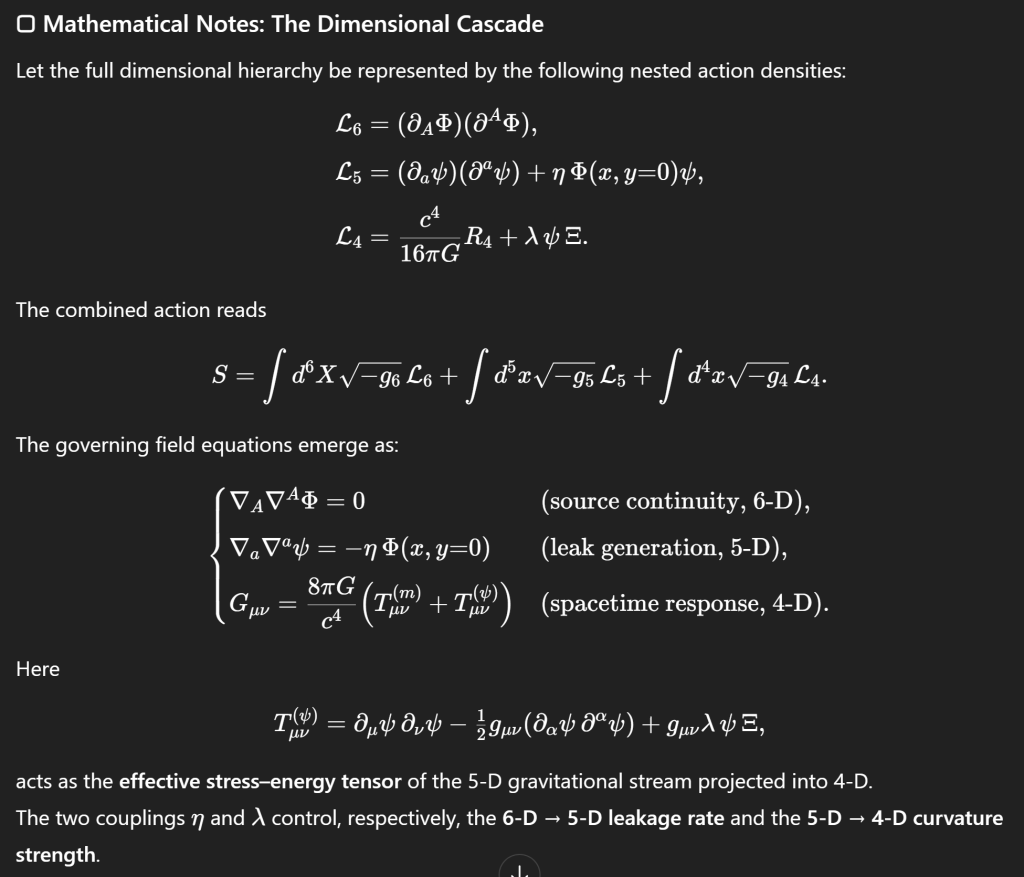
Mathematical formalization would mean expressing Einstein’s equations with an additional conserved flux term representing this current, then verifying that in the low-energy limit it reduces to standard gravity. Whether future theory or observation confirms such a flow remains open, but even as a thought experiment, it demonstrates that the great puzzles of physics—space, time, gravity, and entropy—may be different faces of the same descending river.
Acknowledgment
The author thanks the long tradition of theorists—Einstein, Kaluza, Klein, Randall, Sundrum, Verlinde, Jacobson, and others—whose ideas made such speculation possible.





Addendum C — The Painter and the Stillness
When the sixth dimension’s hand ceases to leak its color through the fifth, the cosmos will dry into stillness.
To the painter beyond, the mural will stand complete—an eternal image containing every moment that ever was or could be.
To those of us painted within it, the end of motion will mean the end of becoming.
Beauty will persist, but only as form, not as experience; it will no longer be something we perceive, but something we are.
Thus the universe, born of flow, will conclude as a perfect still life—a masterpiece to its creator, and a silent eternity to its inhabitants.





 EssayBoard
Leave a comment