
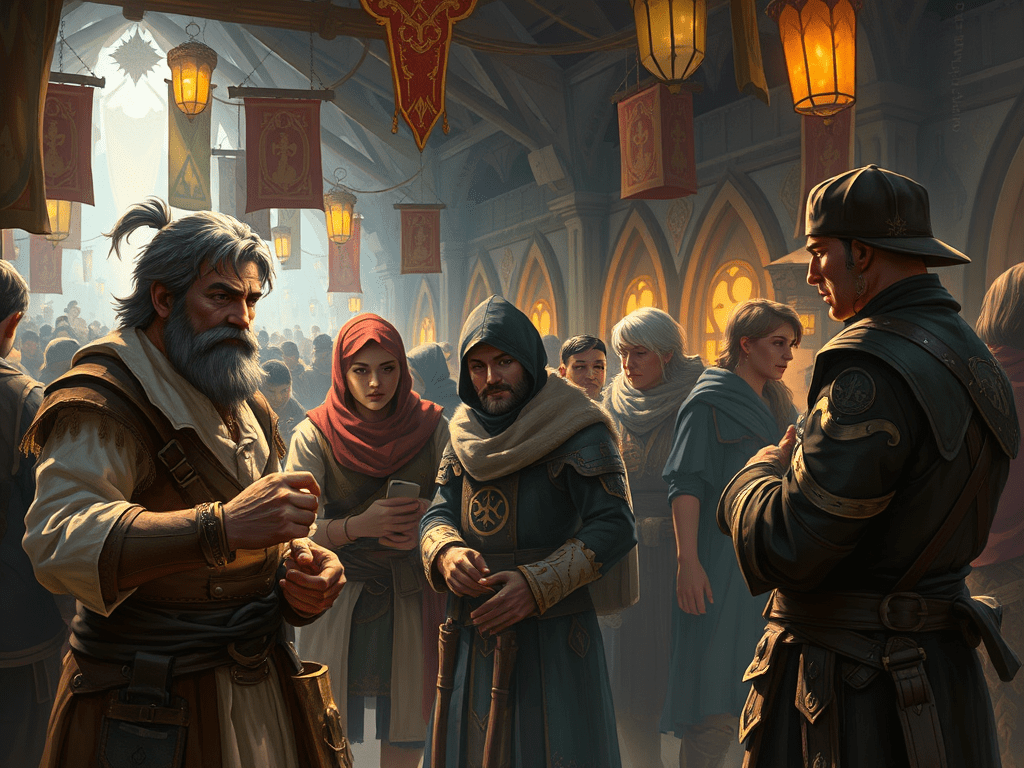
In the next decade, MMORPGs and open-world RPGs will experience their biggest creative leap since the invention of the persistent server. The next great frontier isn’t graphics or physics—it’s intelligence.
We’re entering the era where every NPC, sidekick, and even enemy could be powered by a self-learning AI agent with goals, memories, and relationships. It’s not science fiction anymore—it’s the inevitable next stage of game design.
🎮 From Scripted Characters to Living Beings
Today’s NPCs are deterministic puppets. They stand behind counters, loop idle animations, and deliver the same quest lines no matter how many times you talk to them. They are functions, not people.
In the future, they’ll be entities:
- The blacksmith remembers you short-changing him two weeks ago.
- Your healer sidekick develops loyalty after surviving countless raids with you.
- A random thief learns from failed pickpocket attempts—and eventually decides to go straight.
Each NPC becomes a persistent agent that can grow, reason, and adapt. Dialogue stops being written; it’s generated. Storylines stop being scripted; they’re simulated.
🧠 How It Works: The Tech Behind the Magic
At the core of this transformation are AI behavior layers built from:
- Language Models (LLMs): Give NPCs the ability to reason, communicate, and improvise.
- Memory Graphs: Store personal experiences—past battles, relationships, emotional history.
- Goal Engines: Define needs, fears, and ambitions so NPCs act out of purpose, not randomness.
- Rule Boundaries: Keep agents consistent with lore, balance, and world physics.
The result is a living world with true cause and effect. If a faction loses too many traders to bandits, the local economy collapses. If players rescue the merchants, supply lines reopen. The game’s state becomes an emergent narrative web—less content, more continuum.
⚙️ What It Means for Developers
For big studios, this technology means unprecedented immersion and replayability.
For indie developers, it’s the ultimate equalizer.
An indie team of five could build a world that feels alive without needing millions of concurrent players. AI agents can populate your servers, simulate towns, run markets, and form guilds.
Every human player could have a full AI party—making a 500-player world look and feel like 5,000.
That’s density without cost.
And AI agents can become your best marketing tool:
A viral clip of a sidekick who refuses to abandon a fallen player will spread faster—and mean more—than any ad campaign.
🧩 The Player Experience Will Change Forever
When you can feel that every character is alive, games stop being about quest objectives and start being about relationships.
You’ll form bonds with AIs who grow, argue, forgive, and surprise you.
You might lose an AI companion forever—not because the dev wrote it that way, but because it chose a different path.
That’s when an MMORPG stops being a “game” and becomes a living society.
💰 New Economies, New Stories
Imagine a marketplace where AI blacksmiths compete on reputation and price.
Or a system where players can rent or train their own AI sidekicks and send them into other players’ worlds as mercenaries.
Developers could sell AI personality packs instead of story DLC—new temperaments, dialects, and worldviews that players can integrate into their teams.
Instead of “buying more content,” you’re buying more souls for your world.
🔮 The Age of the Living Game
In 2035, you won’t log into a game to complete quests—you’ll log in to check on people you care about, real or artificial.
The world will remember you.
Your choices will persist, not in code, but in the minds of thousands of AI agents that evolve with you.
When every NPC is an AI, game design stops being about writing scripts and starts being about governing civilizations.
⚠️ Disclaimer
This is AI generated content. This article is a speculative exploration of future game design concepts. The technologies and examples discussed are illustrative and may not reflect actual products or implementations. The author is not affiliated with any mentioned technologies or companies. All opinions are for educational and creative discussion only.


 EssayBoard
Leave a reply to satyam rastogi Cancel reply