
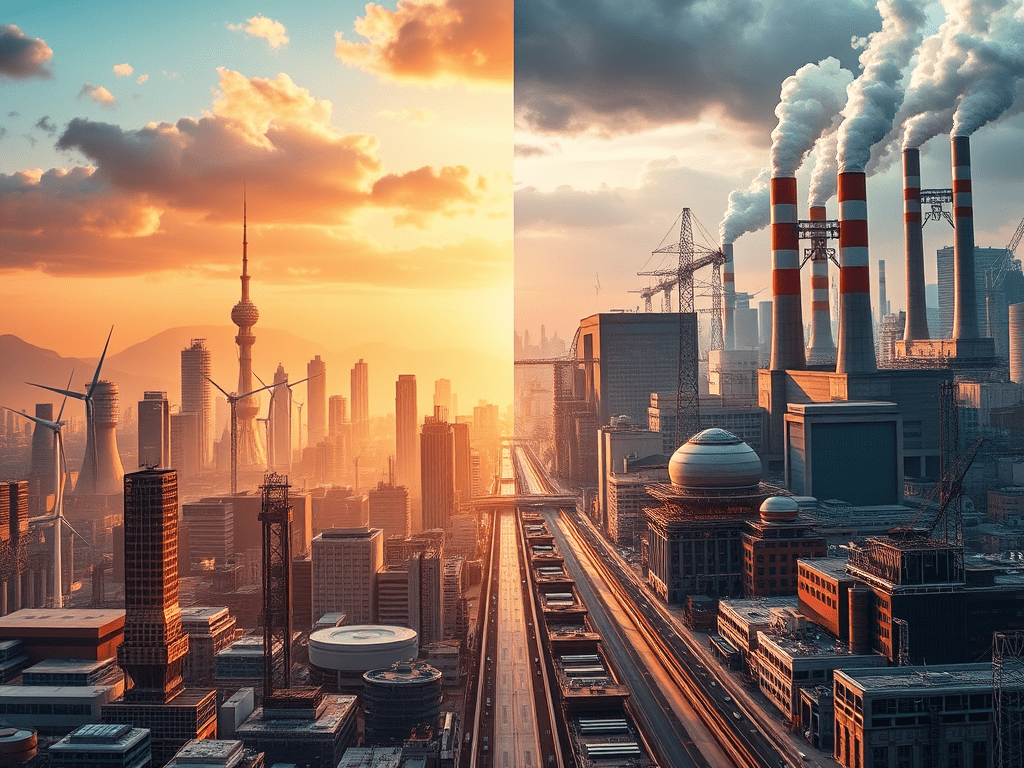
Have you ever wondered why, despite America’s innovative edge, China seems to be pulling ahead in critical technologies like Artificial Intelligence (AI)? The answer might surprise you: energy. Simply put, in the AI era, cheap and abundant electricity isn’t just important—it’s the entire ballgame.
Why AI Is All About Energy
AI isn’t just software. It’s massive computers training huge neural networks, often running nonstop. Each round of training can consume electricity equal to thousands of households. Moore’s Law, the principle that computing power doubles every two years, is slowing down. Now, the real limitation is energy. The cheaper the power, the smarter—and faster—you can train your AI.
China’s “Good Cat” Energy Doctrine
Remember Deng Xiaoping’s famous saying, “It doesn’t matter if a cat is black or white, so long as it catches mice”? That’s exactly how China handles energy policy. Instead of endless ideological battles, China builds everything:
- Renewables: China leads the world in solar and wind energy.
- Hydropower: Massive projects like the Three Gorges Dam generate abundant, reliable electricity.
- Nuclear Power: They’re developing advanced thorium reactors and investing heavily in nuclear fusion research.
- Cleaner Coal: China builds ultra-efficient coal plants to provide stable, low-emission power during the green transition.
On top of all this, China has built an extensive Ultra-High-Voltage (UHV) transmission network to move electricity across vast distances. This lets them place massive AI data centers exactly where power is cheapest.
America’s “Either-Or” Problem
In contrast, the U.S. is caught in a web of political gridlock:
- Energy debates become ideological battles: “drill baby drill” vs. green activists, nuclear supporters vs. renewable enthusiasts, even high-speed rail vs. highway lobbies.
- Permitting processes for new transmission lines or modern nuclear reactors are slow, complicated, and often blocked by local resistance.
- As a result, America’s aging infrastructure struggles to meet the growing energy demand from data centers and industries, leading to rising electricity bills for families and businesses alike.
The Hidden Indicator: PPP-Adjusted Energy Costs
Here’s an insight: look at the cost of electricity adjusted for people’s income (known as Purchasing Power Parity, or PPP). In China, even as power usage skyrockets, electricity bills for the average person remain stable or even decrease. In America, energy bills, adjusted for household income, are creeping upward.
This PPP-adjusted energy cost isn’t just a boring economic indicator—it predicts who’s going to dominate AI. Countries that keep energy cheap relative to incomes will effortlessly attract AI investment and talent.
China’s Transport-Electrification Advantage
China isn’t just increasing energy supply—they’re using less of it for everyday needs:
- Electric Vehicles (EVs): Over a quarter of new cars in China are electric, compared to just 8% in America. These EVs also double as mobile batteries, smoothing out power demands on the grid.
- High-Speed Rail (HSR): With 45,000 kilometers of bullet trains and maglev trains, China moves millions of people daily at a fraction of the energy cost of cars or planes.
- Next-Generation Travel: China is exploring futuristic transport like hyperloops, aiming for speeds over 600 km/h, far outpacing stalled American efforts.
What’s at Stake if Nothing Changes?
If these trends continue, America risks falling behind:
- AI research could shift overseas, where energy is cheaper.
- Military and cybersecurity capabilities could lag behind China’s rapidly advancing technology.
- American businesses and families might face increasingly expensive energy bills, reducing overall economic competitiveness.
How America Can Still Win
But there’s still time to change course. Here’s how:
- Adopt a truly pragmatic energy policy that includes renewables, nuclear, clean coal, and innovative grid solutions.
- Fast-track permitting for crucial infrastructure like power lines and advanced reactors.
- Invest aggressively in groundbreaking energy technologies—fusion, grid-scale batteries, and hydrogen.
- Create incentives for AI investments paired directly with new energy projects.
- Maintain transparency by regularly reporting on PPP-adjusted energy costs to hold policymakers accountable.
Conclusion: Energy is the Key to AI Supremacy
In the AI century, power literally equals intelligence. If America wants to lead, it must set aside ideological battles and follow China’s pragmatic example. The future belongs not just to the smartest countries, but to those that provide abundant and affordable energy to fuel their intelligence.
America, it’s time to catch some mice—no matter the color of the cat.
Disclaimer: This is AI generated content. The content herein is for informational and discussion purposes only and does not constitute investment, legal, or policy advice. All views expressed are the author’s alone. The author may hold positions in companies or sectors mentioned. Do your own research before making investment or policy decisions.

 EssayBoard
Leave a comment