
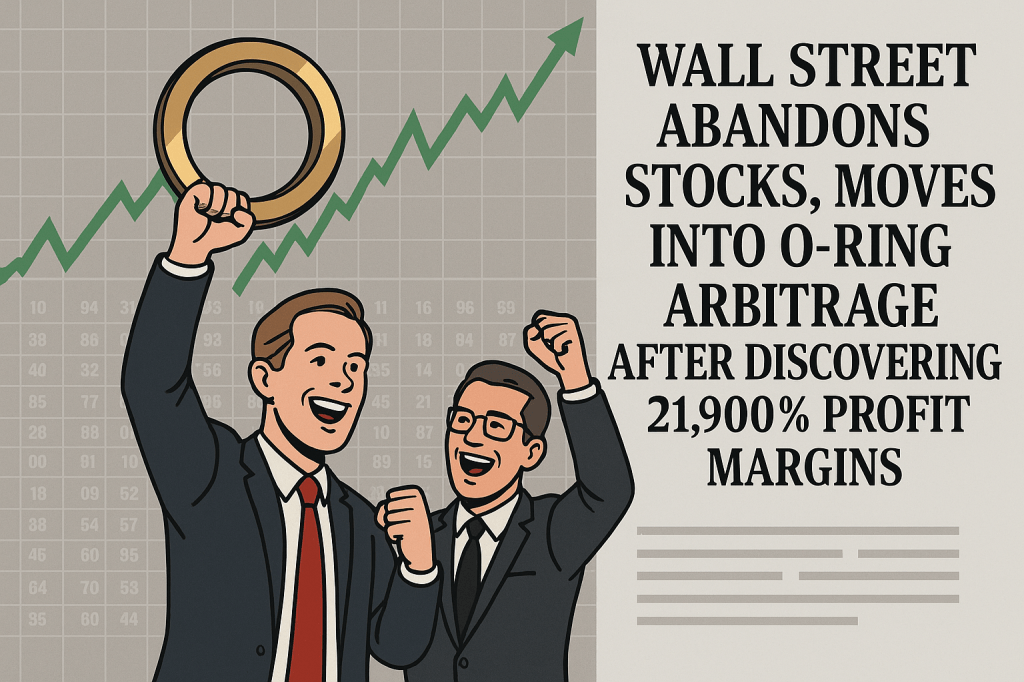
NEW YORK, NY — In a shocking turn of events, Wall Street’s top hedge funds and investment banks have dumped blue-chip stocks, crypto portfolios, and AI startups to pivot entirely into the lucrative world of plastic O-ring reselling.
“After years of chasing 10% annual returns, it turns out the real money was sitting in plumbing supply stores all along,” said Morgan Squidley’s Senior Partner of Global Arbitrage, Richard McDividend, while stroking a tiny $0.25 O-ring and whispering, “My precious.”
The move came after investors discovered that a $0.25 injection-molded part — likely manufactured for pennies in a factory outside of Shenzhen and stored in a warehouse since the Obama administration — could be sold in the U.S. for $55 under the moral cover of “tariff inflation.”
“We were going to invest in green energy,” said one Goldman Sachs analyst, “but then we saw what some backflow preventer O-ring kits were going for, and we realized we were idiots.”
To expedite their new investment strategy, JP Morgan announced it would be launching the first ever O-Ring Commodities Index (ORCI), featuring a basket of overpriced rubber and plastic essentials including:
- Sprinkler system valve seals
- Specialty circuit breakers with a 2-year life span
- That one replacement bolt only sold in packs of 12 at $47.99
Main Street: Confused But Soaked
Meanwhile, consumers across the country are left wondering if the trade war is a battle of tariffs or a battle of who can exploit the working man the fastest. “I went to fix my sprinkler,” said one homeowner, “and somehow ended up funding a yacht named ‘The Free Market’ for some plumbing supply executive.”
Retail employees at plumbing stores reportedly now refer to O-rings as “Silicon Valley stock options for the hardware aisle.”
Tariff Tango
Manufacturers insist their hands are tied. “The tariffs have forced us to reconsider our pricing,” said an unnamed corporate spokesperson while applying gold leaf to his $4,000 espresso machine. “Sure, the O-rings were bought before the tariffs… but we must prepare for future tariffs. It’s called fiscal responsibility.”
Sources confirm that this so-called “anticipatory inflation” model has inspired fast food chains to charge $12 for a cheeseburger in case cows go on strike next year.
Policy Response
The Trump administration, responding to public outrage, has proposed a new bill requiring all O-rings to come with a QR code revealing their true manufacturing cost, but lobbyists successfully amended the measure to instead include a coupon for 3% off your next outrage purchase.
When asked for comment, a White House trade advisor said, “We understand Americans are concerned, but we believe in market solutions. Have you considered buying in bulk from a subscription O-ring box? It’s like HelloFresh, but for sprinkler systems.”
Conclusion: Buy the Dip (In Silicone Grease)
As markets continue to spiral, investors are watching closely to see whether the circuit breaker market will follow suit. Early reports indicate a surge in demand for $110 units that break every two years, followed by a free replacement program that no one knows about unless you call and ask twice.
In a world where economics are driven less by supply and demand and more by “how much can we get away with?” — Wall Street may have finally found its forever home in aisle 9 of your local hardware store.
Disclaimer: This post is satirical. All companies, quotes, and scenarios mentioned are fictionalized for comedic effect. Please don’t sue us with O-ring profits.

 EssayBoard
Leave a comment