
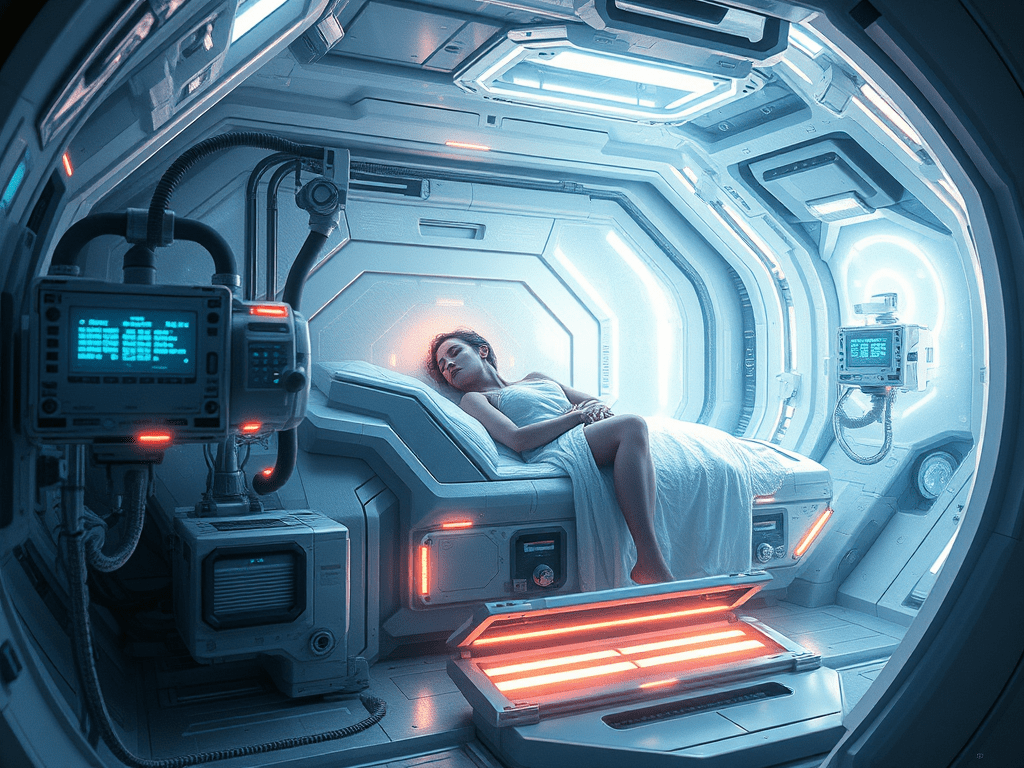
Imagine a future where humans can slip into a near-death slumber, halt the march of time, and awaken centuries later as if emerging from a nap—body renewed, aging paused, and ready to build new memories. No perfect freeze. No immutable memories. Just the promise of survival, revival, and a second chance at life.
In this post, we’ll explore how cutting-edge science and bold sci-fi concepts converge on a transformative vision: Cryosleep as a two-stage system of selective stasis and robust revival.
1. The Cryosleep Paradox: Preservation vs. Revival
Traditional cryonics focuses on perfect preservation—avoiding every possible cell-damaging effect before, during, and after freezing. But real bodies are complex, tissues are fragile, and total perfection remains elusive. What if we flipped the paradigm?
Preserve only what matters most. Repair the rest later.
This shift reframes cryosleep not as an unbreakable stasis chamber but as a gateway to future medical restoration. It’s less about avoiding damage and more about accepting manageable damage with the knowledge that advanced revival systems will heal it.
2. Lessons from Nature: The Tardigrade Blueprint
Enter the humble tardigrade, a microscopic marvel that can survive extreme cold, heat, radiation, and decades of desiccation. Through cryptobiosis, tardigrades suspend their metabolism to a mere 0.01% and dry into a tun, only to rehydrate and return to life unscathed.
Key molecular tricks:
- Dsup protein shields DNA from damage
- Trehalose sugar coats cell membranes
- Metabolic shutdown preserves cellular integrity
Takeaway: If we can borrow tardigrade traits—from DNA protection to controlled metabolic pause—we unlock a path toward human biostasis.
3. Selective Organ Stasis: Tardigrade-Mode for Vital Systems
Human bodies can’t fully mimic tardigrades—yet. But we can prioritize critical organs:
| Organ | Priority Protection |
|---|---|
| Brain | Preserve structure and identity |
| Heart | Maintain viability for reboot |
| Lungs | Ensure oxygen capacity on revival |
| Key cells | Shield DNA and repair later |
In practice, this means engineering gene edits (Dsup insertion), cryogels, and targeted dehydration just for these organs—accepting that skin, muscle, and minor tissues might suffer frost damage but can regenerate later.
4. ARC‑POD: The Rise of the Regenerative Revival Chamber
The real hero of our new cryosleep model isn’t the freezer—it’s the Autonomous Regeneration Chamber (ARC‑POD):
- Patient enters near-death stasis. Core organs protected; others paused.
- Cryosleep duration: days, years, or centuries—aging halted.
- Transfer to ARC‑POD: AI diagnostics map damage.
- Catalytic revival: stem-cell cocktails, CRISPR-based repairs, nano‑bots cleanse and rebuild.
- Wake-up recovery: over hours or days, body and brain are restored.
Cryosleep Phase: Cheap, damage-tolerant storage. Revival Phase: Guaranteed recovery, not just survival.
5. Embracing Biological Reboot Over Memory Continuity
What if your memories don’t survive? In many long-range missions or deep-future stasis, memory loss may be inevitable. But a blank slate isn’t failure:
- You can relearn, adapt, and thrive in a new world.
- Neoborns: descendants of cryoslept humans, reborn without past burdens but with full learning capacity.
- Ideal for interstellar colonization—the mind is remapped, the body endures.
6. Seeding the Stars: The Neoborn Hypothesis
Armed with ARC‑POD technology, humanity could become galactic gardeners:
- Cryo‑seed ships carry stasis pods with Neoborns.
- Autonomous probes land on habitable worlds, deploy habitats.
- Pods awaken pioneers—bodies intact, memories blank.
- New civilizations arise, seeded by Earth’s genetic legacy.
Our own origins might mirror this: Ancient colonizers cryoslept the first “Adam and Eve,” awakening on Earth with no memories, sparking civilization.
Conclusion: From Hope Storage to Civilizational Renewal
Cryosleep isn’t just about cheating death; it’s about storing hope. By focusing on revival over perfection, borrowing from nature’s champions, and building powerful regenerative pods, we edge closer to a future where humans can pause time, traverse the galaxy, and seed new worlds—one recovered life at a time.
Are you ready for a world where death is a delay and awakening is merely the beginning? The blueprint is on the table. Now it’s our turn to build it.
Disclaimer:
This is AI generated content. This blog post explores speculative science and futuristic concepts inspired by current research, science fiction literature, and emerging biotechnology. While grounded in plausible scientific principles, many of the ideas discussed—such as human cryosleep, regenerative revival pods, and interstellar seeding—are not yet achievable with today’s technology. This content is intended for educational, imaginative, and conceptual purposes only and should not be interpreted as medical advice, scientific certainty, or imminent technological capability. Always consult verified sources and experts when engaging with cutting-edge science and medical topics.


 EssayBoard
Leave a reply to Caleb Cheruiyot Cancel reply