
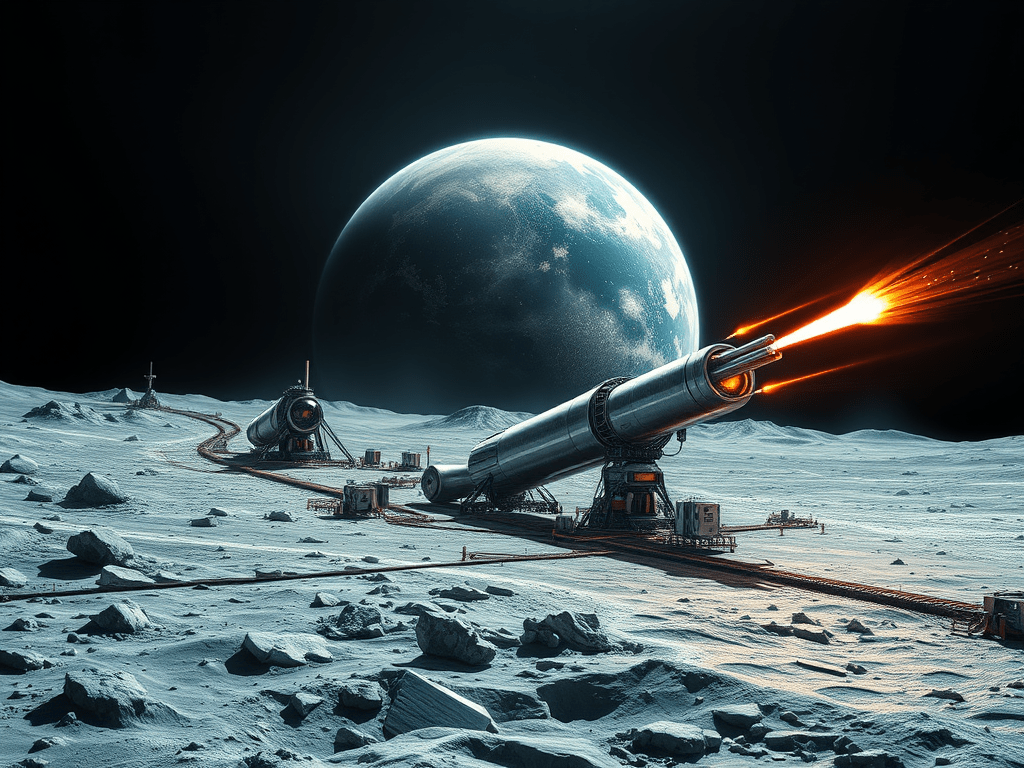
Imagine a future where humanity’s reach extends beyond Earth’s atmosphere—a future where lunar colonies are no longer just scientific outposts, but pivotal strategic entities in an interplanetary power struggle. In this scenario, the battle lines are drawn not only on Earth’s surface but in the vast expanse of space. Advanced railgun rod weapons, a fractured lunar identity, and Earth’s desperate race to secure higher ground in deep space all set the stage for a potential Moon vs. Earth conflict.
In this blog post, we explore a visionary (and admittedly provocative) future where strategic dominance is measured in railgun-fired tungsten rods, orbital kinetic strikes, and the construction of colossal deep-space fortresses. We’ll also look at the probabilities of these scenarios unfolding, based on current technological and geopolitical trends.
1. The New Battleground: Lunar Colonies and Beyond
Permanent Moon Bases: A Near-Inevitable Future
Probability: 90–100% within 50 years
Nations and private enterprises are already planning permanent lunar settlements. With initiatives like China’s push for a lunar base by the early 2030s, NASA’s Artemis program, and the rapid innovation of companies like SpaceX and Blue Origin, establishing a sustained human presence on the Moon is almost guaranteed. But as humanity expands into space, the stakes become much higher than scientific exploration.
Colony Separation and the Quest for Independence
Probability: 60–80% within 100 years
History teaches us that colonies eventually crave independence. Lunar colonists, especially those born and raised in low-gravity environments, may gradually diverge culturally and politically from Earth. Over time, they might see Earth not as a benevolent parent but as an overbearing power—fueling aspirations for self-governance or even outright rebellion. This drift could set the stage for an unprecedented interplanetary conflict.
2. Railgun Rod Weapons: The Silent, Kinetic Game-Changer
The Evolution of Railgun Technology
Railguns, which use electromagnetic forces to launch projectiles at hypersonic speeds, are already in experimental stages on Earth. Their potential application in space—especially as orbital kinetic weapons—takes them to a whole new level. Imagine tungsten rods accelerated from an orbital platform, striking targets on Earth with the devastating impact of a meteor, yet without any explosive payload.
A Weapon of Decapitation
Such railgun-fired projectiles could theoretically serve as a “silent killer,” capable of neutralizing hardened military installations, missile silos, and command centers before a targeted nation even has time to respond. In a scenario where railgun rod weapons are deployed from orbit or a lunar base, a decapitation strike might remove an adversary’s ability to retaliate, fundamentally undermining the doctrine of Mutually Assured Destruction (MAD).
3. Higher Ground Strategy: Beyond the Moon
The Moon’s Ascendancy and Earth’s Response
Once a lunar colony consolidates power, it could potentially control near-Earth space—exercising dominion over communication networks, satellite constellations, and even launching orbital strikes. This prospect creates a “higher ground” dilemma: if the Moon becomes the dominant strategic position, Earth may be forced into a subordinate role.
Building Deterrence in Deep Space
To counterbalance lunar supremacy, Earth might pursue the construction of massive strategic space stations positioned at key points such as Earth-Moon Lagrange points (L1, L2, L4, L5) or even establish colonies on Mars and in the asteroid belt. These installations could serve as:
- Orbital Overwatch Platforms: Providing early warning and defensive capabilities against any kinetic strikes from the Moon.
- Interplanetary Deterrence Nodes: Acting as bases for rapid-response spacecraft and railgun-equipped drones, ensuring that Earth retains a credible strike capability.
- Economic and Energy Hubs: Leveraging resources like Helium-3 and solar power, these platforms could fortify Earth’s strategic and economic position in space.
Probability for Earth Building Deterrent Platforms: 40–60%
If Earth acts proactively and coordinates globally, building these deep-space installations is feasible. Delay, however, may leave Earth vulnerable to a unified lunar force that could shift the balance of power irreversibly.
4. The Grand Strategic Forecast: Chances of a Space War
When we integrate the likelihood of these developments, a picture of interplanetary tension emerges:
- Permanent Moon Colony: 90–100% probability within 50 years.
- Lunar Cultural and Political Independence: 60–80% probability within 100 years.
- Earth Losing Its Strategic Upper Hand: Around 50%, unless Earth’s nations take coordinated action.
- Lunar Rebellion or Hostile Intent: 30–40% probability, rising as autonomy and divergence increase.
- Earth’s Construction of Deep Space Deterrent Platforms: 40–60% probability, contingent on early global collaboration.
Each layer of this scenario compounds the potential for conflict. If the Moon becomes a unified, militarized entity with advanced kinetic weapons—and Earth fails to secure its own strategic high ground—the conditions for a space war could be set.
5. Conclusion: Navigating Our Interplanetary Future
The idea of a Moon vs. Earth space war might seem like science fiction today, but the convergence of space colonization, advanced railgun technology, and shifting geopolitical identities makes it a scenario worth contemplating. The stakes are astronomical—literally.
To prevent such a dystopian future, Earth must begin planning not only for lunar exploration but for a balanced, multi-layered presence in space. Establishing deep-space platforms and ensuring interplanetary cooperation will be essential to maintain a stable balance of power. Otherwise, the silent, decapitating strike of a railgun rod from orbit—and the rise of a rebellious lunar colony—could forever change the fate of humanity.
Are we heading towards a future of interplanetary Cold Wars? With technology advancing at breakneck speed and the geopolitical landscape already showing signs of fracturing, the probability isn’t negligible. It’s a wake-up call for strategists, policymakers, and visionaries alike to take space not just as the final frontier, but as the ultimate battleground for global dominance.
What do you think? Is our future destined to be decided among the stars, or can we steer humanity toward a more cooperative cosmic destiny? Share your thoughts in the comments below!

 EssayBoard
Leave a comment