
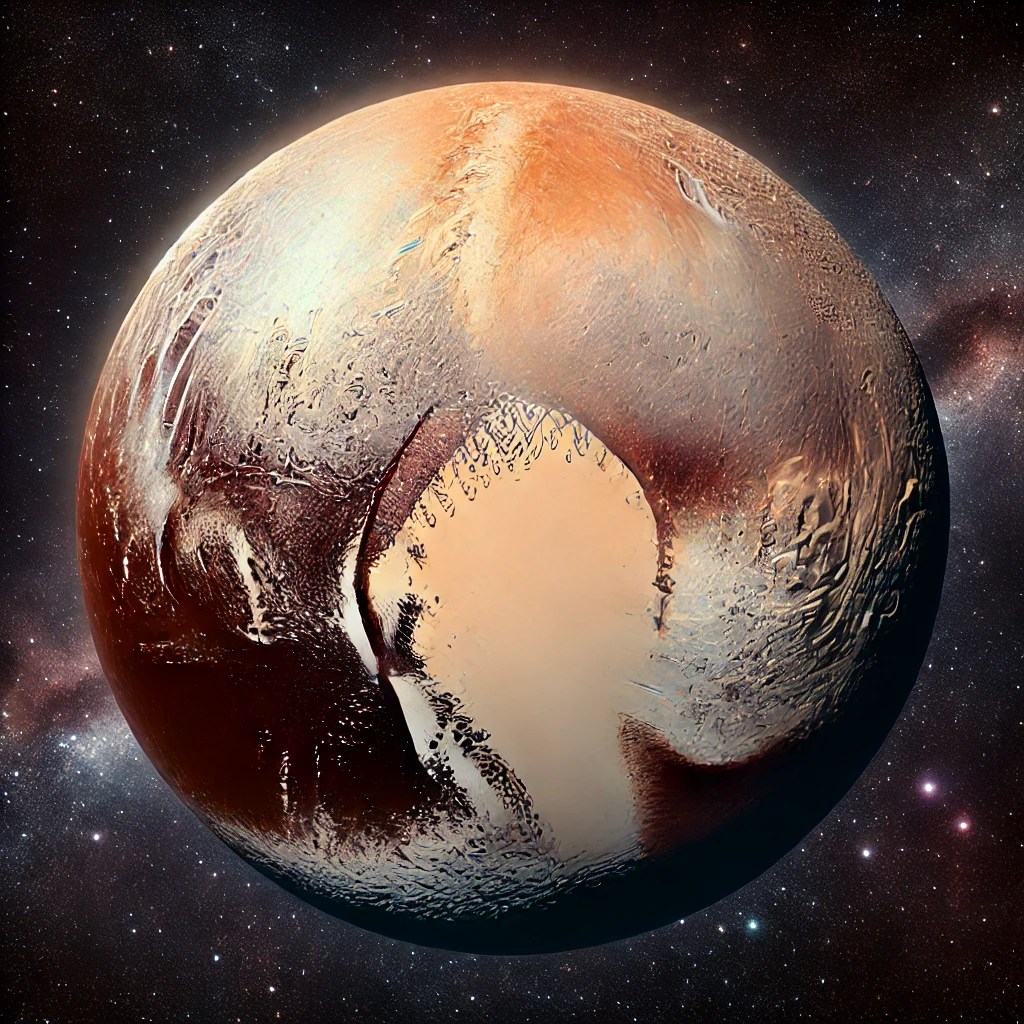
For over seven decades, Pluto held its rightful place as the ninth planet of our Solar System. That was until 2006, when the International Astronomical Union (IAU) controversially reclassified it as a “dwarf planet.” But was this demotion justified? Many scientists, astronomers, and space enthusiasts argue that Pluto should still be considered a planet. Here’s why Pluto deserves to reclaim its planetary status.
1. The “Clearing Its Orbit” Rule Is Flawed
The IAU’s definition of a planet requires that it must:
- Orbit the Sun ✅
- Be spherical in shape due to its own gravity ✅
- Clear its orbit of other debris ❌
Pluto fails the third criterion because it shares its orbit with other Kuiper Belt Objects (KBOs). However, this rule is problematic for several reasons:
- Even Earth hasn’t fully cleared its orbit. Earth shares its path with near-Earth asteroids and Trojan asteroids.
- Jupiter, the largest planet, hasn’t cleared the asteroid belt. If clearing an orbit is a requirement, then even Jupiter would fail in certain cases.
- The Kuiper Belt is vast and full of objects. If Earth or even a super-Earth were placed in Pluto’s position, they also wouldn’t be able to clear their orbits.
- No single planet could ever clear the Kuiper Belt. The Kuiper Belt is billions of miles wide, filled with countless objects, and too massive for any planet—no matter how big—to fully dominate. If the IAU’s rule applied fairly, no planet placed in this region would qualify as a planet!
- Pluto is in resonance with Neptune. Its orbit is shaped by Neptune’s gravity, meaning it never had a chance to fully clear its path. Should a planet be disqualified simply because of its location?
The “clearing its orbit” rule is scientifically inconsistent and biased against outer Solar System planets. Instead of disqualifying Pluto, maybe the definition of a planet should be reconsidered.
2. Pluto Is More Than Just a Chunk of Ice
Pluto is far from a lifeless rock floating in space—it’s an active, complex world with fascinating features:
- It has an atmosphere. Pluto’s thin nitrogen-rich atmosphere changes with its seasons.
- It has weather. Pluto experiences haze layers, temperature shifts, and surface sublimation cycles.
- It has geological activity. Scientists have found evidence of glaciers, ice volcanoes, and a possible subsurface ocean.
- It has moons. Pluto has five known moons, including Charon, which is so large that Pluto-Charon is sometimes considered a binary planetary system.
These are all characteristics we associate with planets—so why should Pluto be an exception?
3. The Public Still Considers Pluto a Planet
Despite the IAU’s decision, Pluto remains a planet in the hearts of many. When New Horizons flew past Pluto in 2015, it revealed a dynamic world full of surprises, reigniting the debate. The term “planet” carries a cultural and historical significance that people aren’t ready to abandon.
Even some leading scientists disagree with Pluto’s demotion. Alan Stern, principal investigator of the New Horizons mission, has been one of the biggest advocates for reinstating Pluto’s planetary status. He argues that Pluto meets all the important criteria of a planet and that the IAU’s definition is unnecessarily restrictive.
4. A More Logical Planetary Definition
Instead of relying on the flawed “clearing its orbit” rule, a better definition of a planet could be based on:
- Whether it is large enough to be rounded by its own gravity (hydrostatic equilibrium).
- Whether it has an atmosphere, weather, and geological activity.
- Whether it has moons or complex surface features.
Under these criteria, Pluto would undeniably be a planet. And so would many other fascinating worlds, like Eris, Haumea, and Ceres, which deserve more recognition.
Conclusion: Pluto Is a Planet!
The time has come to rethink Pluto’s planetary status. The IAU’s definition is outdated and inconsistent with modern planetary science. Pluto isn’t just a “dwarf planet”—it’s an active, evolving world that meets most of the qualifications of a planet.
If we are willing to reconsider our classifications based on new scientific discoveries, then Pluto deserves another chance. Let’s give Pluto back its rightful place in the Solar System!
What do you think? Should Pluto be reinstated as a planet? Join the conversation and share your thoughts!

 EssayBoard
Leave a comment