
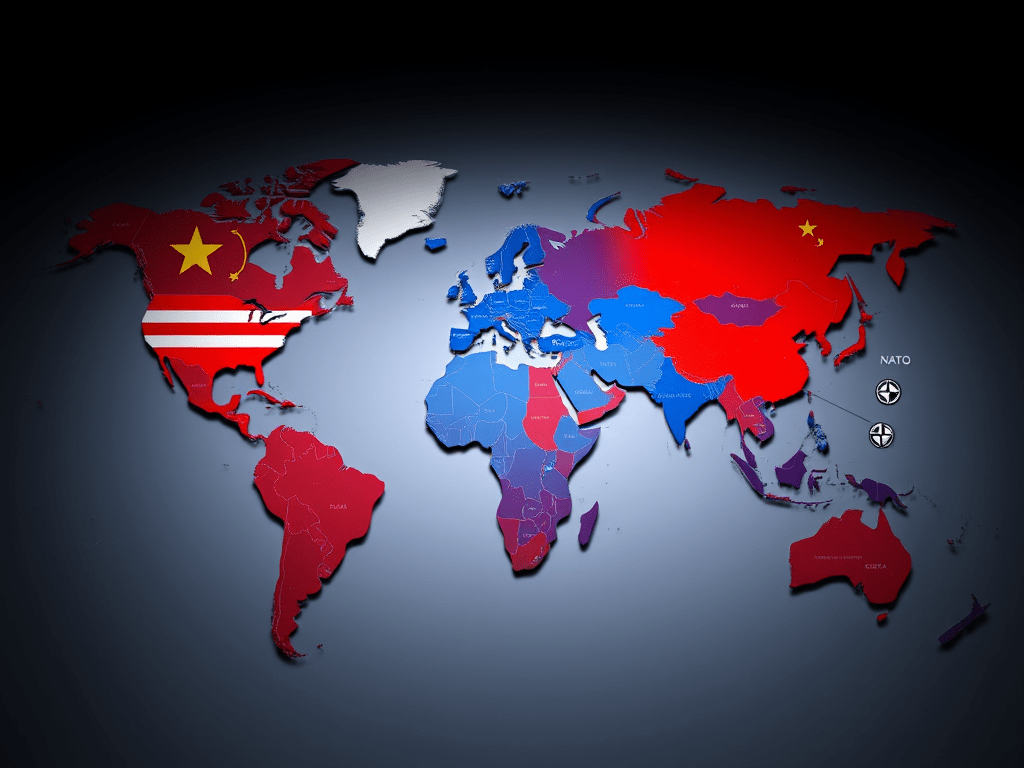
In recent years, debates about NATO’s relevance and the future of U.S. global strategy have intensified. Many pundits see Trump’s recent moves—such as sidelining European voices from Ukraine negotiations with Russia—as reckless or isolationist. But what if these actions are part of a bold, long-term strategy? What if the U.S. is stepping back to rebuild its strength—much like it did before World War II—in order to focus on the real long-term challenge: China? In this post, we explore the provocative theory that America is strategically resetting its global posture to position itself for a future showdown with China.
Step Back to Step Forward: A Pre-WWII Parallel
Before World War II, the United States largely refrained from entangling itself in European conflicts. While Europe and Asia fought their own wars, the U.S. concentrated on internal development—bolstering its economy, industrial base, and military capabilities. After these conflicts subsided, America emerged as the dominant global power, ready to shape the post-war world order.
Could Trump’s recent decisions be the modern equivalent of that historical reset? By reducing U.S. commitments in Europe—especially by sidelining NATO in key negotiations—the theory goes that America may be forcing its allies to shoulder more responsibility while conserving its own strength for future strategic challenges.
The Case for a U.S. Reset
1. Letting Europe Grow Up
For decades, the United States has acted as NATO’s financial and military backbone. Yet many critics argue that this burden-sharing has allowed European nations to underinvest in their own defense capabilities. If the U.S. steps back:
- Europe is forced to increase defense spending and develop more capable military forces.
- European nations must learn to manage their own security, which could lead to a more mature and independent European defense architecture.
- This scenario might even spark a recalibration within NATO, where Europe’s growing self-reliance makes the transatlantic alliance less of an American crutch.
2. Letting Rivals Weaken Themselves
A key element of this theory is the idea that letting Europe—and by extension, Russia—engage in prolonged conflicts can be beneficial in the long run:
- Proxy conflicts and regional wars drain resources. If Europe and Russia weaken themselves in costly military engagements, the U.S. avoids being entangled in expensive, protracted wars.
- A divided or weakened Russia may become less reliable as an ally to China. Without Russian support, China’s ambitions in Asia (and potentially beyond) would face a higher barrier.
- By watching other powers exhaust themselves, the U.S. conserves strength for future challenges.
3. Shifting Focus to China
The real long-term strategic challenge for the United States is not Russia—it’s China. China is expanding its economic, technological, and military influence at an unprecedented rate:
- A focus on the Indo-Pacific region would allow the U.S. to reallocate resources from Europe to Asia.
- By reducing entanglements in European conflicts, the U.S. could concentrate on modernizing its military, advancing technology (think AI, cyber, space), and forming stronger alliances with key regional partners like Japan, Australia, and India.
- This pivot would set the stage for a future where the U.S. is fully prepared to contest China’s rise, rather than being distracted by legacy commitments in Europe.
Is China Playing the Same Long Game?
While the U.S. might be preparing a reset, China appears to be following a similar playbook:
- China is biding its time. Rather than rushing into direct confrontation over Taiwan or elsewhere, Beijing is focusing on expanding its economic clout and military capabilities.
- By engaging in proxy conflicts and expanding its influence through initiatives like the Belt and Road, China is positioning itself as a global power ready to challenge U.S. leadership when the timing is right.
- In this scenario, both the U.S. and China are playing a high-stakes waiting game, where neither side wants to overextend until their rivals have exhausted themselves in other conflicts.
Trump’s NATO Moves: A Strategic Test?
Trump’s actions—such as sidelining European voices from Ukraine negotiations—may be more than just bluster:
- Sidelining NATO forces European nations to step up. If the U.S. withdraws from being NATO’s primary guarantor, European allies must either significantly boost their defense capabilities or face a security vacuum.
- Ending or de-escalating the Ukraine conflict. By negotiating a swift resolution and maybe lifting sanctions, the U.S. reduces Russia’s dependency on China for backing, thus reducing Russia’s role as a long-term strategic partner to China. If Russia is no longer economically isolated, it doesn’t need China as much, potentially creating a wedge between the two.
- Forcing a realignment. These maneuvers could be aimed at reshaping global alliances, signaling that the U.S. is no longer willing to be the world’s policeman while preparing to concentrate on the more formidable challenge posed by China.
What’s at Stake: Predictions and Risks
The Best-Case Scenario
- Europe matures as a defense power. With increased autonomy and stronger military capabilities, Europe can manage its own security and even check Russia if necessary.
- The U.S. reboots its strength. By focusing on internal modernization and rebalancing its strategic commitments, the U.S. emerges in the coming decades as a renewed superpower.
- China is isolated. Without Russia’s support and facing a U.S. that has modernized its forces and alliances, China’s ambitions are significantly curtailed.
The Worst-Case Scenario
- China outpaces the U.S. during the waiting game. If America’s reset takes too long or if China’s growth accelerates, the balance of power could shift irreversibly in Beijing’s favor.
- European instability. If European nations fail to effectively bolster their defenses, a security vacuum could emerge, inviting further instability in the region.
- Global conflict erupts. Heightened proxy wars and regional conflicts might escalate, dragging the U.S. back into a quagmire before its reset is complete.
Conclusion: A Grand Strategic Reset or a High-Stakes Gamble?
This theory challenges the mainstream narrative. Rather than being a sign of weakness, Trump’s recent NATO maneuvers might be part of a deliberate long-term strategy—a calculated step back to allow the U.S. to reboot its might much like it did before World War II. By letting Europe and Russia wear each other down, and by refocusing on the strategic challenge of China, the U.S. might be positioning itself for a future where it can re-emerge as the dominant global power.
Whether this grand strategic reset is a genius move or a high-stakes gamble remains to be seen. What is clear is that the global balance of power is in flux, and the next few decades will be critical in determining whether the U.S. can successfully navigate this complex geopolitical chessboard.
What do you think? Is the U.S. preparing for a strategic reboot to outmaneuver China, or are these moves merely signs of something else? Share your thoughts in the comments below!

 EssayBoard
Leave a comment