
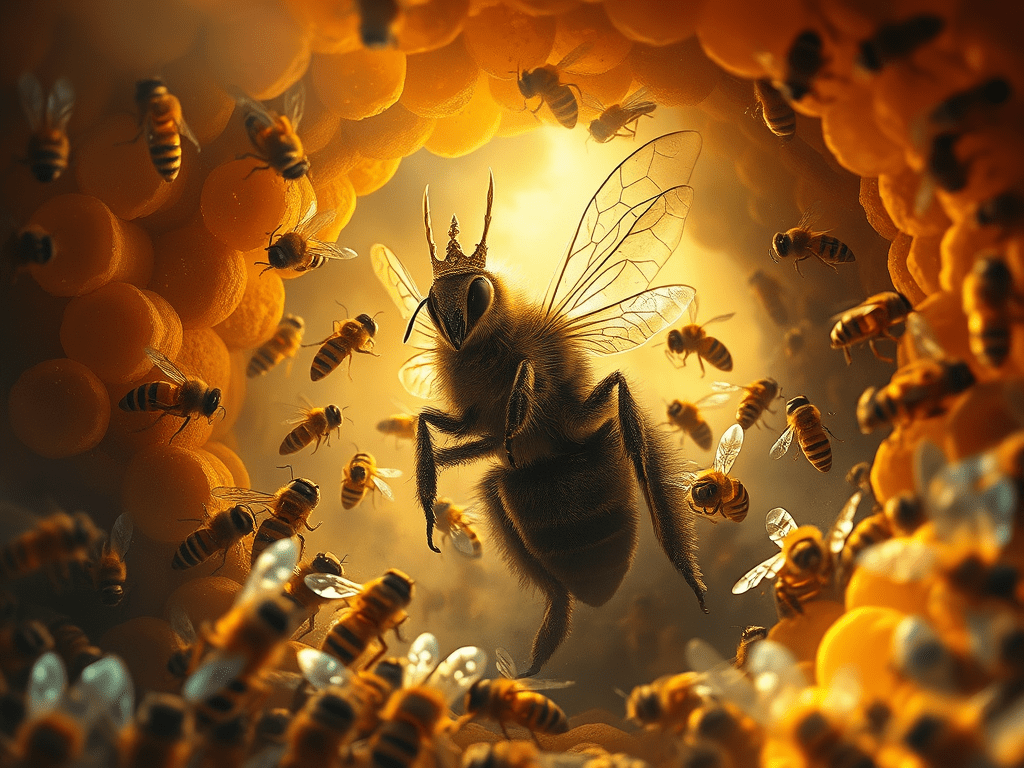
In the intricate world of honeybees, where order and cooperation reign supreme, there exists a fascinating and intense drama that unfolds when it’s time to crown a new queen. This isn’t just a peaceful transition of power — it’s a high-stakes battle of survival. Welcome to the royal showdown of the hive!
Why Do Bees Need a Queen?
The queen bee is the heart of the hive. She’s not just a ruler in title; she’s the sole reproductive female, laying up to 2,000 eggs per day to ensure the colony’s survival. Her unique pheromones act as chemical signals, unifying the hive, maintaining social order, and suppressing the workers’ instinct to reproduce.
These pheromones are the glue that holds the hive together. Known as the queen mandibular pheromone (QMP), this chemical cocktail:
- Signals the queen’s presence to worker bees.
- Suppresses the development of workers’ ovaries, ensuring that only the queen reproduces.
- Regulates hive activities like foraging, nursing, and hive defense.
Without these pheromones, the hive descends into chaos. Worker bees, sensing the absence of a queen, may try to lay eggs themselves (which results in unfertilized, male drones) or begin raising new queens to restore harmony. The hive’s survival hinges on the presence of a healthy queen.
The Royal Showdown: How Queens Are Chosen
The process of selecting a queen begins with a dramatic twist: all larvae have the potential to become queens. However, only a select few are fed an exclusive diet of royal jelly, a nutrient-rich secretion that triggers their development into potential queens. These privileged larvae are housed in special “queen cells,” which are larger and distinct from regular brood cells.
But the real drama begins when these new queens emerge. Unlike workers or drones, queens are born to fight. Here’s what happens:
- Seek and Destroy: When a queen hatches, her first task is to eliminate the competition. She patrols the hive, seeking out other queen cells. Using her sharp stinger, she kills rival larvae or pupae before they can fully develop.
- Queen vs. Queen: If multiple queens emerge simultaneously, a fierce battle ensues. Unlike worker bees, queens can sting repeatedly without dying. These duels are brutal, and only one queen will survive to claim the throne.
- The Victorious Queen: The last queen standing is the rightful ruler of the hive. She now prepares for her next challenge: the mating flight.
The Mating Flight: A Perilous Journey
Once the new queen has secured her position, she embarks on a series of mating flights. Flying to drone congregation areas, she mates with multiple drones in midair, collecting enough sperm to last her entire life. This is a risky endeavor, but it’s essential for the hive’s future. Once mated, she returns to the hive to begin her reign, laying eggs and emitting pheromones that ensure her workers’ loyalty.
What Happens If There’s No Clear Winner?
Occasionally, the hive may face a unique situation where two queens coexist briefly. This can happen during swarming, when part of the hive splits off with the old queen. However, in most cases, one queen eventually eliminates the other, restoring the hive’s single-leader structure.
Why Is This System So Efficient?
At first glance, the idea of queen competition might seem chaotic, but it’s a marvel of evolutionary design. By ensuring that only the strongest, most capable queen survives, the hive increases its chances of thriving. This centralization of reproductive duties and pheromone-driven organization keeps the hive efficient and focused on collective goals like foraging, nursing, and defense.
Nature’s Game of Thrones
The process of selecting a queen is nothing short of nature’s own reality TV. It’s dramatic, ruthless, and essential for the hive’s survival. From the moment royal larvae are chosen to the fierce battles between emerging queens, every step is a testament to the hive’s ability to adapt and endure.
So, the next time you see a humble honeybee buzzing around, remember the epic saga that unfolded in their hive to crown their queen. It’s a reminder that even in the smallest corners of nature, there are tales of power, survival, and cooperation worthy of admiration.

 EssayBoard
Leave a comment