
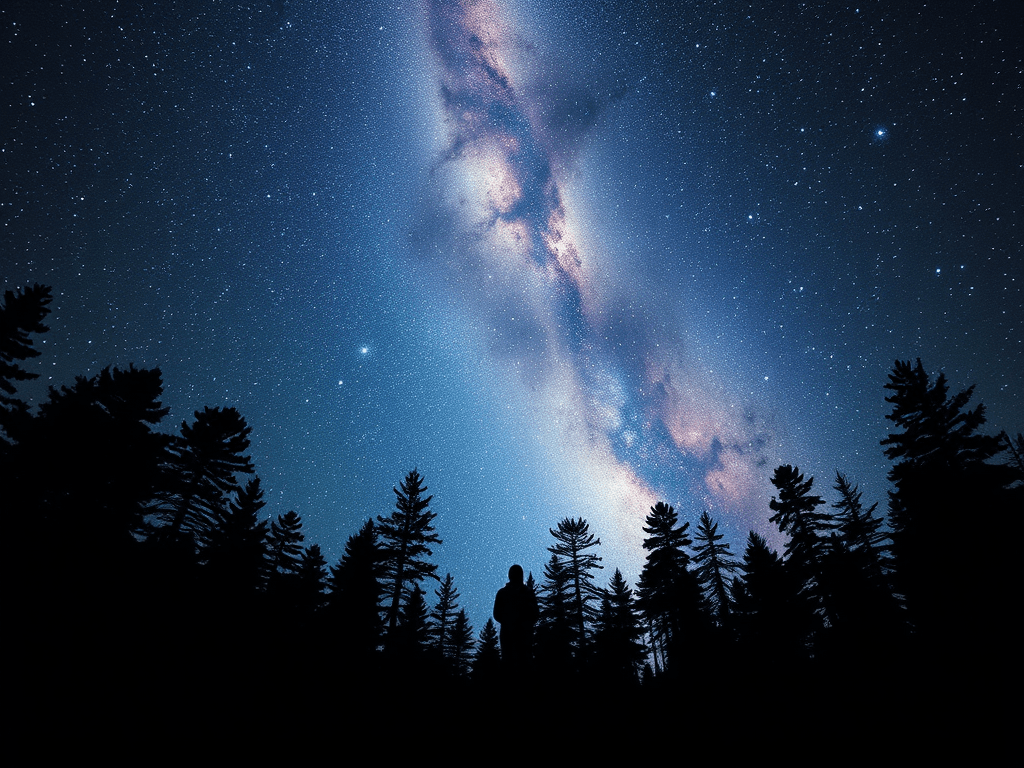
Humanity stands at the edge of the unknown, looking toward the stars with wonder—and trepidation. In this latest episode of Deep Dive, we explore fundamental questions about life, survival, and the universe. From Earth’s unique formula for life to the inefficiencies of terraforming and the risks posed by alien contact, this episode challenges us to rethink humanity’s place in the cosmos.
Here’s a glimpse into the topics we covered.
Earth’s Unique Formula for Life
Earth is a rare gem in the universe. Its unique combination of fire, water, gravity, and atmosphere creates the perfect conditions for life as we know it.
- Fire: Humanity’s mastery of fire fueled our technological evolution, from cooking food to building rockets that let us escape Earth’s atmosphere. But did you know that fire is incredibly rare in the universe? Without free oxygen, combustion isn’t possible, meaning many alien civilizations might develop without it.
- Water: The solvent of life, water enables the biochemical processes essential for existence. Paired with Earth’s stable climate, magnetic field, and plate tectonics, it forms the foundation of a thriving biosphere.
- Gravity and Atmosphere: Earth’s moderate gravity keeps the atmosphere intact while shielding us from deadly cosmic radiation. These conditions, combined with our location in the Sun’s “Goldilocks Zone,” make Earth a truly exceptional planet.
But if life elsewhere doesn’t follow Earth’s blueprint, how do we find it—and what happens if it finds us first?
The Dark Forest Hypothesis
Why does the universe seem so quiet? According to the Dark Forest Hypothesis, it’s because advanced civilizations choose to remain silent. Broadcasting your presence in the cosmos, the theory warns, is like shouting in a dangerous forest—you risk drawing the attention of predators.
In this context:
- Paranoia Prevails: Civilizations might preemptively destroy others to eliminate future threats.
- Humanity’s Risk: Could advanced aliens view us as a threat—or even an infection to be eradicated, like “cosmic white blood cells” targeting a virus?
This chilling perspective reframes the search for extraterrestrial intelligence. Should humanity seek to connect with the universe, or remain quiet and hidden?
The Case Against Terraforming
Terraforming—a process of transforming other planets to mimic Earth—has long been seen as humanity’s answer to interplanetary survival. But the challenges are daunting:
- Timescales and Energy: Terraforming Mars or Venus would take centuries, if not millennia, requiring immense resources.
- Unpredictability: Issues like unstable gravity, a lack of magnetic fields, and inhospitable climates make terraforming risky and potentially unsustainable.
Cloning Earth: The Promise of Artificial Worlds
Instead of terraforming, what if we could engineer Earth-like habitats in space? Advanced civilizations might already do this, bypassing the unpredictability of natural planets. Possible solutions include:
- Dyson Spheres: Mega-structures surrounding a star to harness its energy while providing habitable conditions.
- O’Neill Cylinders: Rotating space habitats with artificial gravity and ecosystems.
- Planetary-Scale Habitats: Massive engineered worlds designed to replicate Earth’s conditions without its vulnerabilities.
Such innovations allow us to:
- Scale habitats to meet population needs.
- Avoid the constraints of alien worlds.
- Thrive in perfectly controlled environments.
Could artificial worlds like these be humanity’s future—and are they where we should search for advanced life?
What Is Humanity’s Role in the Cosmos?
As we look outward, we must ask: How should humanity expand into space? Should we boldly explore, broadcasting our presence, or tread cautiously, avoiding detection?
The choices we make today will shape our survival and our legacy. The universe is vast, and our approach—whether as creators, conquerors, or collaborators—will define humanity’s place among the stars.
Final Thoughts
This episode of Deep Dive explored humanity’s greatest challenges and opportunities in the cosmos. Earth’s life-sustaining formula is rare and precious, but the risks of alien contact and the inefficiencies of terraforming urge us to consider new paths forward. Perhaps the future lies not in adapting other planets to suit us but in building worlds of our own design.
What do you think? Should we venture into the galaxy as explorers—or stay silent in the cosmic dark forest?
Check out the full episode to dive deeper into these fascinating questions.

 EssayBoard
Leave a comment