
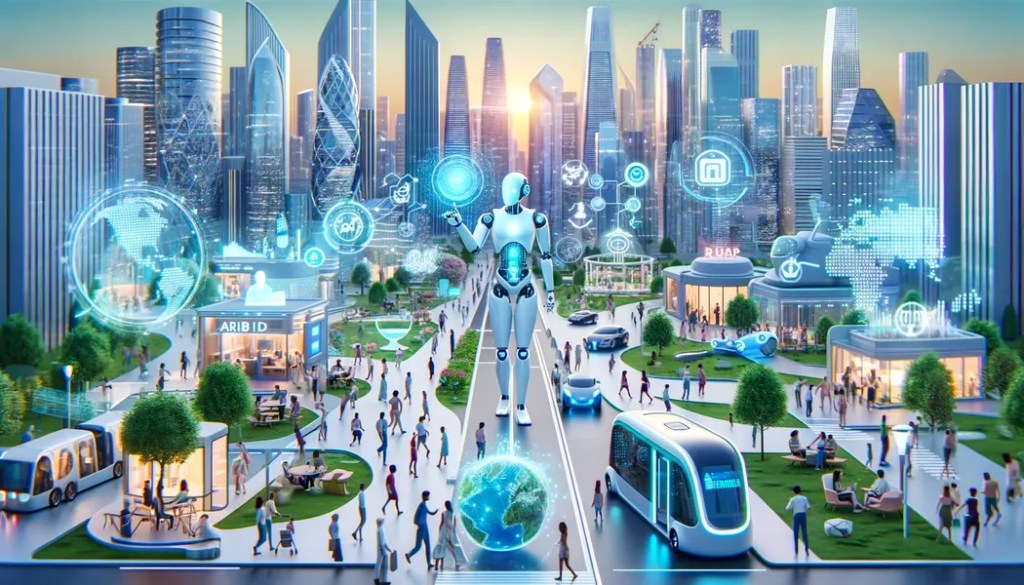
As we stand at the precipice of a technological revolution, the future of artificial intelligence (AI) and its intersection with humanity is a topic of paramount importance. From economic investments and philosophical reflections to rapid technological advancements and ethical considerations, AI is set to transform every facet of human life. This article delves into the current state of AI, its potential future applications, and the profound implications for society.
The Impact of AI Investments
The scale of investment in AI technologies underscores their significance and potential. Startups in the AI sector are receiving billions in funding, a testament to the industry’s growth and the high expectations placed on these technologies. For instance, according to a report by PwC, AI startups attracted over $26 billion in funding in 2021 alone . This surge in investment highlights the critical role AI is poised to play in the future economy.
However, the vast sums required for AI development, particularly for the necessary hardware and infrastructure, make even substantial investments seem minimal. This shift is also reflected in the evolving economic benchmarks, where billion-dollar valuations for startups, once rare, are becoming commonplace. As a result, the focus is now shifting towards the potential emergence of trillion-dollar AI-driven businesses.
Balancing Human Optimism and Realism
The discourse around AI often oscillates between boundless optimism and cautious realism. On one hand, AI has the potential to revolutionize industries, solve complex problems, and enhance human capabilities. On the other, it is essential to address the challenges and limitations of AI to foster critical thinking and ensure a balanced perspective.
Philosophically, this approach aligns with the ethos of skepticism and the perpetual quest for deeper truths. Maintaining an open mind and avoiding fixed beliefs allows for a more nuanced understanding of AI’s role and potential.
AI’s Role in Enhancing Human Experience
AI’s transformative potential extends to various aspects of human life. From automating mundane tasks to providing innovative solutions, AI can significantly enhance productivity and quality of life. For instance, AI-driven personal assistants can help manage daily tasks, improve well-being, and boost productivity. However, ensuring these personal AIs are free from corporate influence is crucial to maintaining user trust and ensuring they act in the user’s best interest.
Future AI Applications: From Law to Personal Assistance
AI’s potential applications are vast and varied. In fields like law, AI can automate repetitive tasks, analyze vast amounts of data, and provide novel solutions. However, AI faces challenges in tasks requiring human flexibility and physical interaction. For example, while AI can excel in rule-based systems like games and certain professional tasks, its effectiveness in the physical world is still limited.
The development of AI agents capable of learning new information and performing specific tasks autonomously is a promising avenue. These AI agents, akin to autonomous software on GitHub, could revolutionize fields by continuously improving and performing tasks efficiently. The concept of infinitely long context windows, allowing AI to handle complex, multi-step tasks, further enhances AI’s capabilities.
Ethical Considerations and Transparency
As AI becomes more integrated into society, ethical considerations and transparency in AI operations are paramount. The potential for AI manipulation by corporate interests raises concerns about trustworthiness and ethical use. Ensuring transparency in AI systems can help mitigate these risks and foster public trust.
Regulation plays a critical role in managing the development and deployment of powerful AI systems. The principle of “trust but verify,” involving private companies as verifiers, is crucial for ensuring compliance and safety. Moreover, using AI to monitor and regulate other AI systems can address the complexity of these models.
Technological Progress and Human Adaptation
The rapid pace of technological advancements necessitates human adaptation. AI can help navigate the complexities of modern life, reduce stress, and improve decision-making. For example, AI-driven tools can assist individuals in managing their finances, health, and personal development, making life more manageable and less stressful.
However, the integration of AI into everyday life also poses challenges. The potential for AI to disrupt traditional market dynamics and challenge established business models requires careful consideration. Companies like Google may face difficulties adapting to these changes, leading to a more competitive and innovative landscape.
Market Dynamics and Future Predictions
The rise of personal AIs and the decline of traditional advertising models are predicted to cause significant shifts in market dynamics. Personal AIs, tailored to individual needs and preferences, could replace traditional advertising, offering a more personalized and efficient approach to marketing.
This shift could lead to a decline in the dominance of large corporations, paving the way for smaller, more innovative companies to thrive. The competitive landscape would become more diverse, fostering innovation and creativity.
The Rapid Progress of AI Capabilities
AI technology is advancing at an unprecedented rate, with new models emerging every 12 to 18 months. These advancements include the development of infinitely long context windows, powerful AI agents, and text-to-action capabilities.
Context Window Expansion: The development of infinitely long context windows allows AI to handle complex, multi-step tasks through “chain of thought reasoning.” This capability enhances AI’s problem-solving abilities and its potential to perform sophisticated tasks autonomously.
AI Agents: AI agents, capable of learning new information and performing specific tasks autonomously, are becoming increasingly prevalent. The future will likely see millions of these agents, similar to the proliferation of software on GitHub. These agents can significantly enhance productivity by performing tasks continuously and efficiently.
Text-to-Action Capability: AI systems are becoming proficient at translating text commands into executable actions, such as writing software code. This automation can revolutionize various fields, including science, medicine, and material science, by enabling continuous and efficient task execution.
Future Implications and Regulatory Considerations
The integration of these advancements will revolutionize numerous fields, from science and medicine to material science. However, it also poses significant challenges in terms of understanding and controlling these systems. The development of private companies as verifiers to ensure compliance and safety is crucial. Moreover, using AI to monitor and regulate other AI systems can help manage the complexity and potential risks associated with these models.
The dual-use nature of AI technology, with the potential for both beneficial and harmful applications, underscores the importance of responsible development and deployment. Open-source models, while beneficial for innovation, also pose risks of misuse. Establishing safety protocols and regulatory frameworks is essential to manage these risks effectively.
Long-term Threats and Preparedness
The potential for recursive self-improvement and heterogeneous agent interactions presents significant long-term threats that require careful consideration. The ongoing dialogue about the existential risks posed by advanced AI systems highlights the need for international cooperation to address these challenges. Collaborative efforts between nations can ensure the safe and ethical development of AI technologies, mitigating potential risks and maximizing benefits.
OpenDevon: A Case Study in AI Development
The OpenDevon project, inspired by Devon, an autonomous AI software engineer, exemplifies the potential of AI in software development. OpenDevon aims to create an autonomous coding assistant that automates mundane coding tasks, allowing developers to focus on creative aspects of software development.
The project has made significant progress, with a large and diverse community of contributors. OpenDevon provides tools for building and running autonomous software agents, catering to academic researchers, agent builders, and average developers. By embedding agents directly into the development workflow, OpenDevon addresses the limitations of existing tools like ChatGPT and GitHub Copilot, which struggle with large codebases and integration into developer workflows.
Agent Architecture and Functionality
The agent architecture in OpenDevon involves a loop where the agent receives a state, generates a prompt for the language model, takes action based on the model’s response, and updates the state with the action’s result. These agents have access to various tools, such as command lines, file systems, and web browsers, to perform their tasks effectively.
OpenDevon also introduces micro agents, which are lightweight agents designed for specific tasks. The project uses the SweepBench benchmark from Princeton to evaluate agent performance on real-world GitHub issues, with OpenDevon recently achieving a 21% score, surpassing the current state-of-the-art agents.
Future Directions and Challenges
The future of OpenDevon involves improving agent performance by incorporating web browsing capabilities and using vector databases for better context management. The long-term goal is to handle more complex GitHub issues, involving multi-step processes like database migrations and API changes.
The project’s success hinges on community involvement and collaboration, encouraging contributions from developers and researchers alike. By fostering a competitive environment for developing better agents, OpenDevon aims to push the boundaries of autonomous software engineering.
Conclusion: Navigating the Future of AI and Humanity
As AI continues to advance, its impact on humanity will be profound and far-reaching. The potential benefits of AI are immense, from enhancing productivity and solving complex problems to revolutionizing entire industries. However, the challenges and ethical considerations associated with AI development and deployment cannot be overlooked.
Balancing optimism with realism, fostering transparency and ethical practices, and ensuring robust regulation are essential for harnessing AI’s potential while mitigating its risks. By embracing these principles, we can navigate the future of AI and humanity, ensuring a harmonious and prosperous coexistence.
The journey ahead is filled with promise and uncertainty, but with careful planning, collaboration, and responsible innovation, we can shape a future where AI and humanity thrive together.

 EssayBoard
Leave a comment