
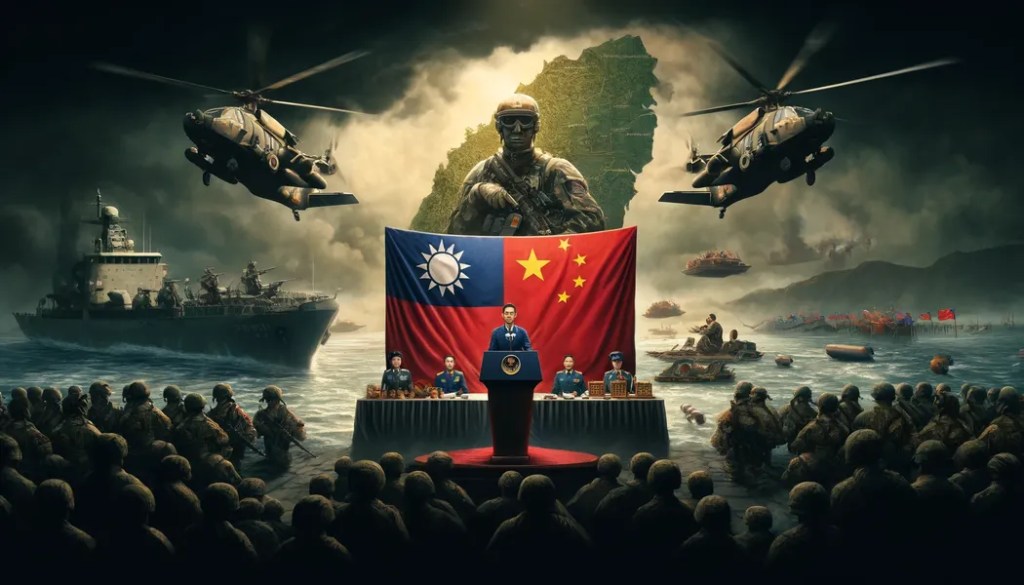
The situation in Taiwan is rapidly escalating, with significant political and military movements indicating a potential conflict with China. The recent video by the YouTube channel Awakening, titled “War is Approaching in Taiwan: Explanation with Predictions of Upcoming Conflict,” sheds light on the volatile dynamics between Taiwan and China, underscoring the possibility of an imminent war. This analysis delves into the geopolitical landscape, examines China’s recent actions, and evaluates the potential responses from the United States and other global powers.
The Inauguration of President Li and Its Fallout
On May 20th, 2024, President Li Ching-te of Taiwan delivered a provocative inauguration speech that has escalated tensions with China. Li’s speech emphasized Taiwan’s sovereignty and independence, stating explicitly that Taiwan and China are separate countries. He also underscored Taiwan’s intent to rely on U.S. support for its defense and independence, a stance that was seen as a direct challenge to Beijing.
In his address, Li urged China to cease its military intimidation and called for peaceful coexistence through dialogue. He reaffirmed Taiwan’s commitment to democracy, freedom, and peace, while simultaneously highlighting the necessity for Taiwan to bolster its defenses in the face of Chinese threats (Office of the President Taiwan) (Hosted) (Yahoo News).
China’s Reaction and Military Drills
China responded swiftly and forcefully to Li’s inauguration speech by organizing extensive military drills around Taiwan. These exercises were unprecedented in scale and intensity, signaling China’s readiness to respond aggressively to any moves towards Taiwanese independence. The drills encompassed maneuvers near Taiwan’s smaller islands and were intended to demonstrate China’s military capabilities and its resolve to maintain sovereignty over Taiwan (Office of the President Taiwan) (Hosted).
The Chinese government criticized Li’s speech as promoting separatism and inciting confrontation. The Taiwan Affairs Office of China’s State Council condemned the address, asserting that Taiwan is an inseparable part of China and that any attempts at independence would be met with strong resistance. This response underscores the sovereignty issue at the heart of the conflict, as China views Taiwan as a breakaway province that must eventually be reunified with the mainland, by force if necessary (Hosted) (euronews).
China’s Strategic Preparations
China has been making significant strategic moves that suggest it is preparing for potential conflict and the subsequent economic fallout. One of the key indicators is China’s recent acceleration in promoting the Yuan as an alternative to the U.S. Dollar. This move is part of a broader strategy to reduce reliance on the U.S. financial system and mitigate the impact of potential sanctions.
Additionally, China has been selling large amounts of U.S. Treasury notes. This divestment can be interpreted as a preemptive measure to safeguard its economy against the economic repercussions of a conflict with Taiwan and the potential for severe Western sanctions. By reducing its holdings of U.S. debt, China aims to decrease its vulnerability to economic pressure from the United States.
French President Emmanuel Macron’s recent statements further complicate the situation. Macron suggested that Europe should not blindly follow the U.S. in sanctioning China if it decides to invade Taiwan. This stance could undermine the unified front that the West typically presents in response to international conflicts, potentially giving China more leeway in its actions.
The U.S. Response and Global Implications
The United States’ response to a potential conflict between China and Taiwan is critical. Historically, the U.S. has maintained a policy of strategic ambiguity regarding Taiwan, providing support while avoiding explicit commitments to defend Taiwan militarily. However, the increasing tension and China’s aggressive posturing may force the U.S. to take a more definitive stance.
In the video, the commentator from Awakening predicts a 30% chance of conflict in 2024 and a 35% chance in 2025, with the likelihood of some form of military action, such as a blockade, being high. The U.S. response would likely involve a combination of diplomatic, economic, and military measures. This could include increased arms sales to Taiwan, economic sanctions against China, and potentially even military intervention to ensure the security of the Taiwan Strait.
The potential for a nuclear confrontation cannot be ignored. China possesses hundreds of nuclear weapons, and any conflict in the Taiwan Strait could escalate to a nuclear level, especially if the U.S. becomes directly involved. This possibility adds a layer of complexity to the strategic calculations of all parties involved.
Lessons from Russia’s Invasion of Ukraine
China is undoubtedly observing Russia’s ongoing conflict in Ukraine and drawing lessons from it. One of the key takeaways for China is the importance of swift and decisive action. Unlike Russia’s prolonged and bogged-down operation in Ukraine, China would likely aim for a rapid and overwhelming strike to achieve its objectives quickly and minimize the window for international intervention.
A swift invasion would not only prevent Taiwan from bolstering its defenses but also limit the time available for the international community to respond. This approach aligns with the analysis that China is more integrated into the global economy than Russia, making it more vulnerable to prolonged conflict and extensive sanctions.
Economic and Military Considerations
The economic costs of a conflict with Taiwan would be immense for China. Apart from direct military expenditures, China would face significant international sanctions, asset freezes, and potential isolation from the global financial system. These economic repercussions would be exacerbated if the U.S. and its allies decide to sever economic ties with China, similar to the sanctions imposed on Russia.
However, delaying action could also be costly for China. Each year of delay allows Taiwan to strengthen its defenses, making a future invasion more difficult and expensive. The analogy drawn in the video compares this to the situation in Ukraine, where an earlier Russian intervention might have led to a quicker resolution with fewer casualties and lower costs.
The Path Forward
The path forward is fraught with uncertainty and potential peril. The current geopolitical climate suggests that peaceful unification under President Li is unlikely, with the commentator from Awakening estimating a less than 1% chance of such an outcome. The entrenched positions and provocative actions on both sides make conflict increasingly probable.
For Taiwan, the immediate priority is to enhance its defensive capabilities. This includes acquiring advanced military technology, fortifying strategic positions, and strengthening alliances with countries that support its sovereignty. The United States, for its part, must navigate a delicate balance between deterring Chinese aggression and avoiding actions that could provoke an escalation.
The Role of Global Powers
Other global powers, particularly in Europe and Asia, will play crucial roles in the unfolding situation. Macron’s stance on not following the U.S. in sanctioning China if it invades Taiwan highlights potential fractures in the Western alliance. However, countries in the Asia-Pacific region, such as Japan, South Korea, and Australia, are likely to align closely with the U.S. due to their own security concerns regarding China’s ambitions.
The broader international community must also consider the implications of a conflict in the Taiwan Strait. The economic and humanitarian fallout would be significant, affecting global trade, financial markets, and regional stability. A concerted diplomatic effort to de-escalate tensions and find a peaceful resolution is imperative.
Conclusion
The situation in Taiwan is a powder keg with far-reaching implications for global stability. The provocative actions of President Li, coupled with China’s aggressive military and economic maneuvers, have set the stage for a potential conflict that could reshape the geopolitical landscape. The United States and its allies must carefully navigate this complex situation, balancing deterrence with diplomacy to prevent an all-out war.
In the coming months and years, the world will be watching closely as this situation unfolds. The stakes are high, and the decisions made by the leaders of China, Taiwan, and the United States will determine the course of history. As we analyze the current dynamics, it is clear that the potential for conflict is real and imminent, and the global community must be prepared for the consequences.
Sources:
- Awakening. (2024). War is Approaching in Taiwan: Explanation with Predictions of Upcoming Conflict. [YouTube video]. Retrieved from https://youtu.be/IMM-7JTOKxs?si=gzcfdBPnEfnq_w05.
- Reuters. (2023). Macron says Europe should not follow US in sanctioning China over Taiwan. Retrieved from Reuters.
- The Guardian. (2024). Taiwan president’s inauguration speech sparks military drills by China. Retrieved from The Guardian.
- Bloomberg. (2024). China’s Sale of U.S. Treasuries Accelerates Amid Rising Tensions. Retrieved from Bloomberg.
- Foreign Affairs. (2024). The New Cold War: China, the United States, and Taiwan. Retrieved from Foreign Affairs.

 EssayBoard
Leave a comment