
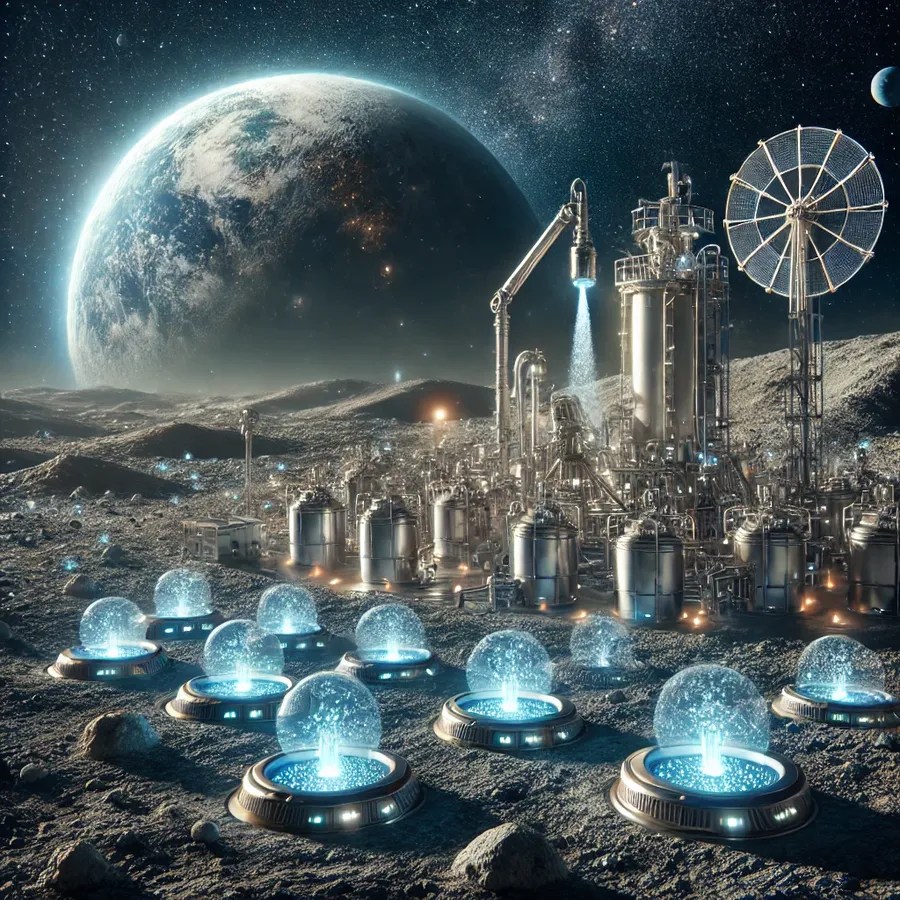
In a groundbreaking discovery, Chinese scientists have unveiled a method to extract water from lunar soil, a development that could revolutionize the future of space exploration. This innovative process, developed after years of research, leverages the hydrogen embedded in lunar soil by solar wind, converting it into water through high-temperature reactions. The implications of this discovery extend beyond the moon, potentially paving the way for sustainable human exploration of Mars and other celestial bodies in our solar system.
The Discovery: Water from Lunar Soil
China’s Chang’e-5 mission in 2020, the first mission to retrieve lunar samples in 44 years, provided the soil that has led to this discovery. Researchers from the Chinese Academy of Sciences found that lunar soil contains significant amounts of hydrogen, implanted over billions of years by solar wind. By heating this soil to high temperatures, they discovered that hydrogen could be extracted and used to produce water vapor. According to reports, this method can yield between 51 and 76 kilograms of water per tonne of lunar soil, sufficient to meet the daily water needs of approximately 50 people(Physorg, AOL.com).
Implications for Lunar Bases and Beyond
This discovery is a pivotal step toward the realization of long-term lunar bases, a goal that China has been steadily advancing towards. The ability to generate water on the moon could drastically reduce the need to transport water from Earth, making lunar habitation more feasible and sustainable. China’s space agency, in collaboration with Russia, aims to establish a basic lunar station by 2035, with a more complex moon-orbiting space station planned for 2045(AOL.com).
But the implications of this discovery stretch even further. The presence of hydrogen in lunar soil suggests that other planets and moons in our solar system, particularly those without atmospheres like Mars, might also have similar hydrogen deposits. If similar processes could be developed for these celestial bodies, it could enable the production of water and oxygen in situ, supporting human exploration and potential colonization(The Express Tribune).
The Path to Self-Sustaining Space Exploration
Water is not only essential for drinking but also for producing oxygen through electrolysis, which separates water into hydrogen and oxygen. This capability could transform space missions, allowing for longer stays on the moon, Mars, and beyond. Moreover, water could be used to create hydrogen fuel, a key component for rocket propulsion. As NASA Administrator Bill Nelson highlighted, the ability to produce water on the moon could serve as a stepping stone for missions to Mars and other distant destinations(AOL.com).
Beyond the Moon: A Vision for Interplanetary Travel
The significance of this discovery extends beyond lunar exploration. The process of extracting water from hydrogen-rich soils could be applicable on other planets and moons. For instance, Mars, which also lacks a protective atmosphere, could have hydrogen deposits in its soil. By using similar methods, future explorers could produce water on Mars, which could then be used to create oxygen and hydrogen fuel.
This capability would allow missions to rely on local resources, significantly reducing the need to transport large quantities of water and fuel from Earth. It could make long-term human presence on Mars and other celestial bodies much more viable. The potential to generate essential resources like water, oxygen, and fuel from local soils represents a major step toward making deep space exploration and colonization a reality(Physorg, The Express Tribune).
China’s Strategic Position in Space Resource Utilization
China’s ability to harness this method could position it as a dominant force in the space resource industry. By mastering the production of water, hydrogen, and oxygen from lunar and planetary soils, China could become a key player in the burgeoning space economy. This capability would not only support its own space exploration and colonization efforts but could also make China a vital supplier of essential resources for other nations and private space companies.
With the infrastructure to produce hydrogen fuel from extraterrestrial sources, China could potentially lead in space mining, refueling stations, and even terraforming projects. The implications of this are profound, as control over space resources could translate into significant geopolitical and economic power. As the U.S. and other nations race to establish their presence in space, China’s advancements in this area could give it a substantial edge in the competition for space dominance(Physorg, AOL.com).
Challenges and Future Prospects
While the discovery is promising, there are significant challenges to overcome. The process of extracting water from lunar soil is energy-intensive, requiring the development of infrastructure capable of operating in the harsh lunar environment. The construction of such facilities, likely to be robotic and automated, will be complex and costly.
Despite these challenges, the potential rewards are immense. The ability to produce water on the moon and possibly on other planets could reduce the dependency on Earth for resources, making human presence in space more sustainable and opening up new possibilities for exploration and discovery.
Conclusion: A New Era of Space Exploration
China’s discovery marks the beginning of a new era in space exploration. As humanity prepares to extend its reach beyond Earth, the ability to utilize extraterrestrial resources will be crucial. This method of producing water from lunar soil not only supports the vision of a permanent human presence on the moon but also hints at the broader potential for resource utilization across the solar system.
As the U.S. and China continue to compete for dominance in space, this discovery underscores the importance of international collaboration and innovation. The future of space exploration may well depend on our ability to harness the resources of other worlds, and this breakthrough is a significant step in that direction.
China’s progress in this field positions it to potentially dominate the space resource industry, controlling the production of water, hydrogen, and oxygen necessary for deep space exploration, mining, and even terraforming efforts. As we stand on the brink of a new space age, these developments could shape the geopolitical landscape of the 21st century and beyond.

 EssayBoard
Leave a comment