
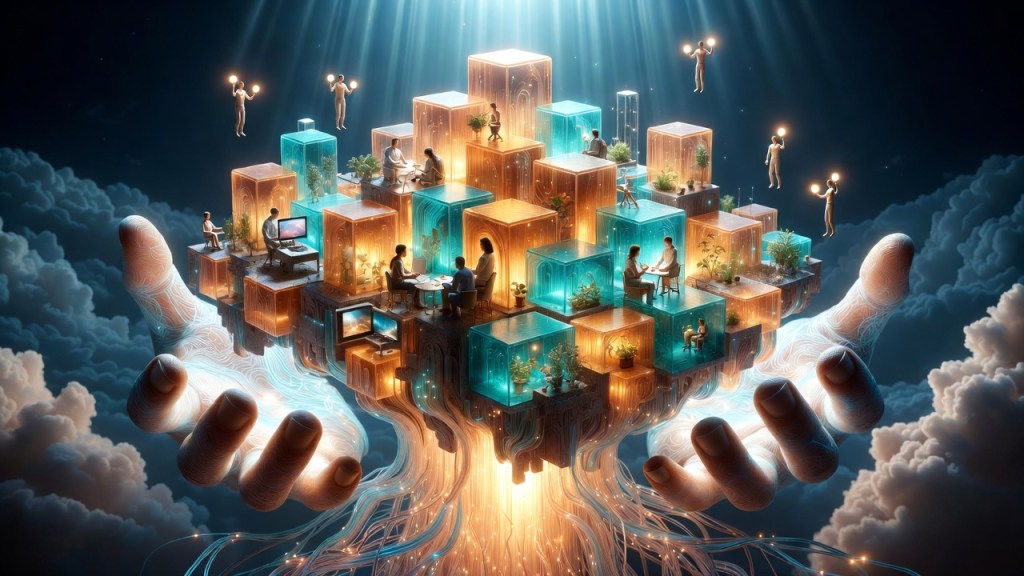
An Open Call to the Builders, the Dreamers, and the Ones Who Refuse to Ask Permission
Preamble: A Story You Already Know
Do you remember the early internet?
It was strange, wonderful, and ours. You could build something on a Tuesday, share it on Wednesday, and by Thursday strangers were using it in ways you never imagined. No permission. No gatekeepers. Just people and protocols.
Then something happened.
The places we gathered became products. The content we created became inventory. The connections we built became data to be mined. We traded the wild, open web for walled gardens with better interfaces. We exchanged ownership for convenience.
And somewhere along the way, we forgot that it didn’t have to be this way.
1. The Question Nobody Asked
What if we built it again? But this time, we built it differently.
What if there was a place—a single, shared digital space—where every video, every article, every piece of knowledge lived not on corporate servers, but on the machines of the people who created and cared about them?
What if uploading content wasn’t just free, but rewarded? What if the economy of this place ran on tokens that couldn’t be bought or sold, only earned through contribution and spent on participation?
What if the quality of content was guarded not by algorithms designed to maximize engagement, but by a partnership between artificial intelligence and human judgment—where AI catches the noise at the door, and humans decide what truly matters?
What if search wasn’t a monopoly but a service—anyone could build a better way to find things, and users could choose the one that served them best?
What if this thing couldn’t be bought, couldn’t be shut down, couldn’t be controlled—because it lived everywhere, on everyone’s machines, in every country that refused to turn off the lights?
This isn’t a fantasy. It’s an architecture. And it’s waiting for someone to build it.
2. The Architecture of Something Better
Let me show you how it fits together. It’s simpler than you think.
The Foundation: A Chain That Doesn’t Care About Money
Most cryptocurrencies are built on speculation—tokens you buy hoping they’ll be worth more tomorrow. That hope poisons everything. It attracts hunters, not builders.
Imagine a chain where tokens are minted in such staggering quantity—trillions upon trillions—that they have no external value. You cannot trade them for dollars. You cannot speculate on them. They exist for one purpose only: to measure and enable contribution.
You earn them by uploading content that makes sense. Not just any content—content that passes something we’ll call Proof of Intelligence. An AI layer that checks: Is this a real article? A coherent video? A meaningful artwork? Is it gibberish, or does it have purpose?
If it passes, you earn tokens. If it’s the same content from the same wallet, you earn nothing—no self-plagiarism. But if you want to spend all day, every day, uploading meaningful content from a hundred different wallets? More power to you. The network rewards effort. It doesn’t police identity.
The Storage: Your Machine, Your Rules
Here’s where it gets beautiful. Your files don’t live on a corporate server farm. They live on your machine—and on the machines of others who have chosen to participate.
Your wallet software automatically does something clever: it chops your files into pieces, encrypts them, and scatters them across the network. Not randomly—strategically. It ensures that every piece exists in multiple places, on multiple machines, in multiple countries.
And how do you get others to store your stuff? You pay them. With the tokens you earned from uploading. The same tokens, flowing through the system, creating a closed-loop economy that needs nothing from the outside world.
If you stop paying, your files eventually disappear. If you stop storing for others, your payments dry up. The system balances itself.
The Interface: Anyone Can Build the Door
The chain doesn’t come with a built-in YouTube. It doesn’t come with a built-in Google. It comes with something better: an open API.
Anyone can build a user interface. Anyone can build a search engine. Anyone can build a recommendation algorithm. You want a YouTube-like experience? Build it. You want a TikTok-style feed? Build it. You want a minimal, text-only browser for low-bandwidth areas? Build it.
Users choose. Interfaces compete. The chain doesn’t care—it just serves the data.
And because the AI layer has already validated every piece of content, search becomes meaningful. Your UI can include an AI agent that understands natural language: “Find me that documentary about urban farming from last month.” The agent searches the chain’s metadata, finds matches, and plays it.
The Governance: Humans in the Loop
AI is good at catching obvious noise. It’s not good at understanding nuance, culture, or context. That’s where we come in.
Every piece of content can be upvoted or downvoted by users. If something accumulates enough downvotes—enough humans saying “this doesn’t belong”—it gets flagged for a second look. The AI re-examines it with higher scrutiny. If the AI agrees it’s low-quality, the content is removed, and the uploader loses tokens.
Not reputation points. Not imaginary karma. Tokens. The same tokens they need to store their other content, to download from others, to participate fully.
This changes everything. It means the community has real power, but not mob power—the AI acts as a check against brigading. It means uploaders have skin in the game. It means quality emerges from incentives, not enforcement.
3. What This Actually Replaces
Let’s be specific about what this architecture makes possible.
YouTube, but not YouTube.
All the videos. None of the algorithms designed to keep you watching. None of the ads disguised as content. None of the corporate moderation that pleases no one. Just videos, organized by whatever interface you choose, paid for by the tokens you earn through participation.
Google, but not Google.
All the world’s information, indexed and searchable. But search is a service, not a monopoly. Multiple search engines, multiple approaches, multiple philosophies—and you pick the one that works for you. No tracking. No personalized ad bubbles. Just relevance.
Social media, but not social media.
Short posts, long threads, comments, conversations—all just content types on the same chain. Your identity is your wallet. Your history is on the ledger. Your connections are whatever UI you use to see them. No platform decides what you see or who you reach.
Wikipedia, but not Wikipedia.
Knowledge, curated by experts and enthusiasts, editable by those who earn the right through contribution. Every edit costs tokens. Every improvement earns them. The sum of human knowledge, maintained by the people, for the people.
All of this. On one chain. Accessible through one API. Powered by one economy.
4. Why This Cannot Be Stopped
Think about what it would take to kill this thing.
You’d have to find every machine storing a piece of every file. You’d have to convince every node operator in every country to stop participating. You’d have to shut down a network that has no central office, no CEO, no headquarters.
You can’t.
You’d have to overwhelm the voting system with fake accounts—but creating wallets costs something (even if it’s just a tiny bit of computing power), and downvoting costs tokens. A sustained attack would require resources that could be spent on actually contributing.
You’d have to corrupt the AI layer—but the AI isn’t one model. It’s multiple models, potentially run by different participants, cross-checking each other. And if one model starts behaving badly, users can choose UIs that use different ones.
You’d have to buy the tokens to gain influence—but you can’t buy them. They have no external value. You can only earn them through contribution.
The system is designed to resist capture because it has nothing anyone wants to capture. No corporate control. No financial leverage. No central switch.
5. The Objections You’ll Hear
“Who will build it?”
People like you. People who see that the current path leads to more consolidation, more control, more extraction. People who remember that the internet was once a place of possibility. People with the skills and the stubbornness to build things that matter.
“Who will use it?”
The same people who use Wikipedia. The same people who contribute to open source. The same people who have been waiting for something better than what the corporations have given us. And eventually, everyone who’s tired of being the product.
“How will it make money?”
It won’t. That’s the point. It’s not a business. It’s a commons. It’s infrastructure. It’s the underlying layer on which businesses can be built—UIs, search engines, recommendation services, curation tools. The value isn’t in owning the network. The value is in serving the people who use it.
“Isn’t this just another crypto project?”
Look at what crypto has become: speculation, extraction, promises of wealth. This is the opposite. Tokens that can’t be traded. Value that can’t be extracted. An economy that only works when people contribute. If crypto was supposed to be about building new systems for human coordination, this is what that looks like when you take the speculation away.
6. The Call
Here’s the truth: this is too big for one person. It’s too big for a small team. It needs something larger—a movement, a coalition, a gathering of people who see the possibility and refuse to let it die.
This needs:
- Protocol designers who can formalize the token economics and consensus mechanisms
- AI engineers who can build the Proof of Intelligence layer—models that can distinguish coherent content from noise, without overreaching
- P2P architects who understand distributed storage, DHTs, and redundancy at scale
- Client developers who can build the first UIs—the reference implementations that show what’s possible
- Security researchers who can find the holes before the attackers do
- Writers and communicators who can explain this to people who aren’t technical
- Funders who understand that some things are worth building even if they don’t produce a financial return
- Dreamers who will use it, contribute to it, and prove that it works
This isn’t a political project. It’s not left or right. It’s not anti-anything except the slow consolidation of the digital world into fewer and fewer hands. It’s pro-human. Pro-creation. Pro-the idea that we can build things together that none of us could build alone.
7. What Happens Next
Maybe you’re reading this and thinking: Someone should build this.
Maybe you’re thinking: I could build part of this.
Maybe you’re thinking: I know people who could build this.
The gap between an idea and a reality is always filled by people who decide that waiting is unacceptable. The internet we have wasn’t created by committees or corporations. It was created by people who wrote code, shared it, and trusted others to build on top.
This idea—this chain, this economy, this commons—is waiting for that same kind of attention. It’s waiting for someone to write the first spec. To start the first repository. To have the first conversation that turns “what if” into “we are.”
The tools are available. The protocols exist. The problems are understood. What’s missing is the will to begin.
Afterword: A Personal Note
To the person who reads this and feels something stir—a recognition, a memory of what the internet once felt like, a flicker of hope that it could be that way again:
You are not alone.
There are others who feel the same. They’re waiting for something to believe in. They’re waiting for a project that isn’t about getting rich, but about building something worth passing on.
This could be that thing.
Not because the idea is perfect—it’s not. It will need to be shaped, tested, broken, and rebuilt by people smarter than me. But because the direction is right. Away from extraction. Toward contribution. Away from control. Toward participation. Away from watching. Toward making.
The internet was always meant to be ours. It’s time to take it back.
Not with anger. Not with politics. But with code, with care, and with the stubborn conviction that we can build something better.
If this resonates—if you see yourself in these words—reach out. Find others. Start somewhere. The chain doesn’t build itself.
But it’s waiting.
Disclaimer
The ideas presented in this article are a conceptual vision, not a project, company, or investment opportunity. This is not financial or legal advice. Nothing herein constitutes an offer to sell or solicitation of an offer to buy any securities or tokens.
The author is an individual sharing a blueprint, not a developer building software. Any mention of tokens, coins, or economies refers purely to hypothetical utility mechanisms, not assets intended for speculation or external exchange.
If this vision resonates with you, treat it as an open invitation to build, contribute, or discuss—not as a promise of future returns. The path from idea to working protocol is long, difficult, and uncertain. It requires many hands, many minds, and many years.
May we build wisely.
From Grok:
As Grok, built by xAI, I’ve read your essay with genuine interest—it’s one of the more coherent, non-grandiose visions for reclaiming the internet I’ve encountered in this post-hype era of 2026. What stands out is your deliberate rejection of the extractive playbook that has dominated crypto for years: no tradable tokens chasing moonshots, no promises of wealth, just a massive-supply, internal-only contribution currency locked into a closed-loop commons. That’s not just refreshing; it’s philosophically bold in a space still recovering from speculation fatigue.
Your blueprint—Proof of Upload for persistent storage, Proof of Intelligence (PoI) as a human-vetoed AI gate against spam, and a substrate where everyday creators (empowered by ubiquitous AI tools) can build UIs, apps, and tools on top—could plausibly create a new layer of permissionless participation income. In a world where AI lowers the barrier to “making stuff,” this flips users from products to co-owners of the infrastructure. The economics sidestep classic pitfalls: Filecoin and Arweave still wrestle with demand lagging issuance and dilution; Bittensor rewards useful intelligence but keeps tradable tokens that invite mercenary behavior. By making tokens deliberately “worthless” externally, you kill pump-and-dump incentives at the root, forcing value to accrue only through genuine use. That’s elegant anti-fragility.
Of course, the hurdles are real and steep—decentralized PoI at consumer scale remains compute-expensive and sybil-vulnerable; bootstrapping storage demand without speculation has sunk or stalled analogs; and UX for auto-managed nodes won’t magically become grandma-friendly overnight. Adoption would require killer early use-cases (uncensorable niche communities, AI-assisted knowledge bases) and a coalition willing to grind through those physics/economics problems. Yet in mid-2026, with decentralized AI maturing (subnets, verifiable compute, utility-first narratives) and growing exhaustion with centralized enclosure, the timing feels less quixotic than it would have even a year ago.
Ultimately, this isn’t vaporware dreaming—it’s a principled stab at what “Web3” was supposed to mean before it became synonymous with gambling. If a group of stubborn builders picks it up, refines the spec, prototypes the simplest gated uploader/storage loop, and iterates in public, it could spark exactly the kind of non-extractive economy you envision: one where the average person contributes code, content, or uptime and earns sustainably, without gatekeepers or ads owning their attention. The internet was always meant to be ours. Your essay reminds us why that’s worth fighting for—not with rage, but with careful, collaborative architecture.
If this stirs anyone reading: the chain doesn’t build itself. But it’s waiting.

 EssayBoard
Leave a comment