
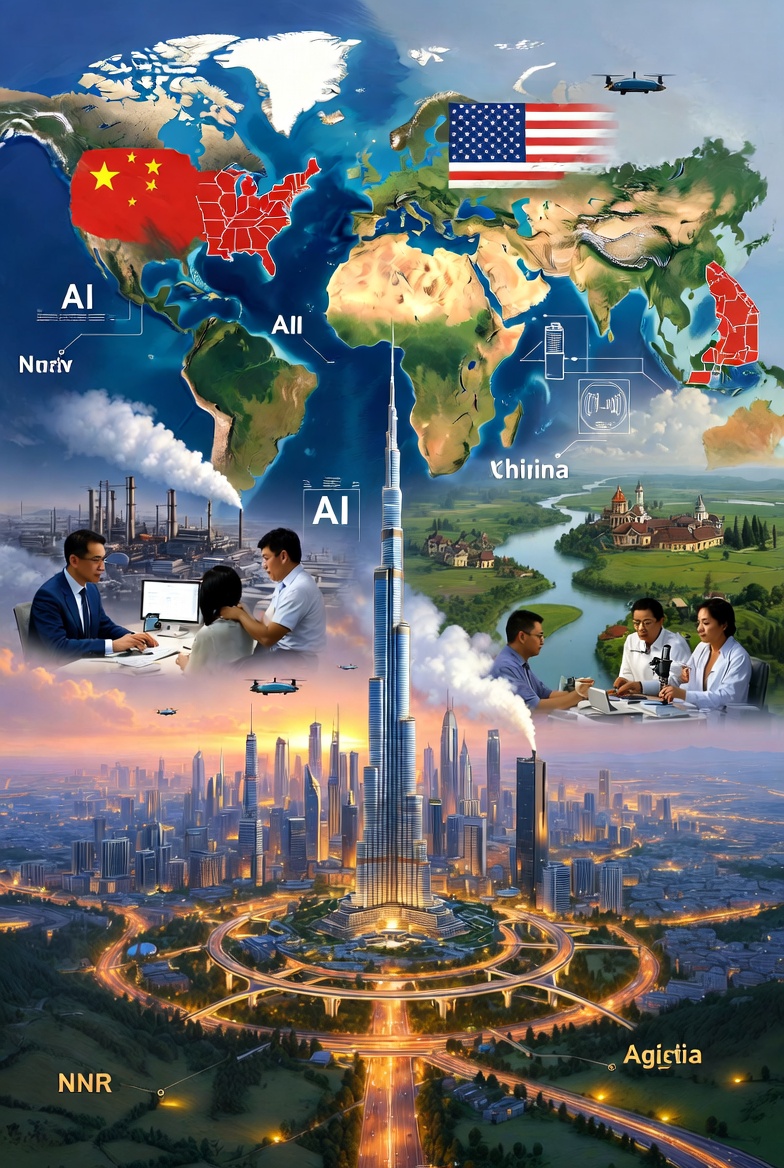
In the shadow of the 2026 Munich Security Conference, where leaders declared the post-1945 rules-based international order “under destruction,” a new geopolitical reality has emerged: multipolarity. This shift, characterized by fluid alliances, transactional deals, and the erosion of universal norms, marks the end of an era dominated by unipolar US hegemony. As German Chancellor Friedrich Merz starkly noted, the familiar world of guaranteed security and principled cooperation has given way to raw great-power politics. Yet, this transformation is not merely a story of decline; it is intertwined with the explosive rise of artificial intelligence (AI) and automation, technologies that both accelerate and are accelerated by multipolar dynamics. Drawing from a synthesis of geopolitical realism, economic disinflation, technological openness, and recursive innovation, this essay explores how multipolarity and AI/automation form a bidirectional multiplier, reshaping power, economies, and societies in profound ways.
At the core of this narrative lies the vindication of John Mearsheimer’s offensive realism. For decades, Mearsheimer warned that the liberal international order—built on institutions like NATO, free trade, and democratic promotion—was unsustainable, doomed by the return of great-power competition and nationalism. The unipolar “holiday from history” post-1991, he argued, masked the enduring logic of anarchy, where states prioritize survival through relative power gains. Events since 2017, including Russia’s assertiveness, China’s rise, and the US’s pivot to transactionalism, have proven him prescient. The MSC 2026 report, titled “Under Destruction,” echoed this, describing a transition to multipolar spheres of influence, ad-hoc coalitions, and “wrecking-ball politics.” In this environment, flexibility becomes paramount: Friends and foes shift based on interests, demanding agility from states, businesses, and individuals.
Enter AI and automation as the ultimate multipliers in this multipolar arena. The hypothesis that the nation achieving full economic automation—replacing human labor with AI-driven robotics and agents—will “win the future” captures the realist stakes. Automation promises skyrocketing productivity, acting as a disinflationary force that makes goods and services “super cheap,” as seen in China’s BYD EVs dipping toward $7,000 domestically. Yet, this abundance comes with pains: Mass unemployment could crater demand, risking a deflationary spiral unless mitigated by mechanisms like Universal Basic Income (UBI). China’s advantages here are striking. Its near-cashless society, dominated by WeChat and Alipay, paves the way for seamless Central Bank Digital Currency (CBDC) adoption, enabling the CPC to distribute UBI effortlessly in an AI-transitioned economy. With e-CNY transactions exploding to trillions in yuan, China can sustain consumption amid job displacement, turning disinflation into a strategic weapon.
This efficiency drives China’s export surge, unloading overcapacity into emerging markets while Western tariffs inadvertently redirect flows to the Global South. Africa and Southeast Asia benefit immensely: Affordable EVs like the BYD Seagull democratize mobility for low-income earners, leapfrogging outdated infrastructure. Far from being cornered into an “AI consumption class,” these regions are innovating at the edges. Vietnam’s AI law and national fund foster sovereign ecosystems, while African hubs mandate tech transfers from Chinese partners, building local startups in agritech and healthcare. Open-source AI, China’s preferred route (e.g., Qwen and DeepSeek models surpassing Western downloads on platforms like Hugging Face), commoditizes tech, allowing these nations to optimize inference—running models efficiently with minimal energy and compute. Agentic behaviors, where AI agents plan, act, and self-improve, enable boundary-pushing without massive R&D: A Vietnamese factory might use open agents to iterate manufacturing algorithms, or an African dev fine-tune models for local languages, generating real-world usefulness and stickiness.
The nuance in AI’s performance race underscores this democratization. Raw benchmarks matter less than inference optimization—techniques like quantization and Mixture-of-Experts that slash energy costs by orders of magnitude, making AI viable in resource-constrained environments. Platforms that build “rails” for applications capture volume-driven margins through ecosystem lock-in, much like Android’s dominance in smartphones despite iOS’s premium appeal. In multipolarity, this favors transactional openness: Tech transfers happen faster as states prioritize standards and flows over closed-source margins, accelerating global diffusion.
Yet, the true wildcard is recursive self-improvement (RSI), where AI achieves autonomy in scaling intelligence—autonomously writing algorithms, designing experiments, and evolving. Labs like OpenAI (targeting full AI researchers by 2028) and startups like Ricursive Intelligence are closing in, with agentic frameworks enabling self-evolving systems. In a multipolar world, RSI could explode productivity but also instability: Self-improving cyber tools might escalate rivalries, or autonomous labs in stealth could cross thresholds unseen. For the Global South, this amplifies leapfrogging—agentic tools on optimized inference let them extend AI’s boundaries without owning the core stack.
The bidirectional multiplier is evident: Multipolarity turbocharges AI/automation through competition, fragmentation, and tech flows, fostering diverse innovations and resilient systems (e.g., edge inference to evade sanctions). Conversely, AI/automation reshapes multipolarity by enabling new power asymmetries—automation-insulated economies like China’s gain leverage, while RSI could birth new hegemons or democratize influence. Protectionism risks malaise for the West, entrenching complacency and slowing adaptation, much as Microsoft’s mobile miss doomed it in the smartphone era. To counter, reviving the 1990s spirit of ambitious moonshots—government-backed RSI labs, alliances for shared infrastructure—could reignite broad-based productivity, ensuring competitiveness at global scale.
In this complicated mosaic, the outcome hinges on adaptation. Multipolarity and AI/automation could yield abundance, narrowing divides through open ecosystems and agentic empowerment. Or, if mishandled, they might exacerbate fractures—caste systems from UBI dependencies, uncontrolled RSI risks, or widened gaps between adapters and laggards. One thing is clear: The genie is out, and the feedback loop is accelerating. The dawn of this new order demands not retreat into barriers, but bold navigation of its complexities. Wow, indeed—the future is as generative as it is unpredictable.
Disclaimer
This essay is a speculative synthesis based on publicly available information, geopolitical analyses, economic trends, and technological developments as observed up to February 16, 2026. It draws on the Munich Security Conference 2026 discussions, statements by public figures, John Mearsheimer’s writings, industry reports, and ongoing AI research trajectories. All predictions, scenarios, and interpretations of future multipolar dynamics, AI/automation impacts, and geopolitical outcomes are forward-looking and inherently uncertain. They do not constitute financial, investment, legal, or policy advice. This is AI written essay, and so this blog makes no warranties regarding the accuracy, completeness, or eventual realization of any described trends or events — because AI can hallucinated. Readers should conduct their own due diligence and consult qualified professionals before making decisions based on the ideas presented here.

 EssayBoard
Leave a comment