
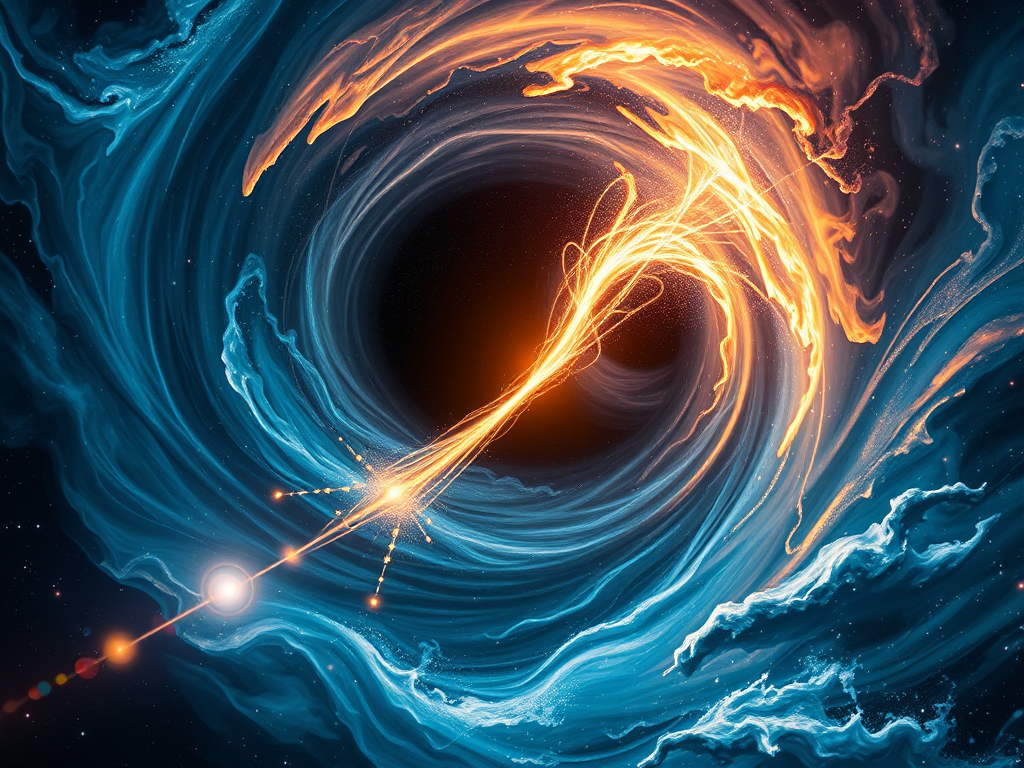
Somewhere out there, the universe may already be running the experiment we can never perform. Black holes—those cosmic furnaces of gravity—press the fabric of spacetime until it folds, stretches, and finally tears. To wonder what lies beyond that tear is to stare into the edge of reality itself.
For a century physicists have treated space and time as a single fabric: flexible, elastic, capable of ripples we call gravitational waves. But push that fabric too hard and the equations falter. Spin a planet fast enough, cram too much energy into too small a point, and spacetime ceases to behave like a smooth continuum. It reaches what some physicists liken to a boiling point—the Planck scale, where the temperature climbs to 10³² kelvins and distances shrink to 10⁻³⁵ meters. Below that, geometry dissolves into quantum foam.
Black holes already dwell in that regime. Inside their horizons, density and temperature soar beyond all laboratory limits. What happens there—whether matter collapses into an infinitesimal singularity or rebounds into something else—is nature’s greatest secret. To peer inside would be to watch the universe test its own limits.
Scientists suspect that at such extremes spacetime undergoes a phase change, much as water becomes steam. Theories of quantum gravity suggest it could fragment into tiny, discrete “atoms of space,” or perhaps loop into higher dimensions. In that sense, every black hole is a cosmic pressure cooker, simmering at the boundary between the known and the impossible.
If the black hole represents collapse, its mirror image—the white hole—would represent release: a region that spews matter and allows nothing to enter. None have been seen, yet their mathematics haunt the equations of relativity like a reflection we can’t quite banish. Some researchers imagine that when a black hole finishes evaporating, it could rebound as a white hole—a last exhalation of a dying star, turning inward gravity into outward fury.
Between those opposites lies perhaps the most seductive idea of all: the wormhole, a tunnel linking two distant patches of spacetime. It’s the dream of every traveler and the nightmare of every physicist, because keeping a wormhole open would require matter with negative energy—a substance that defies every known energy condition. Push the geometry further and the wormhole might loop back on itself, like a snake swallowing its tail, creating a time loop where cause and effect lose meaning. Stephen Hawking called this the chronology protection problem; nature, he argued, despises paradox and would destroy such a loop before it could form.
The deeper question may not be whether these things exist, but what they reveal about the universe’s personality. Reality, it seems, is both generous and mischievous—inviting our curiosity right up to the point where equations fracture. In that fracture, imagination steps in. Physicists use mathematics to chase those fractures; dreamers use metaphor. Both are acts of exploration.
Perhaps the “boiling point of spacetime” isn’t a dead end at all, but a horizon of understanding—a place where new physics waits, as quietly as stars forming beyond the nebula’s veil. The universe may be twisting itself into shapes we can barely conceive, folding and refolding its cloth until, somewhere, it bites its own tail and begins again.
Disclaimer
This is AI generated content. This article is speculative and educational. It draws on established physics concepts—general relativity, quantum gravity limits, and black-hole thermodynamics—but extends them through imaginative analogy. No stable white holes or traversable wormholes have been observed; their descriptions here represent theoretical and philosophical exploration, not empirical fact.

 EssayBoard
Leave a comment