
DISCLAIMER: This is AI generated content. This article contains speculative analysis drawn entirely from open-source intelligence, media reports, commercial satellite images, and publicly available data. No claims herein are officially verified by any government or military agency.
The Quiet Arrival of the Chinese Spy Ship
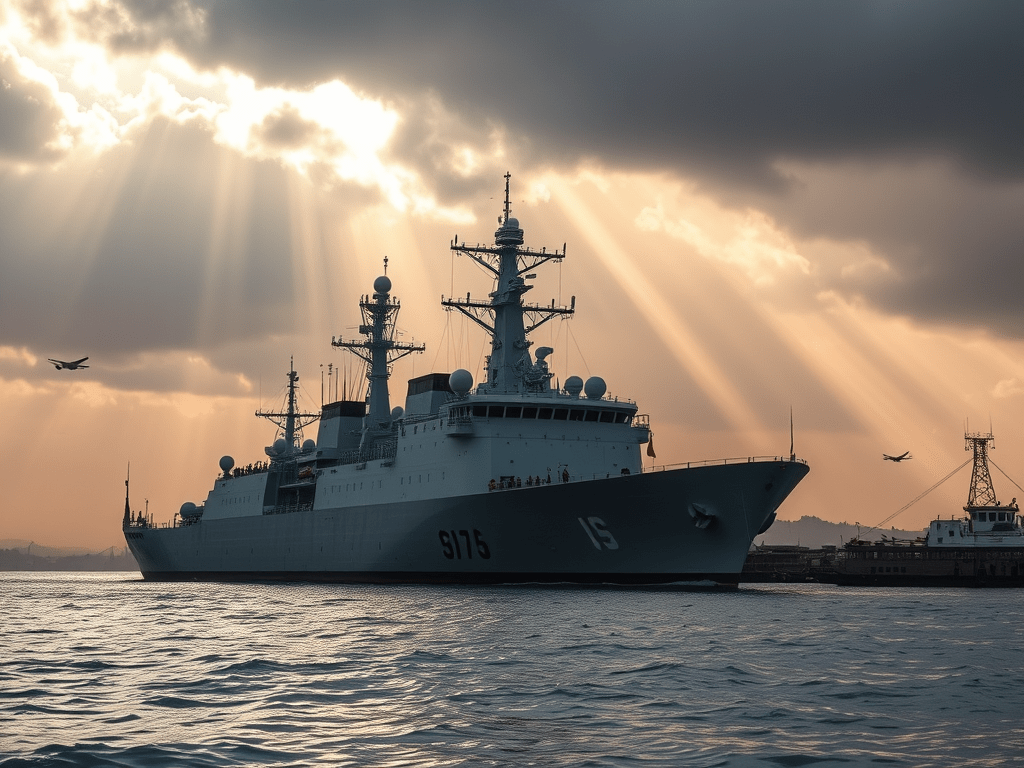
Recently, rumors swirled online as a Chinese electronic reconnaissance ship, suspected to be a Type 815A class vessel, reportedly docked quietly at Iran’s Bandar Abbas. Official confirmations were absent, yet satellite imagery sparked heated discussions in defense circles. The event appears minor, yet its implications ripple far beyond the Gulf’s waters.
Learning from War Without Firing a Shot
This incident underscores a broader pattern: China systematically uses regional conflicts to refine its military strategies. For China, the Persian Gulf isn’t just a geopolitical hotspot—it’s a live laboratory.
Consider recent aerial combat between Pakistan and India in May 2025, where Pakistani pilots, flying Chinese-supplied J-10C fighter jets armed with PL-15 missiles, reportedly downed at least one Indian Rafale jet. Though the incident remains disputed, its significance is clear: China gains real-world validation of its military technology without direct involvement.
The Hidden Classroom: How China Benefits
China’s spy ships, like the suspected Type 815A in Iran, serve as mobile surveillance platforms, collecting invaluable electronic signals and radar patterns from advanced Western aircraft and drones operating nearby. Each conflict zone, from Israel-Iran confrontations to Pakistan-India air battles, offers China a front-row seat to observe, learn, and adapt.
This gathered intelligence is fed directly back to Chinese analysts, refining artificial intelligence algorithms and improving the performance of Chinese military hardware in potential future conflicts, such as scenarios involving Taiwan or the South China Sea.
A Global Signal Intelligence Web
The spy ship at Bandar Abbas is not an isolated example. Recently, similar vessels have appeared near Australia, Japan, and throughout the South China Sea. China’s message is clear: It intends to monitor Western and allied military activities continuously, building a comprehensive intelligence picture.
China’s spy ships act as quiet deterrents, signaling subtly but powerfully: “We are watching, recording, and prepared to counter any move.”
Risks of “Accidental” Escalation
What if U.S. or Israeli forces attempt a subtle strike nearby to send a warning? China, with its advanced surveillance capabilities, would likely detect any hostile intent immediately. Such “accidents” risk significant escalation, as Beijing would possess concrete evidence, enabling diplomatic or economic retaliation without public disclosure.
Economic Implications and Strategic Leverage
China’s presence in the Gulf isn’t purely military. By securing critical energy routes—through which 44% of its oil imports transit—China ensures economic stability. Moreover, the heightened risks drive up insurance costs and reroute commercial shipping, indirectly asserting Chinese economic leverage.
The Containment Paradox
Western strategies aimed at containing China’s military rise appear increasingly flawed. Each conflict the West engages in becomes a free, real-time training ground for China. Whether it’s observing American stealth drones over the Gulf or learning from the combat performance of European fighter jets against Pakistan, China’s knowledge base grows rapidly.
Containment strategies leak, ironically providing Beijing with deeper insights into Western capabilities.
Counterpoints and Cautions
We must acknowledge the uncertainties. The spy ship’s exact capabilities remain speculative. The Pakistani J-10C’s claimed success against India’s Rafale is disputed by Dassault and Western analysts. China’s stated nuclear doctrine remains “no first use,” suggesting cautious engagement strategies. There’s also a possibility the West intentionally deploys misinformation to mislead China.
Final Thoughts
Former President Clinton once cautioned America to imagine a world where it wasn’t number one. China’s strategic use of regional conflicts as learning platforms may hasten such a shift. As democracies continue to show their military cards openly, Beijing quietly takes notes, preparing for a future where it might not need to fight at all—because it already knows exactly how its opponents will act.
Join the Conversation
How can the West effectively navigate conflicts when every military move becomes a lesson for adversaries? Share your thoughts and engage with others below.
Reminder: This is speculative analysis derived from publicly available data and open-source intelligence.

 EssayBoard
Leave a comment