
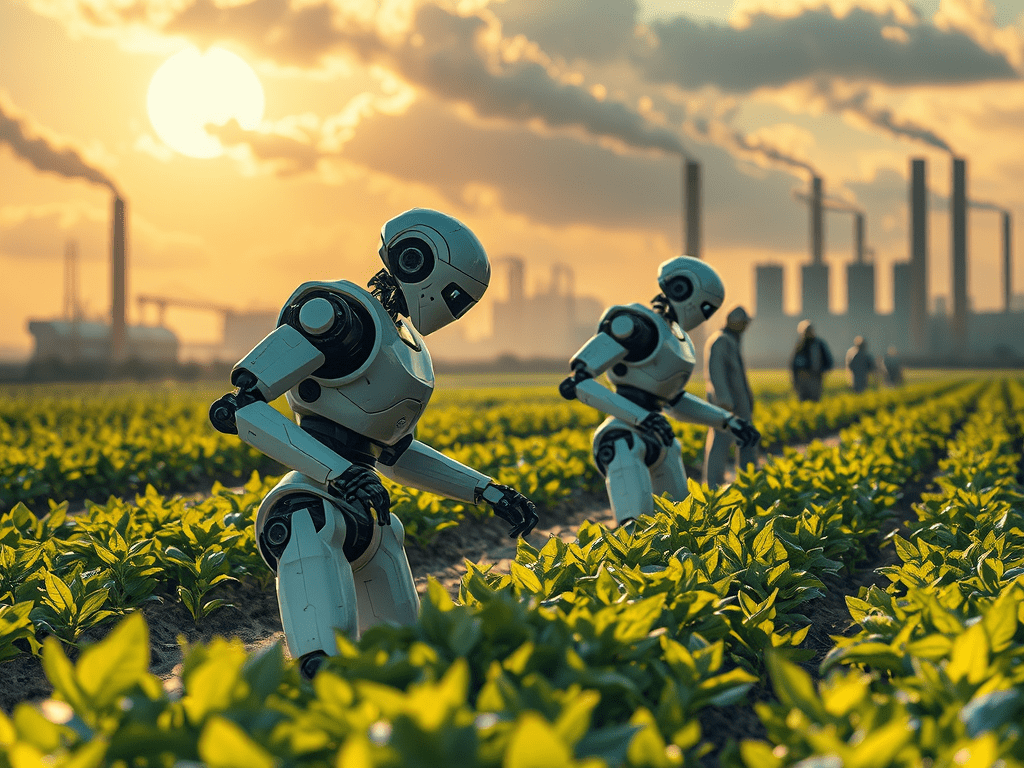
For 4,000 years, humans whipped humans to pick cotton. In 2025, a robot harvester can do it alone.
We stand at a crossroads. The machines designed to free us from centuries of oppression also threaten to erase the very purpose that defines us. Will automation be the key that unlocks human potential—or the lock that cages us in a new kind of obsolescence?
A Very Brief History of Forced Labor → Automation
From the dawn of civilization, forced labor has powered empires. Ancient societies thrived on the backs of slaves, whose lives were owned and traded like cattle.
The Industrial Revolution shifted the paradigm. Wage labor replaced chains, but exploitation remained. Factory workers toiled in grueling conditions, paid just enough to survive.
Then came the machines: looms, assembly lines, early robots—tools that both frightened workers and promised progress. Today, artificial intelligence and robotics don’t just follow instructions; they learn, adapt, and improve without human hands.
Key dates from chains to chips
- 1800 BCE: Earliest recorded slavery systems
- 1760–1840: Industrial Revolution ushers wage labor
- 1913: Ford’s assembly line automates production
- 2025: GPT-4o and advanced robotics reshape work
Automation as Liberation
When machines reduce labor costs near zero, the economic justification for slavery and exploitative labor evaporates.
Robots can step in for the dangerous, demeaning jobs no one should endure: mining toxic sites, harvesting perilous crops, performing delicate surgery with unmatched precision.
Vertical farms thriving in cities, autonomous trucks hauling minerals, and robotic surgeons saving lives—all testify to the moral dividend automation offers. For the first time, economic efficiency can truly align with human dignity.
Automation as Obsolescence
But this shiny promise has a shadow.
Studies predict up to 40% of current jobs could be automated in the next decade. More than just blue-collar roles—white-collar jobs face algorithmic gatekeepers that decide who gets hired, who gets credit, who gets policed.
When “What do you do?” becomes an empty question, a crisis of purpose looms.
Meanwhile, wealth concentrates into the hands of platform owners and tech oligarchs—turning society into a digital caste system.
Pull-quote: “The next chains may be invisible—made of code, not iron.”
The Paradox Explained
| Liberation Gains | Obsolescence Risks |
|---|---|
| Economic efficiency near zero | Massive job displacement |
| Safer, more dignified work | Algorithmic exclusion and bias |
| Alignment of rights and profits | Crisis of human purpose |
| New industries and creativity | Wealth concentration and inequality |
Both stem from the same root: productivity unleashed without policy to guide its course.
Three Diverging Futures
- Utopian: Universal Basic Income cushions all. Lifelong learning stipends spark a renaissance of creativity and innovation. Humans focus on art, empathy, and exploration.
- Dystopian: Techno-feudalism takes hold. Mass redundancy creates a sprawling underclass trapped by digital gates. Power rests in the hands of code-wielding elites.
- Middle Path: Smart regulation balances innovation and inclusion. Corporations share dividends with workers. Human-in-the-loop cultures blend AI efficiency with human judgment.
What We Can Do Now
Policy pilots of UBI and robot taxes can soften shocks and share gains.
Corporations must embed ethical AI boards and commit to reskilling their workforce.
Individually, we cultivate versatile skills, engage civically, and build mental resilience to adapt in this shifting landscape.
Closing Reflection
The whip is gone. The algorithm is here.
What we do next decides whether freedom truly scales or slips away unnoticed. We must be vigilant, imaginative, and bold—because automation will shape the future, but we must choose which future.
Disclaimer:
This AI generated content. This article is intended for informational and educational purposes only. It reflects the common sense views and interpretations of automation, technology, and society. The content is not financial, legal, or professional advice. Readers should perform their own research and consult qualified professionals before making any decisions related to automation, employment, or policy. The future is inherently uncertain, and predictions or scenarios presented here are speculative and meant to provoke thought rather than guarantee outcomes.

 EssayBoard
Leave a comment