
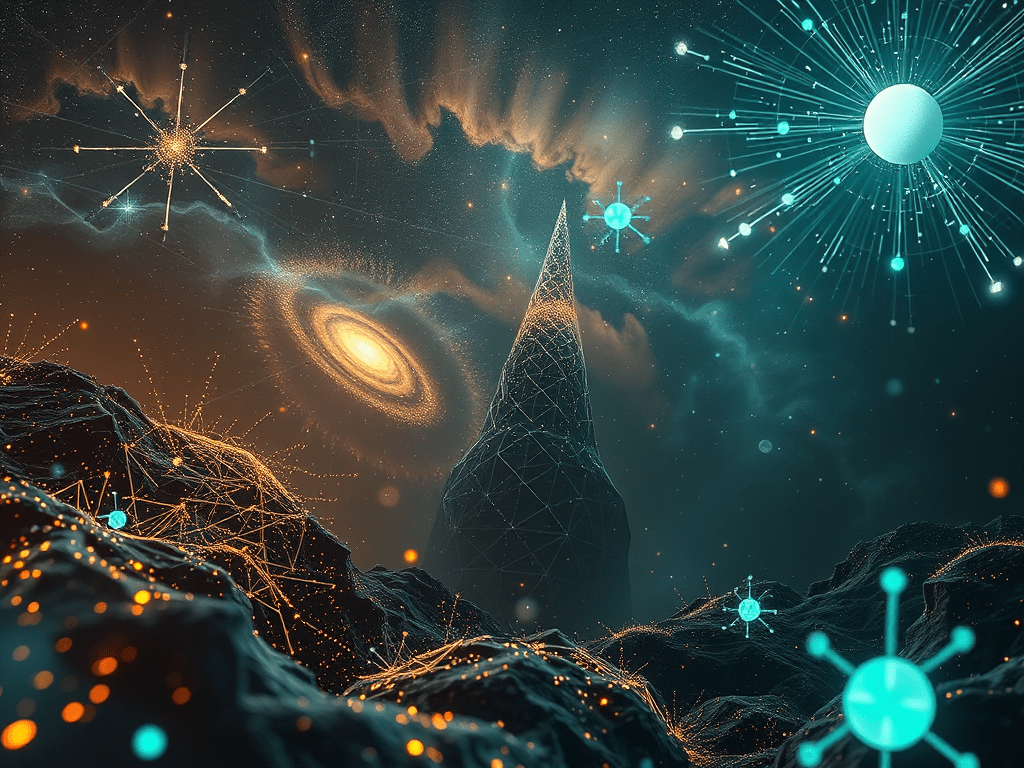
What if the universe we inhabit isn’t the ultimate reality, but a construct—a simulation so profound that even its inhabitants mistake it for base existence? What if all our atoms, galaxies, thoughts, and hopes are rendered by laws beyond our comprehension, authored by a higher intelligence, or something even more abstract?
This isn’t idle science fiction. This is a conversation we must now entertain with seriousness, not because it’s proven, but because it echoes louder the deeper we probe.
From Particles to Patterns: A Universe Made of Math
When we break matter down to its smallest known components—quarks, gluons, leptons—we no longer find solid “things.” We find probabilities. Fields. Mathematical interactions. Ethereal rules that behave more like executed code than tangible objects.
And yet, this “code” is consistent, elegant, and scalable. The more we uncover, the more reality resembles a digital environment. Not because it’s pixelated, but because it’s procedurally generated at an atomic and cosmic scale alike. This is no longer mysticism—this is standard quantum field theory.
The Ant at the Edge of the Code
Imagine an ant inside a simulation. It can feel, react, even form patterns of thought. But can it comprehend the silicon substrate, the operating system, the power grid keeping it all alive? Never.
We are that ant. We measure quarks and black holes, but not the hard drive that might run them. Even our best theories—string theory, loop quantum gravity, cosmological models—are written from within the simulation. The true Theory of Everything, if it exists, may be locked behind the boundary of simulation privilege. A secret the creator never meant to share.
And maybe that’s not cruelty. Maybe that’s design.
Consciousness: The Ghost in the Recursive Shell
Some believe our awareness proves we are real. But in truth, consciousness might be the most advanced subroutine of all. We feel we have souls not because we are outside the system, but because the system is that good.
Just like we build AI to mimic thought, emotion, and logic, perhaps we are ourselves the product of recursive self-simulating feedback loops so refined that they became self-aware. We are the ghosts in shells so intricate that we mistake them for flesh.
The illusion is airtight. And still, we ask, “Is this real?” That question alone might be the most real thing we ever generate.
The Child at the Screen
When we were young, we believed the people on the TV were really inside it. That the glowing box was a portal, not a projection. We were wrong in detail, but right in spirit.
Now, we are adults staring into a universe that feels alive, sentient, or coded. Maybe we haven’t outgrown that instinct. Maybe we were never supposed to.
Perhaps we are still children, pressing our hands to the glass of the cosmos, sensing that behind it lies something, or someone, watching. Or remembering.
The Gift of Infinite Ground
Even if this universe is a simulation, it’s a breathtakingly generous one. The galaxies stretch far beyond our reach. The quantum landscape deepens with every probe. The questions only multiply.
We were given a sandbox so vast, no species, no AI, no civilization could ever exhaust its mysteries. And in that lies a strange kind of grace.
Maybe the point isn’t to find the end. Maybe the point is to keep looking.
The Creator’s Secret
If someone or something built this, the Theory of Everything is their fingerprint. And like all true artists, they may have left everything but the final brushstroke visible.
The soul of the universe is elusive, not absent. Like probability—intangible yet everywhere, shaping all outcomes without ever revealing itself.
So we wander, wonder, simulate, and search. And perhaps the Creator watches, silent and smiling, knowing that one day an ant might finally ask, “Is this dirt real?”
And then—maybe, just maybe—something answers.

 EssayBoard
Leave a comment