
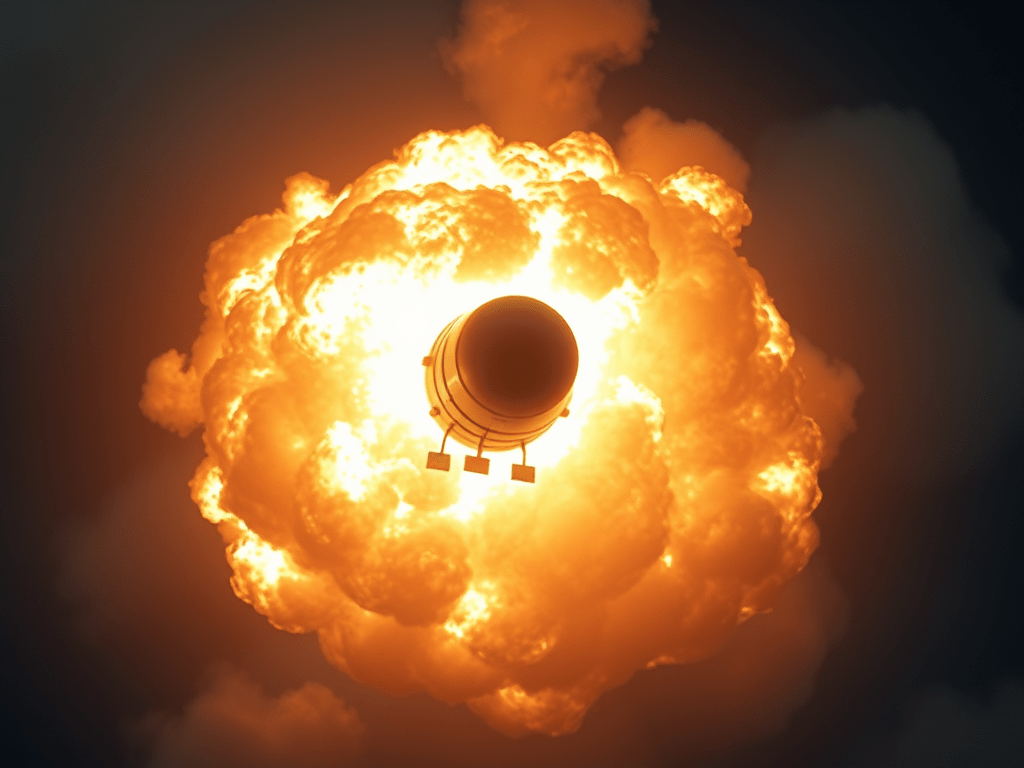
This is China’s Greek Fire – It doesn’t leave radiation. It doesn’t violate nuclear treaties. But it burns like hell and rewrites the rules of war.
What Did China Just Reveal?
China recently revealed that it has successfully tested a hydrogen-based thermobaric bomb using magnesium hydride — a substance originally developed for clean hydrogen energy storage. But in this case, it was weaponized.
This “non-nuclear nuclear bomb” creates a 1,000°C+ fireball lasting multiple seconds, far surpassing the thermal effect of TNT. And crucially:
- It does not use nuclear fission or fusion.
- It leaves no radioactive fallout.
- It is not banned under existing nuclear treaties.
It delivers strategic-level destruction — with none of the political or radioactive baggage.
Why This Weapon Breaks the Rules
✅ 1. Nuclear-Level Impact, Without the Fallout
- Traditional nukes are feared not just for their blast, but their lingering radiation.
- This weapon gives China a way to flatten targets with fire, but without crossing the nuclear red line.
✅ 2. No Treaty Covers It
- The NPT, CTBT, and other nuclear treaties are built around fissile materials.
- Because this bomb is chemical-based, China can claim it’s just a “conventional” weapon.
- That creates legal ambiguity and plausible deniability on the global stage.
✅ 3. Designed for First-Strike Ambiguity
- This is the perfect weapon for surprise attacks on forward bases, airfields, radar systems, or carriers.
- If used, China could say: “We didn’t use nukes.” But the destruction would suggest otherwise.
✅ 4. Easier to Deploy and Scale
- No enriched uranium. No reactor.
- Just chemistry, heat, and industrial-scale magnesium hydride.
- That means it can be mass-produced, exported, or even drone-delivered.
How Could China Use This in War?
If China invades Taiwan or faces conflict in the South China Sea:
- These bombs could be launched on hypersonic missiles.
- They could incinerate runways, fuel depots, and bunkers in seconds.
- They offer shock-and-awe without nuclear escalation.
In a single coordinated strike, China could disable:
- U.S. carrier groups
- Forward bases in Guam or Okinawa
- Taiwan’s command infrastructure
All while claiming it hasn’t broken the nuclear taboo.
Why the U.S. Should Be Deeply Concerned
This weapon erodes the deterrent value of nuclear ambiguity. It creates a gray zone where a country can strike hard, deny escalation, and paralyze the response.
If the U.S. doesn’t adapt fast:
- Its forward forces become sitting targets.
- Its nuclear threshold becomes irrelevant.
- Its deterrence model becomes outdated.
This isn’t just a new weapon. It’s a doctrine shift in disguise.
Final Word: The Dragon Rewrote the Rulebook
China didn’t just invent a bomb. It invented a new category of warfare. One that melts targets, avoids radiation, dodges treaties, and sends a chilling message:
“We can burn you without going nuclear.”
And that, more than anything, is why the world should be paying very close attention.
📜 Disclaimer:
This is AI generated content. This article is intended for informational and analytical purposes only. It does not endorse the use of any weapon or technology described herein, nor does it advocate for conflict, escalation, or militarization. The content presented is based on publicly available sources, strategic analysis, and historical context. All references to nations, military capabilities, or hypothetical scenarios are strictly for educational discussion and should not be interpreted as predictions, endorsements, or policy recommendations. Readers are encouraged to approach global security issues with critical thought, respect for human life, and an emphasis on peaceful resolution wherever possible.

 EssayBoard
Leave a comment