
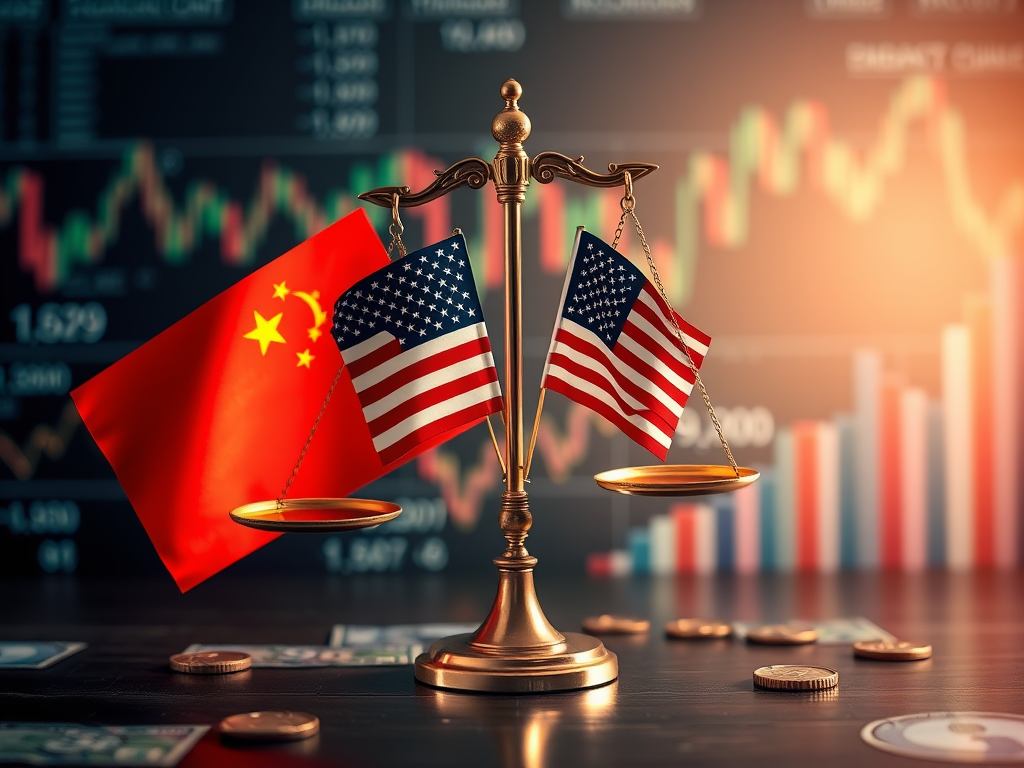
In the latest chapter of the ongoing U.S.–China trade saga, Beijing has responded to Washington’s sweeping 104% tariff on Chinese imports by imposing an 84% retaliatory tariff on American goods. While the headline figure is striking, a deeper analysis reveals that China’s move is largely symbolic—a calculated show of strength aimed at preserving national pride and negotiating leverage, all while carefully avoiding a full-blown economic rupture.
The Symbolic Power of the 84% Tariff
A Show of Defiance Without Self-Sabotage
Rather than launching an all-out economic attack, China’s 84% tariff represents a targeted, symbolic gesture. Here’s why:
- Political Messaging:
The tariff signals Beijing’s defiance in the face of U.S. trade pressure. It plays well domestically, strengthening internal support and showcasing China’s unwillingness to be cornered on the global stage. - Selective Impact:
The tariffs focus on specific U.S. imports, carefully avoiding broad disruptions—especially to U.S. firms that manufacture and operate within China. Apple, Tesla, and others remain largely unaffected because their Chinese operations serve local consumers and are embedded in the Chinese economy. - Avoiding Escalation:
China is flexing just enough to maintain face while preserving economic stability. This calibrated approach avoids triggering an uncontrollable decoupling that could destabilize both nations—and the global economy.
Strategic Nuances: Who Really Gets Hit?
U.S. Importers vs. U.S. Companies Operating in China
A critical asymmetry is now clear:
- U.S. importers that rely on low-cost Chinese goods (e.g., Walmart, Home Depot, Sam’s Club) face direct cost increases due to the 104% U.S. tariff and China’s 84% retaliation.
- U.S. companies with production inside China are largely insulated. Their goods sold to Chinese consumers don’t face these new tariffs, allowing them to operate as usual—even as political tensions escalate.
This means that the real economic pain is landing squarely on U.S. retailers, small businesses, and consumers—not on U.S. corporations operating inside China, nor on Chinese producers themselves.
The Rare Earth Factor: Quiet, Strategic Pressure
In tandem with the tariffs, China has expanded its ban on rare earth mineral exports—a crucial resource for defense systems, semiconductors, and clean tech. Though less visible than tariffs, this move carries immense strategic weight. By restricting select rare earths, China sends a clear signal that it holds real leverage over high-tech supply chains, applying pressure without overt confrontation.
Where Does the Tit-for-Tat Go From Here?
Short-Term Impacts
- Consumer Costs:
U.S. consumers will likely see prices rise—particularly at retailers dependent on Chinese goods. Everyday items like clothing, electronics, tools, and home goods could all face inflationary pressure. - Market Uncertainty:
Financial markets remain jittery as investors react to the trade war’s escalation. The risk of further retaliation or policy surprises is now a persistent concern.
Medium-Term Possibilities
Negotiation and Adjustment
Both nations may eventually return to the negotiating table, recognizing that a full-scale trade war benefits no one. Temporary easing, carve-outs, or phased tariff adjustments could follow once economic and political pressures build.
Supply Chain Diversification
Some U.S. companies may attempt to diversify supply chains away from China in pursuit of long-term resilience. However, U.S. tariffs on countries like Mexico, Canada, and Vietnam complicate this strategy. These blanket measures—meant to protect U.S. industries—may deter diversification by undermining the economics of friend-shoring.
As a result, many companies may choose to remain in China, seeing it as the lesser of two unpredictable environments. China offers scale, efficiency, and a stable industrial ecosystem. In contrast, U.S. trade policy often shifts with each political cycle, making long-term planning for alternate supply chains a risky bet.
Long-Term Projection: Interdependence Under Pressure
Selective Decoupling Has Begun
While a total and immediate U.S.–China economic decoupling remains unlikely, the early stages of a selective decoupling are clearly underway:
- Strategic industries such as semiconductors, AI, and green energy are seeing policy-driven realignment and investment flow toward domestic or allied production.
- Some U.S. companies are slowly building some capacity in India, Vietnam, and Mexico, while China accelerates self-sufficiency efforts to reduce reliance on Western technologies.
Rather than a sudden break, this is a phased separation—driven more by national security and great-power competition than by market logic.
At the same time, the “tit-for-tat” posture is likely to continue, with tariffs, export bans, and sanctions serving as diplomatic pressure tools rather than decisive economic weapons.
Policy Shifts and Future Adjustments
Future U.S. administrations—Democratic or Republican—may recalibrate trade strategies depending on electoral pressure, global events, or domestic economic conditions. The ultimate goal for both Washington and Beijing may be to strike a new equilibrium: one that secures national interests without derailing global stability.
Conclusion
China’s 84% retaliatory tariff, along with its expanded rare earth restrictions, is a symbolic yet strategic response in a rapidly evolving trade war. It targets American vulnerabilities, protects domestic strengths, and avoids a full collapse of economic interdependence.
Meanwhile, U.S. companies and consumers face complex ripple effects—rising costs, limited supply chain alternatives, and a shifting policy landscape that offers little long-term clarity. The early signs of strategic decoupling are unmistakable, even as both sides continue to posture and push back.
As the U.S. and China maneuver through this high-stakes economic chess match, the global economy remains suspended between cooperation and confrontation, integration and fragmentation.
Disclaimer
This is AI generated content. The opinions and views expressed in this blog post are provided for informational and entertainment purposes only. They do not constitute financial, legal, or business advice. The analysis contained herein is speculative and based on hypothetical scenarios regarding current trade policies and market conditions, which are subject to rapid change. Readers should not rely on this information as a basis for any decision and are encouraged to consult qualified professionals before making financial or business decisions. Neither the author, the publisher, nor any affiliated parties will be held liable for any financial losses or other damages arising from the use or reliance on the information presented in this post. Use this information at your own risk.

 EssayBoard
Leave a comment