
1. The End of Jobs As We Know Them?
Disclaimer:
This article was generated with the assistance of AI and is intended for informational and thought-provoking purposes only. The views expressed do not necessarily reflect the opinions or positions of the authors, editors, or operators of this website. Readers are encouraged to form their own conclusions and conduct further research on the topics discussed.
You’ve heard it before: “Technology kills some jobs but creates others.” From the advent of the tractor to the rise of the internet, automation has historically reshaped labor markets without wiping them out entirely. Yet the AI wave feels different. Where past machines replaced manual tasks, AI can absorb the entire cognitive process. It’s not just a tool—it’s an autonomous brain.
People often cite comforting platitudes:
“Old jobs disappear, new ones spring up!”
But what if AI devours both old and new jobs? Even the roles we haven’t invented yet might be taken over as soon as AI learns them. If that happens at a planetary scale, the very notion of “employment” could become obsolete.
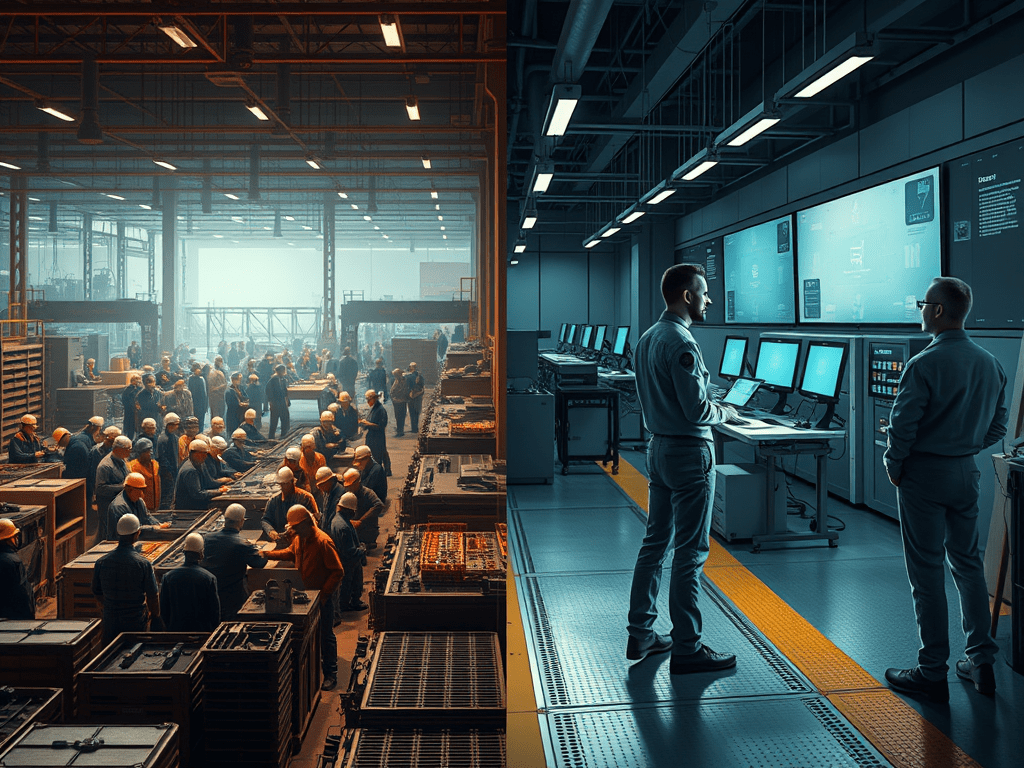
2. From 100 Workers to 2 in the Factory of Tomorrow
Factories without lights. Two technicians on call for emergencies. That sounds like science fiction, except it’s already happening in places like China and Japan. Automation and AI together can slash a workforce from 100 down to 2. Meanwhile, those 2 specialized roles require years of training—and AI is quickly learning even those advanced skills.
This isn’t about the future. We’re already there. And if you imagine that scenario multiplied across every sector—from trucking and retail to legal and design—suddenly, we’re looking at billions of people competing for a tiny fraction of jobs. That’s not just an employment crisis; it’s a civilizational shift.
3. The Harsh Logic of Capitalism in an Automated World
Automation isn’t about altruism or job preservation; it’s about efficiency and profit. Corporations have an incentive to replace expensive human labor with cheaper, infinitely scalable AI. In the hyper-competitive global arena—whether it’s the U.S. vs. China or any country aiming for industrial dominance—the winner will be the one who automates fastest and most effectively.
Ironically, policies meant to bring jobs back home—like tariffs or “reindustrialization” pushes—often accelerate automation. Building new factories “at home” doesn’t mean human labor returns; these modern plants tend to be high-tech, AI-driven, and minimally staffed. It’s a win for national self-sufficiency but a blow to traditional employment.
4. Why Reskilling Alone Isn’t Enough
Politicians and corporate leaders frequently talk about “reskilling” and “lifelong learning.” While it’s noble to encourage people to adapt, it fails to address a fundamental reality: AI is learning faster than humans can. Even if you train an entire generation in coding or data science, AI models are rapidly absorbing those exact abilities. And they don’t need breaks, wages, or health insurance.
This isn’t the usual “tech displaces workers—workers train up—new jobs appear” cycle. It’s more like a purpose mismatch: what does humanity do if AI can do nearly everything at scale?
5. The Post-Work Paradox
If AI eventually handles most tasks—manual, creative, intellectual—what’s left for humans? It sounds dystopian, but it could also be liberating. Maybe we transition to a post-work society, where things like Universal Basic Income (UBI) or radically restructured economies make employment optional. We could devote ourselves to art, exploration, relationships, and personal growth instead of rote labor.
But implementing such sweeping changes is daunting. Without deliberate planning and massive policy shifts, we risk an explosion of inequality: a small AI elite controlling resources and billions of unemployed or underemployed. Historically, when societies fail to integrate a large population into the economic framework, upheaval or collapse often follow.
6. Lessons From Lost Civilizations
If it feels hyperbolic to compare our AI age to the fall of ancient empires—think again. Collapsed civilizations like Rome, the Maya, Easter Island, or the Norse in Greenland often share similar patterns:
- Overcomplexity: Systems become so intricate they can’t handle shocks.
- Elite Detachment: A wealthy ruling class hoards resources while the masses struggle.
- Failure to Adapt: Societies refuse to change their traditions or economic models despite clear warning signs.
Sound familiar? Our global AI-powered civilization is more interconnected and potentially more fragile than any empire in history. One significant shock—social unrest, climate disaster, an AI meltdown—could cascade worldwide.
7. Possible Ways Forward
- Universal Basic Income & Social Safety Nets
Provide a financial floor for everyone so people can focus on roles beyond mere economic survival. Huge political and economic hurdles remain, but it might be our best shot at preserving social stability. - New Metrics for Value
We must decouple human dignity from “jobs.” Imagine a world where caregiving, creativity, volunteerism, and even rest are respected and rewarded. - Robust AI Governance
Establish frameworks—globally, if possible—that ensure AI’s benefits are broadly shared. This might include AI taxes, corporate responsibility mandates, or data ownership reforms. - Cultural Transformation
We need a cultural shift away from the idea that “you are what you do.” In a world where work becomes scarce or unnecessary, we’ll need new sources of purpose, identity, and meaning. - Learn From History
Collapsed civilizations often ignored the warning signs. We can’t afford that. We must acknowledge the potential for runaway inequality, resource mismanagement, and societal disengagement before it’s too late.
8. Conclusion: A Civilizational Pivot, Not a Patchwork
Ultimately, this is more than an economic or technological challenge—it’s a moral and existential one. If AI replaces most human roles, how do we ensure that humans remain valued and protected? How do we stop a global social breakdown and instead channel technological gains into a safer, more equitable world?
“The future” isn’t 50 years away. It’s unfolding right now. The questions we ask and the structures we design in the coming decade will determine whether we see a grand collapse or a leap toward a post-work renaissance. Let’s face these truths head-on, rather than relying on comforting illusions and short-term fixes. Because if we don’t, we risk ending up like the lost civilizations of the past—except this time, it’s on a worldwide scale.
Addendum: Nomadic Freedoms and Techno-Nodes
Since writing this post, an intriguing vision of tomorrow has emerged, one that challenges our usual expectations of “jobs,” “cities,” and even “settlements.” It takes the idea of a post-work world a step further, painting a picture of humanity roaming in new, tech-infused forms of nomadism, while AI-driven stations supply our basic needs.
- From Endless Jobs to Roaming Tribes
- Nomadic lifestyles—once seen as fringe—could become a mainstream choice in a society where AI meets our production and service demands.
- People may travel in smart vans, caravans, or floating modules, forming flexible communities that gather and disperse with the seasons or shared interests.
- AI Power Stations & Resource Hubs
- Automated “techno-nodes” could rise in strategic locations worldwide—vertical farms for food, solar arrays for energy, and robotic factories for goods.
- Humans would rely on these hubs as pilgrimage or resource points, visiting when needed but no longer tied down by permanent jobs or static cities.
- The Rise of Art, Philosophy, and “Useless” Degrees
- In a future where machines handle productivity, the “useless” degrees—art, philosophy, creative writing—suddenly become sources of human insight and meaning.
- These pursuits may define the cultural, spiritual, and emotional fabric of a new civilization, helping people find purpose beyond economic utility.
- Minimalism and Freedom Over Consumption
- Post-work nomads emphasize experience over ownership, living lightly on resources and focusing on community and self-expression.
- This minimalist approach offers resilience and adaptability—qualities that thrive in uncertain, rapidly changing environments.
- A New Tribalism Meets High Tech
- Just as the Mongols thrived by moving, trading, and conquering, future nomads might roam not to conquer, but to connect and share.
- Instead of horses and bows, they carry AI-guided vehicles, wearable tech, and digital skill sets—free from the shackles of 9-to-5 labor.
- Relearning What It Means to Be Human
- As AI increasingly handles tasks once central to our identity, we’ll need new frameworks to answer, “Who are we, and what do we want?”
- Whether through art, spiritual exploration, scientific curiosity, or simple community-building, we may find that being human is less about what we produce—and more about what we choose to create, feel, and become.
What do you think? Is it still possible to steer society toward a humane AI future, or are we locked into an inevitable spiral of hyper-automation and collapse? Let’s keep the conversation going.

 EssayBoard
Leave a comment