
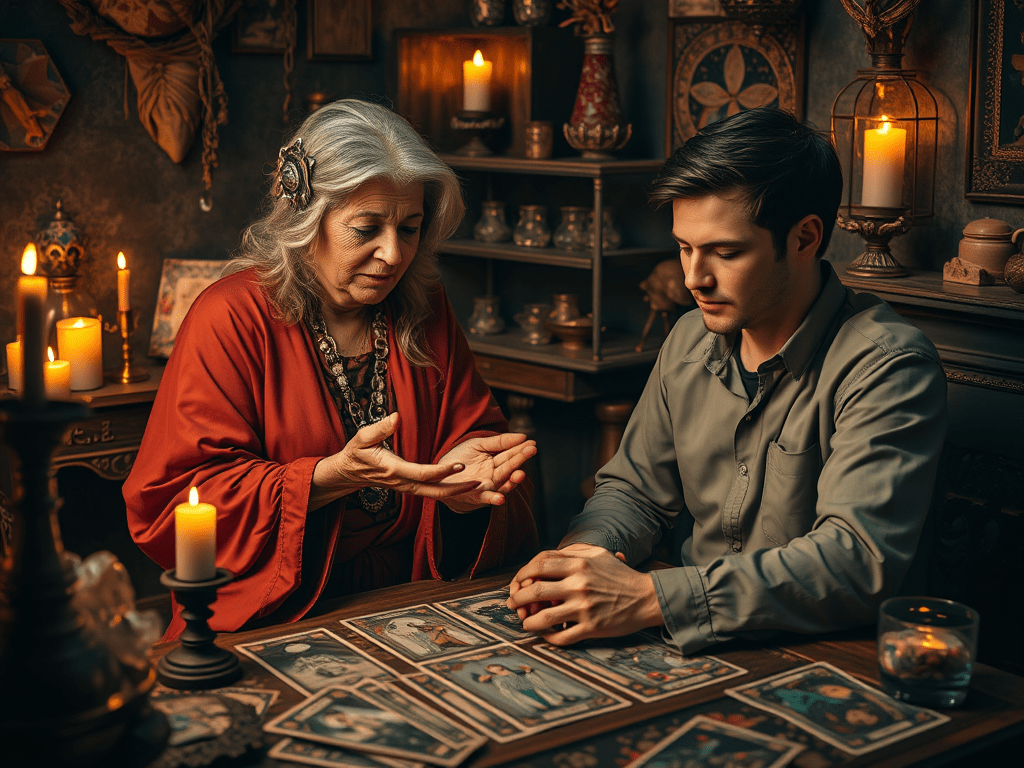
Disclaimer: This content is AI-generated for entertainment purposes only. It is not intended to be taken as realistic or predictive, and should not be used as a basis for any important life decisions. The ideas and techniques described here are presented purely for creative exploration and fun. Always consult qualified professionals for serious advice or guidance.
Introduction: Fortune telling has fascinated people for millennia. Across different cultures and eras, many systems of divination emerged – from reading tarot cards and celestial charts to interpreting palms and tea leaves. In an entertainment context, these practices serve as engaging experiences, blending symbolism, storytelling, and psychology. This guide explores major fortune telling traditions, their history, symbols, and how performers use them for fun, not prediction, highlighting showmanship techniques and ethical best practices.
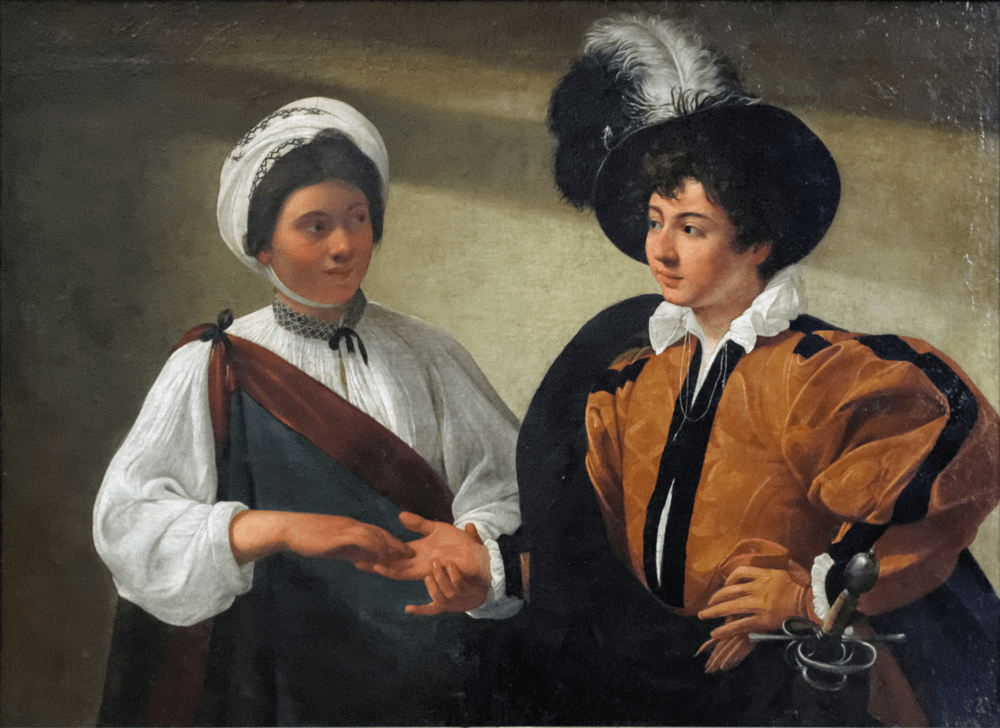
Figure: A 16th-century depiction of a fortune teller reading a young man’s palm (Caravaggio’s The Fortune Teller, 1594). Such imagery reflects the longstanding cultural fascination with divination and the mystique surrounding it.
Major Fortune Telling Traditions & Systems
Below we cover major fortune telling systems – their historical roots, cultural evolution, key symbols, and how they are commonly practiced for entertainment today. Each tradition has its own set of tools and interpretation techniques that fortune tellers use to craft engaging readings.
Tarot Card Reading (Taromancy)
- Origins & History: The tarot began as a card game in Renaissance Italy (15th century) and was not originally intended for divination (Before Fortune-Telling: The History and Structure of Tarot Cards – The Metropolitan Museum of Art). Early tarot decks (e.g. Visconti-Sforza deck) were lavishly illustrated playing cards with trump cards for gaming (Before Fortune-Telling: The History and Structure of Tarot Cards – The Metropolitan Museum of Art). The use of tarot for fortune telling and occult purposes became popular only in the 18th–19th centuries, driven by mystics like Antoine Court de Gébelin in France. By the 19th century, tarot cards had firmly transitioned from a parlor game to a tool of divination in Europe. Modern tarot reading as we know it (Rider-Waite-Smith deck, etc.) took shape in the early 20th century under the influence of occult societies.
- Deck Structure: A standard tarot deck has 78 cards, divided into:
22 Major Arcana – archetypal trump cards like The Fool, The Lovers, Death, The World, etc., often seen as representing major life themes or spiritual lessons.
56 Minor Arcana – four suits (traditionally Cups, Pentacles (Coins), Swords, Wands) similar to playing cards (Before Fortune-Telling: The History and Structure of Tarot Cards – The Metropolitan Museum of Art). Each suit has cards Ace through 10 and four Court Cards (Page, Knight, Queen, King). The suits have elemental associations: Cups (water/emotions), Pentacles (earth/material life), Swords (air/intellect/conflict), Wands (fire/creativity/ambition). - Symbolism & Reading Technique: Tarot reading is highly symbolic. Readers shuffle and lay out cards in a pattern called a spread. A popular example is the Celtic Cross spread, which uses 10 cards in positions signifying factors like past influences, future possibilities, one’s attitude, and external influences. Each card’s meaning is interpreted in context. For example, The Tower card (a falling tower struck by lightning) often symbolizes sudden upheaval or revelation, whereas The Sun card indicates clarity and optimism. During readings, fortune tellers weave a story from the cards: e.g. drawing The Devil might be explained as confronting one’s inner fears or breaking unhealthy attachments, not a literal devil. The interpretation is flexible, allowing the reader to tailor the message to the querent’s life with creative storytelling.
- Entertainment Use: Tarot’s rich imagery makes it a crowd favorite at fairs and parties. Performers often encourage participants to pick a few cards and then deliver an improvised but insightful reading. The mystique of the cards (ancient symbols, exotic artwork) engages the imagination. Readers may use a bit of theatrical flair – slowly turning cards over, reacting dramatically (“Ah, the Wheel of Fortune – change is in the air!”) – to entertain. Because tarot cards are so open to interpretation, they are ideal for giving positive spins or thought-provoking advice without making concrete predictions (e.g. focusing on “personal growth” indicated by Death meaning transformation rather than any morbid outcome). This keeps the reading fun and uplifting.
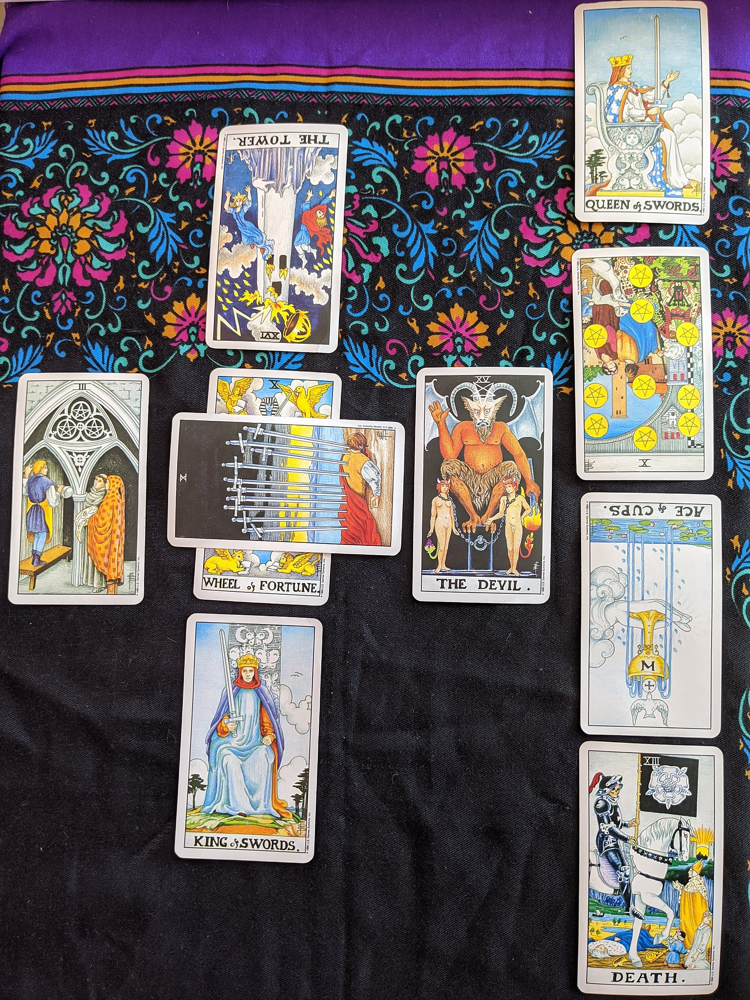
Figure: Example of a tarot spread (Celtic Cross). Cards like The Tower (seen reversed at top) or The Devil carry specific symbolic meanings (upheaval and confronting inner shadows, respectively), which the reader interprets in relation to the seeker’s question. In entertainment readings, the reader highlights such symbols to craft an intriguing narrative. (image source: https://commons.wikimedia.org/wiki/File:Celtic_Cross_Tarot_Spread.jpg)
Astrology (Western & Eastern)
- Origins & History: Astrology is one of the oldest divinatory systems, rooted in ancient peoples’ observation of the skies. Western astrology traces back to Mesopotamia (19th–17th century BCE), where Babylonians correlated celestial movements with earthly events. It spread to Greece and Rome; the Hellenistic Greeks (c. 2nd century BCE) developed the zodiac of 12 signs and the concept of natal horoscopes. The astronomer Ptolemy in the 2nd century CE codified astrological theory in his Tetrabiblos, which became the foundation of Western astrology. Astrology was studied as a scholarly discipline through the Middle Ages (often alongside astronomy) and used by rulers for guidance. After a decline during the Enlightenment, astrology resurged in popular culture in the 20th century (e.g. daily newspaper horoscopes).
- Western Astrology Basics: Western astrology uses the tropical zodiac – 12 signs based on the position of the Sun over the year (Aries through Pisces). It interprets the positions of the Sun, Moon, and planets at the exact time of a person’s birth (their birth chart) to infer personality traits and life tendencies. Each zodiac sign is associated with personality archetypes (e.g. Leo – dramatic and confident; Virgo – analytical and modest). The birth chart is divided into 12 houses, each governing an area of life (identity, finances, communication, home, etc.). The interplay of planets (like Venus symbolizing love, or Mars symbolizing drive) in specific signs and houses forms the basis of astrological interpretation. For entertainment, most casual astrology focuses on the Sun sign (the sign the Sun was in at birth) – hence the common horoscopes saying “If you’re a Gemini, expect surprises this month,” which are broad and fun. Professional astrologers might do a full chart reading for deeper insight, but in an event setting this may be simplified to quick sign-based readings for brevity.
- Eastern Astrology: Many cultures have their own astrological traditions. A notable one is the Chinese zodiac, which assigns an animal sign to each year in a 12-year cycle (Rat, Ox, Tiger, …, Pig). According to Chinese tradition (firmly in place by the Han Dynasty, ~2nd century BCE), people born in a given year share characteristics of that year’s animal. For example, someone born in the Year of the Dragon might be considered ambitious and charismatic. The Chinese zodiac also cycles through five elements (wood, fire, earth, metal, water), creating a 60-year elemental-animal cycle that adds nuance. Eastern astrology is often consulted during festivals (e.g. Lunar New Year) or for fun compatibility checks (“Will a Dragon and a Monkey get along?”). Indian (Vedic) astrology is another major system (with 12 signs similar to Western but calculated sidereally, and a rich tradition of its own), though in entertainment contexts the Indian system is less commonly used unless within related cultural communities.
- Symbolism & Entertainment Use: Astrology’s symbols are the zodiac signs and planets, often depicted by familiar glyphs (♈︎ for Aries, ♀ for Venus, etc.). In an entertainment setting, an astrologer might ask for someone’s birthday and give a quick personality sketch: “Ah, a Taurus! As an earth sign ruled by Venus, you probably appreciate comfort, good food, and stability.” Such statements leverage the Barnum-like descriptions astrology is famous for – general but flattering traits that many feel resonate (see Barnum Effect in the Psychological Techniques section). Astrology booths at events sometimes create natal chart printouts as souvenirs, or use compatibility tables to match couples for fun. The key is to keep it light and relatable, focusing on positive aspects (“your stars favor creativity”) and using the mysterious allure of the cosmos to spark the guest’s imagination. Even though astrology lacks scientific support, it remains hugely popular because it offers people entertaining insights about themselves in a symbolic language of stars and planets.
Palmistry (Palm Reading / Chiromancy)
- Origins & History: Palmistry – the study of the palm’s lines, mounts, and shapes to divine information – is ancient. It likely originated in India and spread throughout Eurasia in antiquity. Historical records suggest it was practiced in Hindu astrology (Jyotish) and incorporated into Chinese I Ching traditions. Greek philosophers, such as Aristotle, were aware of palmistry; a legend claims Aristotle found a treatise on palm-reading and presented it to Alexander the Great, who then examined his officers’ palms to judge character. During the Middle Ages, palmistry was periodically suppressed (viewed as superstition or even witchcraft), but it resurged in the Renaissance and especially in the 19th century when interest in the occult blossomed again. Victorian-era “cheiromants” like Cheiro (Count Louis Hamon) became famous for reading the palms of celebrities and heads of state, cementing palmistry’s place in fortune-telling entertainment.
- Symbols & Hand Features:“The lines of your hand tell a story.” In palmistry, the most commonly referenced lines are:
- Life Line: arcs around the base of the thumb. Contrary to myth, it doesn’t predict length of life but rather vitality and life changes (a deep life line indicates strong vitality; breaks or forks might suggest sudden events or lifestyle changes).
- Head Line: runs horizontally across the middle of the palm. It relates to intellect, mentality, and decision-making style (a straight head line could mean logical thinking, a curved or sloping line indicates creativity and intuition).
- Heart Line: curves below the fingers. It represents emotional life and relationships (a clear, deep heart line signifies openness and steady emotions; faint or broken heart line might suggest emotional struggles or openness issues).
- Fate Line: (if present) a vertical line in the center of the palm. It’s associated with one’s life path or career and how strongly fate influences it (deep fate line implies a strong sense of purpose or many externally driven events; a faint or missing fate line might mean a more free-willed life course).
- Other features: Mounts (fleshy pads under each finger, linked to planetary traits like Mount of Venus = love and passion, Mount of Saturn = discipline and wisdom), finger shapes, and even skin texture are considered. For instance, a firm hand with thick skin might point to a practical, down-to-earth person, whereas a soft, supple hand could belong to someone more sensitive or adaptable.
- Practical Technique: A palmist typically begins by choosing a hand to read. In some traditions, the dominant hand (the one you write with) shows your developed personality and current life, while the non-dominant hand reveals inherited traits or potential. The reader will often trace the lines with their finger (this tactile element can be engaging) and make observations: “Your head line and heart line are joined at the start – you tend to let your heart rule your head in youth, wearing your heart on your sleeve. But see how they separate? That shows growing independence of thought.” Such interpretations mix genuine traditional lore with the reader’s intuitive impressions.
- Entertainment Use: Palm reading is interactive and personal, making it a staple of carnival fortune tellers and street psychics. It requires no props beyond the person’s hand, allowing spontaneity. The reader often uses warm reading techniques – observing things like the client’s age, jewelry, or demeanor to tailor the reading. For example, seeing a wedding ring, the palmist might focus the heart line interpretation on married life. The language used is generally positive and open-ended: challenges are framed as opportunities (“This break in your life line doesn’t mean tragedy – it could be a great change where you reinvent yourself”), and strengths are emphasized (“See this strong Mars mount under your thumb? That’s your courage and fighting spirit”). Because people are naturally fascinated by themselves, a palm reading that validates their traits or offers gentle guidance can feel both entertaining and affirming.
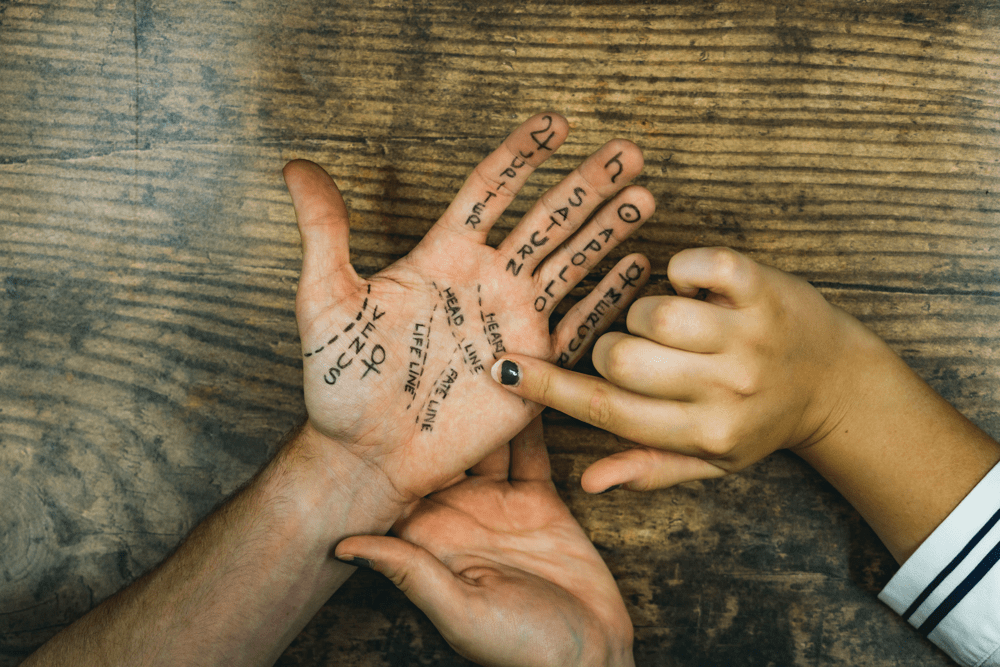
Figure: A fortune-teller examining a client’s left palm. Key palm lines are labeled: Life Line, Head Line, Heart Line, etc. In entertainment palmistry, these lines serve as prompts for the reader to discuss the subject’s personality and life themes (e.g. a long heart line might be playfully said to indicate “you love deeply and have great capacity for affection”).
Numerology
- Origins & History: Numerology is the study of numbers’ mystical significance in our lives – essentially assigning meanings to numbers and numeric values to letters (like a coded language of the universe). The idea that numbers hold divine meaning dates back to antiquity. The Greek philosopher Pythagoras (6th century BCE) is often cited as “the father of numerology” for his teachings that numbers have spiritual properties (Number symbolism – Pythagoreanism, Numerology, Mysticism | Britannica). Pythagorean followers believed, for example, that 1 represented creation, 2 the female principle, 3 the male, and so on, and that numbers combined to express relationships (e.g. 1+2+3+4 = 10, considered the most perfect number, symbolizing the harmony of creation) (Number symbolism – Pythagoreanism, Numerology, Mysticism | Britannica). Separately, Hebrew Kabbalah developed gematria, assigning numeric values to Hebrew letters and interpreting biblical words by their totals. Similar practices of alphanumeric divination existed in ancient China and elsewhere.
- Modern Numerology: In the early 20th century, the term “numerology” became popular in the West (prior to that it was often called arithmancy). Modern numerology often centers on a few key numbers derived from a person’s name and birth date. The most famous is the Life Path Number, calculated by summing one’s full date of birth and reducing to a single digit (for example, a birthdate of June 5, 1990 -> 6+5+1+9+9+0 = 30 -> 3+0 = 3). The result, 1 through 9 (or sometimes a master number like 11 or 22), is said to reveal one’s core personality and life direction. Other numbers include the Expression (or Destiny) Number from the full name, Soul Urge Number from vowels, etc. Each number has a character profile:
- 1: Leadership, independence, initiative (a “1” Life Path might be told “You’re a born leader, unafraid to go it alone”).
- 2: Partnership, diplomacy, sensitivity (“2” suggests you’re cooperative, a peacekeeper who values relationships).
- 3: Creativity, self-expression, sociability (3s are often described as charismatic communicators).
- 4: Stability, practicality, hard work (4 is steady, organized, the builder of foundations).
- 5: Adventure, freedom, change (5s are free spirits who thrive on variety).
- 6: Nurturing, responsibility, family (6 indicates a caring, service-oriented nature).
- 7: Intellectual, introspective, seeker of truth (7s are analytical, spiritual, a bit mysterious).
- 8: Ambition, power, material success (8 is associated with business acumen and worldly achievement).
- 9: Humanitarian, compassionate, idealistic (9s are generous and concerned with the greater good).
- Entertainment Use: Numerology appeals because everyone has important numbers (birthdays, lucky numbers, etc.). In an entertainment setting, a numerologist might do quick calculations for guests. It’s common to use a chart or notepad to show how their name converts to numbers (A=1, B=2, etc.) and then summarize the findings. For example: “Your name adds up to 33, which reduces to 6 – the number of the caregiver. No surprise you’re the one friends turn to for help!” These readings often use the Forer effect – providing agreeable statements that feel personal (e.g. “you have a lot of untapped potential” – which applies to almost everyone). Numerology also lends itself to simple predictions or advice: a personal year number might be calculated (by combining current year with birth date) to tell someone the “theme” of the year (1-9 cycle of beginnings through completion). Because it’s math-based, numerology can come across as more “scientific” or structured to clients, which adds intrigue. The entertainer can enhance this by acting as if decoding a secret formula of the universe, giving the session a “mystery solving” vibe.
Runes and Rune Casting
- Origins & History: Runes are characters of ancient alphabets used by Germanic and Norse peoples. The most commonly referenced set is the Elder Futhark (24 runes), in use from roughly 100–800 CE in Northern Europe. These symbols were letters, but also held symbolic names and meanings. According to Norse mythology, the god Odin discovered the runes by enduring a mystical ordeal (hanging on the World Tree), thus bringing their wisdom to humanity. Historically, there is evidence (from the Roman writer Tacitus, 1st century CE) of Germanic tribes casting lots inscribed with symbols (likely early runes) for divination. In the Norse sagas, runes were used not only for writing but for magic spells, protective charms, and prophecy. The use of runes for fortune telling largely died out with Christianization, but it was revived in the 20th century under the influence of neopagan and occult movements. Today, rune casting is popular in modern pagan (Heathen/Wiccan) communities and as an alternative to tarot in New Age shops.
- Rune Set & Meanings: A typical rune set for divination consists of 24 stones or wood pieces, each engraved with a rune symbol (sometimes a blank rune is included as a modern addition symbolizing the “unknown” or free will). Each rune has a name and core meaning. For example:
Fehu (ᚠ) – Literally “cattle/wealth.” Symbolizes prosperity, abundance, material gain, but also cautions to manage resources wisely (cattle were a measure of wealth, so Fehu can mean earned income or reward (Number symbolism – Pythagoreanism, Numerology, Mysticism | Britannica)).
Uruz (ᚢ) – “Aurochs (wild ox).” Stands for strength, endurance, raw power – it can mean health and vitality or a challenge requiring courage.
Ansuz (ᚨ) – “God/Odin.” Represents communication, wisdom, divine inspiration – could indicate receiving important advice or messages.
Gebo (ᚷ) – “Gift.” Signifies giving and partnerships, often interpreted as love or sacrifice leading to reward (a balance of exchange).
Algiz (ᛉ) – “Elk.” A rune of protection, suggesting safe refuge or a need to defend oneself; looks like a crow’s foot, often seen as reaching for higher protection.
Dagaz (ᛞ) – “Day.” Symbolizes breakthrough, hope, daylight after darkness, major life shift or enlightenment. Each rune can also have a reversed or merkstave interpretation (if it lands upside-down or face-down, etc.), often indicating a blockage or opposite energy (e.g., upright Algiz = protection, reversed Algiz = vulnerability). - Casting Technique: Rune casting is typically done by randomly picking runes from a pouch or casting (tossing) them onto a cloth. There are various spreads/patterns – one simple method is to draw three runes for “past-present-future” insights. Another is casting all runes and reading those that fall face-up, noting clusters or positions (some use a cloth with a circle representing the present and outside the circle as future influences, for instance). The reader then interprets the symbols in context. For example, if someone asks about a new job prospect and draws Algiz, Fehu, and Raidho (raidho ᚱ means “journey”): the reader might say “You are protected in this transition (Algiz) and it does promise material gain (Fehu). Raidho suggests this job could involve travel or a significant journey – perhaps a metaphorical journey of personal growth in your career.”
- Entertainment Use: Runes, like tarot, offer visual intrigue – often carved on pretty stones or wood, they invite curiosity. A rune reading session might start with the entertainer explaining briefly that these symbols are ancient and magical, piquing interest. Because most people are less familiar with runes than tarot cards, the reader has freedom to spin the meanings without the client having preconceived notions. The performer can draw parallels to common experiences: “The rune Uruz is like the strength card in tarot – it tells me you have the raw energy to tackle obstacles.” This helps the audience relate. Rune casting can be done quickly (a single rune “draw of the day”) or in a longer format. It often feels like a game of chance – pulling stones from a bag – which adds to the entertainment. Also, the tactile act of handling stones and the clatter they make when cast can be engaging in a live setting. As with other methods, the rune reader uses broad interpretations and positive framing. Even if a rune with challenging meaning appears (like Hagalaz ᚺ, meaning disruption or “hail”), it can be turned into advice: “Hagalaz indicates an unexpected storm – maybe not everything will go according to plan, but remember, storms pass and fresh growth follows.” The key for entertainment is to use the aura of Viking mystery and runic magic to captivate the audience, delivering a fun and insightful experience rather than a grim prophecy.
I Ching (Yi Jing) – The Book of Changes
- Origins & History: The I Ching is an ancient Chinese divination system and text, dating back over 3,000 years (traditional legends attribute it to the mythic emperor Fu Xi and later contributions by King Wen and Confucius). It centers on 64 hexagrams – six-line symbols each associated with a philosophical commentary. The hexagrams are generated by random processes (historically by casting yarrow stalks, later by tossing coins). Each hexagram (two trigrams combined) corresponds to a chapter in the I Ching text, which offers poetic guidance about the situation at hand. The I Ching was used in China both in royal courts and by common folk to seek advice on personal matters. In the West, it gained popularity in the 19th–20th centuries; by the 1960s it was embraced by the counterculture as a tool for introspection, aided by influential translations. (Notably, psychologist Carl Jung wrote a foreword to a famous I Ching translation in the 1950s, exploring its use as a method of tapping the collective unconscious.)
- Symbolism & Method: The core of I Ching divination is the concept of yin and yang lines. A hexagram is a figure of six lines, each either broken (yin) or solid (yang). For example, Hexagram 11 “Peace” (泰, Tai) looks like 三 unbroken lines over 三 broken lines. Each hexagram has a name and a set of meanings, plus text called “Judgment” and “Image,” and sometimes specific line-by-line omens. The process: one traditionally throws 3 coins six times to determine each line (heads vs tails yielding broken or solid, with possibility of changing lines). The resulting hexagram is looked up in the I Ching. One might also get a second hexagram if there are changing lines (lines that are “old yin” or “old yang” flipping to their opposite), adding depth to the reading.
- Interpreting an Example: Suppose someone asks for guidance on starting a new business. The coins are tossed and the hexagram obtained is Hexagram 3 – “Sprouting” (Difficulty at the Beginning). The reader (with a copy or knowledge of the I Ching) would explain: “The I Ching says: Sprouting. This hexagram signifies a tough birth – the beginning of any endeavor is fraught with obstacles (the imagery is of a seed pushing through soil). But within this difficulty is the potential for great growth. The advice is to persevere, seek guidance (perhaps a mentor), and be patient. The changing line (if any) might add: ‘Misfortune if one becomes too anxious. Wait for the right moment.’ In essence, the oracle encourages you to not give up in the face of initial challenges.” The language of the I Ching is often metaphorical and requires interpretation into the person’s context, which the fortune teller will do in simpler terms.
- Entertainment Use: Using the I Ching in a party or casual setting is less common than tarot or palmistry, since it can be text-heavy and philosophical. However, a savvy entertainer can simplify it. They might use a quick coin-throw for a single hexagram and then consult a slimmed-down guidebook of meanings to give the guest a take-home message. The novelty factor is high – many have heard of the I Ching but never seen it used. To keep it fun, the reader can dramatize the process: “Let’s ask the ancient Book of Changes about your question – toss these coins!” Then after the toss: “Our hexagram is number 25, Wu Wang, meaning ‘Innocence’ or ‘The Unexpected.’ This tells me that if your intentions are pure, even an unexpected outcome will be favorable.” Often, simpler is better for entertainment: focus on the main theme of the hexagram (each has a one- or two-word essence like Conflict, Grace, Journey, Abundance) and give an upbeat interpretation. The I Ching’s long poetic lines can be distilled into accessible advice. Since it’s less visual, an I Ching reading relies on the storytelling ability of the fortune teller to convey the wisdom in a relatable way, making it a more intimate, thoughtful kind of act.
Crystal Ball Gazing (Crystallomancy)
- Origins & History: The image of a fortune teller gazing into a crystal ball is iconic. Crystal gazing (scrying) means looking into a reflective or translucent surface to see visions. The practice is very old – the Roman author Pliny the Elder (1st century CE) mentions soothsayers using a crystal orb (crystallum orbis) to divine the future. Throughout the Middle Ages and Renaissance, crystal balls or mirrors were used by seers (John Dee, advisor to Queen Elizabeth I, famously used a scrying mirror). The crystal ball also became closely associated with the Romani (Gypsy) fortune teller stereotype in European folklore. By the 19th and early 20th century, crystal balls were common props in magic shows and clairvoyant demonstrations – partly because they theatrically signal “psychic” to any audience.
- Method & Symbolism: Unlike tarot or runes, a crystal ball has no set symbols on it – it’s a blank canvas. The fortune teller typically uses it as a focus object to aid trance or concentration. In entertainment contexts, the seer might peer into the ball and simply pretend to see images which they then interpret. For example, “I gaze into the crystal… I’m seeing waves – perhaps indicating travel over water – and now I see a key – this could mean a new home or unlocking a new opportunity.” The beauty of the crystal ball is that it allows for pure improvisational storytelling. The performer can attribute any imagery they like to the cloudy reflections. Usually the ball is placed on a table with a stand or on a carved base, sometimes illuminated by a faint light from below to enhance its glow. (In fact, real quartz crystal balls can create interesting optical effects; even if the reader isn’t truly scrying, they can describe the natural inclusions or refracted light as meaningful visions.)
- Entertainment Use: Crystal ball gazing is often used as a center stage act or a booth attraction because it looks mysterious. The fortune teller may don flowing clothing or a shawl (playing up the mystical persona) and pass their hands over the ball theatrically. In a one-on-one reading, after a client poses a question, the seer silently “tunes in” to the ball. This silence builds anticipation. Then the seer narrates what they “see,” often in a poetic or dramatic way: “There’s a haze… now clearing. I see two paths diverging in a forest. One is lit brightly, the other dim. This tells me you’re at a critical choice point. The bright path – I sense this is the safer, known route in your career. The dim path represents the risky new project you asked about. The crystal ball shows light at the end of the dim path after some darkness, meaning if you brave the uncertainty, you could find success.” Notice how, as an entertainment reading, this offers a narrative and a gentle nudge rather than a firm directive. The ambiguity of scrying imagery gives the reader enormous flexibility (and is virtually impossible to “get wrong” since the visions are subjective). It exemplifies the use of highly generalized symbols that the client then fits to their life (much like dream interpretation). This free-form style can be enchanting to an audience, as it feels like witnessing magic in real time. Often, crystal ball readers will incorporate bits of other systems – for instance, “I see the outline of the glyph for Jupiter – a great omen of good fortune in astrology!” – to layer the mystique. Ultimately, crystal ball readings in entertainment rely on the reader’s creativity and showmanship far more than any fixed system of rules.
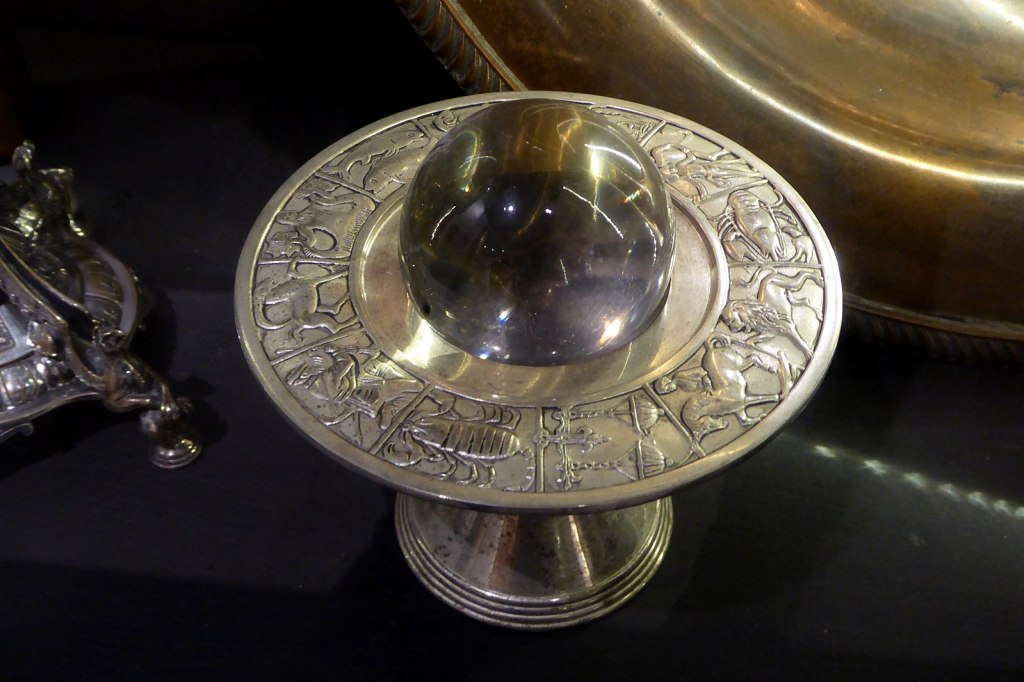
Figure: A crystal ball on an ornate zodiac stand, used as a fortune teller’s prop. The zodiac symbols around the base evoke astrology, blending two mystical motifs. In a reading, a performer might run their hands around the ball and describe “visions” forming within it – the imagery can be tailored to the client’s question, making the experience feel personal and magical. (Image source: https://commons.wikimedia.org/wiki/File:Crystal_Ball_with_Zodiac_Stand_in_the_Museum_of_Witchcraft_and_Magic.jpg)
Tea Leaf Reading (Tasseography)
- Origins & History: Reading tea leaves (or coffee grounds) – known as tasseography (from French tasse for cup) – is the art of interpreting random shapes left by the dregs in a cup. This practice seems to have developed after the introduction of tea to Europe in the 17th–18th centuries. It gained huge popularity in Victorian England, where parlor games and occult curiosities were in vogue (For Centuries, People Have Searched For Answers In The Bottom Of …) (For Centuries, People Have Searched For Answers In The Bottom Of …). By the late 19th century, tea rooms often doubled as fortune telling salons. An earlier form of cup divination was reading wine sediments, and Middle Eastern coffee reading has been practiced for centuries. But the classic image of two ladies with a tea cup, marveling at what the leaves portend, is a product of the Victorian era’s fascination with spiritualism and self-analysis (For Centuries, People Have Searched For Answers In The Bottom Of …) (For Centuries, People Have Searched For Answers In The Bottom Of …). Today, tasseography remains as a fun party activity or an offering at metaphysical shops, though it’s less common than card or palm readings due to the need for brewing actual tea.
- Method: After a person drinks a cup of loose-leaf tea (leaving a small amount of liquid), the cup is swirled and inverted onto a saucer. The remaining leaves scatter in patterns inside the cup. The fortune teller then inspects the shapes formed by the tea leaves, typically starting from the handle (if present) and moving clockwise, with the area near the rim indicating the near future and the bottom indicating later or deeper issues. The reader looks for recognizable symbols – much like finding shapes in clouds. This requires imagination. A skilled tasseographer has a mental dictionary of common shapes and their traditional meanings.
- Common Symbols & Their Meanings: (These can vary by source, but common interpretations include:)
- Heart: Love, friendship, or positive emotions. (E.g. “a heart shows love or romance on the horizon; if there are little dots around it, it could even mean monetary gifts around a relationship”.)
- Anchor: Success and stability if clear; if blurred, it can mean uncertainty in one’s goals. (Anchors are usually good omens of staying put in a happy way – such as flourishing in a career or committed relationship – unless the image is muddy.)
- Bird: Good news or messages coming. A flying bird could mean news from afar, whereas a perched bird might suggest waiting for news.
- Circle or Ring: Completion or marriage. A ring next to initials might literally mean marriage to someone with that name. Circles also signify full cycles or opportunities coming full circle.
- Snake: Difficulties or deceit. Traditionally a warning of an enemy or a betrayal. But context matters – near a heart, it could mean temptation in love; near a person’s symbol, a false friend.
- Star: A very positive sign – success, happiness, or divine protection.
- Letter (literal alphabet letter): Often interpreted as the initial of a person involved in the querent’s life or an upcoming event (e.g. “M could be the name of a helpful friend or a place that will be important”).
- Numbers: Could indicate timing (a 7 might mean seven days or July, etc.) or a significant number related to the person.
- Cross: Generally indicates troubles or burdens (small crosses: minor obstacles; a big cross: a major trial, sometimes even interpreted as death or ill omen in older traditions, though entertainers would soften that).
- Fish: Good fortune, especially in business or personal wealth (also a classic sign of travel across water if interpreted literally).
- Entertainment Use: Tea leaf reading has an old-world charm that can be very engaging if set up properly. Typically, it’s done one-on-one or in small groups since it requires handling a beverage. For a fun event, a host might actually serve a cup of loose tea to a participant or use a proxy cup if hygiene is a concern (sometimes fake tea leaves or confetti can be used purely for demonstration). The fortune teller will then go through the ritual: swirl, flip, tap thrice (some do this as a little dramatic superstition), then lift the cup and peer inside with exaggerated concentration. There’s a delightful suspense as others lean in to see what pattern will be “revealed.” The performer might even invite the querent: “What do you see there? Yes, it does look like a letter A… that could be significant!” making it interactive. The reading itself should be light-hearted: “I see a cat – a cat means independence. Perhaps you’ve been feeling like doing your own thing lately? There’s also a cluster of leaves here by the handle that looks like a crown – that foretells success and recognition, maybe an award at work!” By linking symbols like this, the fortune teller gives a string of mini-readings that together form a positive outlook or an amusing story. Guests often enjoy trying to spot shapes themselves, so it becomes a bit of a collaborative game. The performer’s role is to gently guide the interpretation, ensuring it remains optimistic or insightful (avoiding any dire meanings for the sake of enjoyment). When done well, tasseography readings are memorable because they feel personalized (the shapes were unique to that cup) and they involve a touch of everyday magic – turning something as mundane as tea dregs into a conversation with fate.
Pendulum Dowsing
- Origins & Background: Pendulum dowsing in fortune telling typically uses a small weight (like a crystal or metal bob) on a chain. The practice grew out of dowsing, where pendulums or rods were used to locate water or minerals. As a psychic tool, pendulums became popular in the Spiritualist movement of the 19th century, when people sought simple methods to contact spirits or the subconscious. A swinging pendulum’s motion was believed to be guided by unseen forces (in reality, subtle muscle movements – the ideomotor effect – cause the motion). Today, pendulums are used in New Age circles for answering yes/no questions or locating imbalances in energy healing. They’re easy to use and require minimal setup, making them a common demo in psychic fairs and by stage mentalists.
- How It Works: The pendulum is held between the thumb and forefinger, elbow steady on a table. The reader first establishes what each movement means. For example: “Show me yes” – the pendulum might start swinging back-and-forth; “Show me no” – it might swing side-to-side; “Show me uncertainty” – perhaps it circles. This “calibration” can be presented as the pendulum attuning to the reader’s energy. The client then is asked to silently or openly state a question (often yes/no like “Should I take the new job?”). The pendulum is held still and then released. After a moment, it will invariably begin to swing in some direction. The direction is interpreted as the answer (yes/no/maybe). Some practitioners use special pendulum mats or charts marked with answers (Yes, No, Maybe, Rephrase) or even letters (for spelling out words Ouija-board style), but for entertainment, keeping it simple is best.
- Symbolism: The pendulum itself can be a crystal (for added mystical appeal) – common ones are amethyst or quartz – or even a ring on a string. The lack of specific symbols means the responses are binary or directional. Entertainers often imbue the pendulum with a persona, calling it things like “my little oracle” or attributing its movements to a spirit (“Grandma’s spirit says yes by moving it this way”). In truth, its power as an entertainment device lies in the suspense of waiting for it to give an answer, and the audiencе’s curiosity whether it will swing strongly or barely at all.
- Entertainment Use: Pendulum dowsing is often used as a quick, interactive fortune telling game. For example, at a psychic party the host might let each guest try the pendulum to answer one burning yes/no question. It’s participatory – the guest can hold the pendulum themselves while the fortune teller guides them. This active involvement often elicits delight (“Oh my, it’s actually moving!” is a common reaction as the person subconsciously causes the motion). The entertainer can add showmanship by asking the question in a ceremonial way and making a show of the pendulum’s first twitch: “Look, it begins to move… the spirits are indicating Yes!” If the answer is unexpected or unclear, the fortune teller can use a bit of ambiguity to keep things positive: “It’s not a strong no… it’s barely moving, which suggests the outcome isn’t fixed. Perhaps you can influence it with your free will.” In a stage context, a pendulum can be used with a large chart to “divine” an audience member’s secret selection or thought, combining both genuine ideomotor effect and magician’s trickery for a dramatic demonstration.
- Note: Ethically, pendulum dowsing should be framed as light-hearted in entertainment. Since it gives yes/no answers, it could be taken too seriously. A responsible fortune teller might preface with, “Pendulums pick up on our subconscious leanings. Treat this as insight, not absolute truth.” By doing so, they ensure the participant doesn’t base a life decision solely on the swing of a crystal. In practice, most people ask fun or low-stakes questions (love, hobby, trivial future event) which keep the mood easy. Pendulums, like all these tools, ultimately provide a way to externalize one’s thoughts – the performer just makes that process fun and engaging.
Table: Quick Comparison of Major Systems (Tradition, Tools, Key Focus, Entertainment Appeal)
| Tradition | Tools/Method | Key Focus / Symbols | Entertainment Appeal |
|---|---|---|---|
| Tarot | 78-card deck; layouts (spreads) | Archetypal images (Fool, Lovers, Death); four suits (Cups, Swords, etc.) | Rich visuals allow storytelling tailored to client; dramatic “reveal” of cards is engaging. |
| Astrology | Birth details (date/place/time); horoscope charts | Zodiac signs, planets, houses (e.g. Aries, Venus in 5th house) | Familiar & personal (sun signs); easy to give personality readings that feel specific. |
| Palmistry | None (just the subject’s hand) | Lines (heart, head, life, fate), Mounts (Venus, Mars, etc.), hand shape | Very personal touch; interactive as reader “maps” person’s life on their palm. Validating and flexible interpretations. |
| Numerology | Birth date and/or name (for calculations) | Numbers 1-9 (and master nos. 11,22); core numbers like Life Path, Destiny | Quick to compute; people love numbers about themselves. Provides neat labels (Leader, Peacemaker, etc.) that flatter the ego. |
| Runes | Set of rune stones (24) drawn or cast | Ancient Norse symbols (Fehu = wealth, etc.) | Exotic and historical; tangible casting process feels like a game. Allows creative linking of symbols to question. |
| I Ching | Coins or yarrow stalks; I Ching book | 64 Hexagrams (patterns of 6 lines) with poetic names (e.g. “The Well”) | Profound and novel; can be simplified to one proverb-like message. The ritual of coin tossing adds anticipation. |
| Crystal Ball | Crystal or glass sphere on stand | Gazing yields “visions” (subjective images) | The quintessential mystic prop – instantly captivating. Unlimited creative imagery to entertain with dramatic flair. |
| Tea Leaves | Tea cup, loose tea, saucer | Random leaf patterns -> interpreted symbols (heart, anchor, letter, etc.) | Charming old-fashioned feel; participatory “do you see it?” fun. Each cup’s uniqueness makes it special for the querent. |
| Pendulum | Weighted pendulum (on chain) & possibly a chart | Motions indicating yes/no or other answers | Simple and interactive (guest can do it); suspenseful to watch. Great as a quick “let’s see what it says” game. |
(Sources: historical origins; examples of use.)
Psychological Techniques in Entertainment Fortune Telling
Professional entertainers who perform fortune telling often rely on psychological tricks as much as the divination system itself. These techniques help make readings feel amazingly accurate and personal, even though the reader is a stranger. Here are key methods used (sometimes subconsciously) in entertainment-based fortune telling:
- Cold Reading: A technique where the reader starts with broad, general statements and then hones in on details based on the subject’s reactions. It’s called “cold” because the reader has no prior knowledge of the person. For example, a cold reader might begin with statements that almost everyone finds true, such as “I sense that you have a hidden talent you haven’t fully tapped into” or “I see you often put others’ needs before your own, sometimes at the expense of yourself.” These are known as Barnum statements – vague, universally applicable remarks that people nonetheless perceive as insightful about themselves. As the person responds (verbally or non-verbally), the reader refines the reading. If the subject’s eyes light up or they nod when career is mentioned, the reader will focus there (“Yes, I’m getting that you’re unfulfilled in your current job – you crave more creativity”). Cold readers also pick up on visual cues: age, clothing, demeanor, and any information freely given (“my mother passed recently” will steer the reading toward that topic). With skill, a cold reader can convince someone that the fortune teller “knew things they couldn’t possibly know,” when in fact the subject supplied the data through reactions. This is extremely common in psychic entertainment and is not supernatural – it’s a mix of keen observation and interpersonal skill.
- Hot Reading: In contrast to cold reading, hot reading involves obtaining actual information in advance about individuals and then presenting it during the reading as if divined psychically. In an entertainment context, this might happen in a stage show where audience members fill out cards or talk to associates of the performer beforehand (unknowingly giving details). For ethical performers, hot reading is usually avoided or just used with the participant’s prior consent (because it is outright deceptive). Historically, some fraudulent psychics have used hot reading to great effect – for instance, a medium’s assistant might eavesdrop in the waiting room and pass on tidbits via hidden microphone. In a fun party setting, there’s little need for hot reading; it’s more a phenomenon in large-scale shows or unsavory scams. When used, it can wow people (“The fortune teller knew my husband’s name and that I had surgery last year!”), but in an entertainment-only approach, transparency and trust with the audience are key. Therefore, hot reading is mentioned here mostly as a point of contrast – it’s a known technique but ethically dubious if not disclosed.
- Warm Reading: This technique falls between cold and hot. With warm reading, the fortune teller relies on general truths that apply to many people along with the tendency to find personal meaning in the ambiguous. A classic warm reading approach is referencing the Forer (Barnum) effect: making statements like “You’ve had ups and downs in life but you’ve learned important lessons from the difficult times” – nearly everyone will agree this describes them. Warm reading does not require prior information or much feedback; it banks on the fact that humans recognize themselves in universal statements. Another warm reading tactic is to use statistics or common experiences (“I sense a childhood incident involving water…” – many people have some significant memory with water, such as a near-drowning, a boat ride, a storm, etc.). In entertainment readings, a performer might have a mental list of such high-probability hits: references to relative with health issues, a conflict with a friend that left unresolved feelings, an upcoming decision weighing on the person. Because these occur often in life, chances are the person will connect it to something real. When they do, the reader can smoothly take credit for the “accuracy.” Essentially, warm reading is about leveraging what’s generally true or likely and packaging it as a personalized insight. It often goes unnoticed by the subject because of the personal validation bias – we latch onto things that resonate and forget the parts that don’t.
- The Barnum/Forer Effect: As mentioned, this is the psychological phenomenon where people give high credence to descriptions that are vague and generic, believing they are specifically about them. Entertainers exploit this by using statements that sound specific but in fact apply to almost anyone. Examples: “You have a lot of untapped potential that you haven’t used to your advantage.” or “At times you’re very sociable, yet you also value time alone to recharge.” Upon hearing such remarks, clients often say, “Yes, that’s so true!” because indeed, everyone feels they have unused potential, and most people exhibit both sociable and introverted tendencies at times. The effect is so strong that in controlled experiments, people rated Barnum statements as highly accurate for themselves even when they knew the same sketch was given to others. Fortune tellers for entertainment lean on this effect constantly. Horoscopes in newspapers are a prime example – by keeping things positive and universal (“This week you may encounter an exciting opportunity or meet someone who influences you”), readers of all signs feel it speaks to them. A good entertainer will phrase Barnum statements in a colorful way that fits the theme of the divination system (e.g. a numerologist might say “As a Life Path 5, you sometimes feel confined by routines – you thrive when you can break free and explore.” Most people, Life Path 5 or not, like to think of themselves as free spirits occasionally). The audience, eager to find meaning, will subconsciously do the work of making these statements fit their unique circumstances.
- Use of Ambiguity and Symbolic Storytelling: Ambiguity is a fortune teller’s friend. By staying ambiguous, the reader avoids being wrong and allows the querent to fill in the blanks. For example, instead of saying “Your brother will have a car accident in March” (specific and risky, and also too serious for an entertainment setting), an ambiguous approach would be: “I see a warning related to travel in the spring; be extra cautious on the road and make sure your loved ones do the same.” If nothing happens, the advice was harmless; if anything close occurs (even a fender-bender in April), the client will recall the “prediction.” In entertainment readings, the language is often metaphorical or open-ended: “There’s a shadow on one aspect of the cards here – this could mean a challenge or simply a delay in what you’re hoping for.” This way, whether the outcome is a minor delay or a major challenge, the statement holds true. Storytelling comes into play when the fortune teller links symbols into a narrative. People naturally connect dots in stories. If a tarot reader says, “This spread tells the story of someone who left behind comfort (Six of Swords shows departure) to pursue a dream (The Star). It won’t be easy (Nine of Wands – challenges), but the end result is worth it (The World – fulfillment),” the client will overlay this story onto their own life journey. By speaking in analogies and parables, the entertainer makes the reading engaging like a little fable, and the client extracts their own meaning. Ambiguity also extends to double meanings – e.g., seeing the symbol of a “key” in a crystal ball could mean a literal key (house, car) or a metaphorical key (solution to a problem). A fortune teller might present both: “This key might be a new home, or it could be saying you’ll soon find the key to solving that issue that’s been bothering you.” The client will latch onto the interpretation that feels right. In sum, by keeping statements flexible, the performer ensures that the reading will resonate in some way, and it allows the client to take an active role in making the reading accurate by applying it to their situation. This collaborative aspect (knowingly or not) is part of the fun – it becomes like decoding a puzzle together, where the fortune teller provides pieces and the client completes the picture.
In all these techniques, the underlying principle is that people want to believe and will contribute to the success of the reading. A skilled fortune-teller guides this process artfully, making the experience feel personal, mysterious, and meaningful – all while using cues and language techniques that are, at their core, perfectly natural psychology and communication.
The Performative Aspects of Fortune Telling
Fortune telling for entertainment is as much a performance art as it is a mystical consultation. The goal is to create an immersive, memorable experience. Here we discuss the meta-level showmanship and interpersonal skills that turn a simple reading into captivating entertainment:
- Creating Ambiance and Mystique: The setting and props significantly enhance the experience. Dim lighting, candles, incense or fragrance, and mystical background music can set the mood instantly. Many performers decorate their reading space with rich fabrics (velvet tablecloths, beaded curtains) and symbolic items (crystal ball, ancient-looking books, astrological posters). The fortune-teller’s attire might include flowing robes, lots of jewelry (rings, bangles), and colors like purple or deep blue associated with psychic imagery. This isn’t mandatory, but it helps signal to the audience “you are entering a magical space.” Even subtle choices like speaking in a soft, measured tone or adopting a mysterious persona (perhaps a whimsical alias) can contribute to the atmosphere. The idea is to transport the participant out of the ordinary – so they momentarily suspend disbelief and engage with the reading playfully. Some entertainers begin with a ritualistic introduction: shuffling cards in a practiced, elegant way, or doing a little “cleansing” of the space (maybe waving sage or asking the participant to take a deep breath and focus). These touches not only set the scene but also put the client in a receptive mindset, ready to be entertained and perhaps enlightened. Essentially, the performer is creating a mini-theater, and the querent is the audience of one (or a few). As one source puts it, successful fortune telling often comes down to “the clever interpretation of ambiguities, or a brazen announcement of the inevitable” delivered with showmanship – and the right ambiance makes even a brazen guess feel like a prophecy.
- Building Rapport with the Subject: People are more amazed by a reading if they feel connected to the reader. A warm greeting, a genuine smile, and an inviting demeanor go a long way. The fortune teller might start with small talk or a light compliment to break the ice (“I love that necklace – such an interesting symbol, where did you get it?”). This not only relaxes the person but might also yield a tidbit for use in the reading (if they say “Oh, it’s a family heirloom,” the reader knows family is important to them). Empathy and active listening are key. During the reading, the performer will pay attention to the person’s reactions and show understanding: if the client’s face falls at mention of a struggle, the reader may reach out or soften their tone: “I can see this is something you’ve been carrying heavy in your heart. Don’t worry, we’ll see what guidance the cards give.” Such moments of emotional attunement build trust. Even though it’s entertainment, many people open up about personal hopes and worries in a fortune telling session; handling those confessions kindly and without judgment is crucial. Good entertainers often have a counseling-like quality – they validate the person’s feelings (“That must have been difficult for you”) and make them feel seen and heard. This rapport creates a positive feedback loop: the client becomes more engaged and responsive, which in turn gives the reader more material and confidence to deliver an impactful reading. Essentially, friendliness and trust are the foundation; once those are established, the performative “revelations” land much more powerfully.
- Reading the Subject’s Reactions (and Adapting): A fortune teller in performance is constantly observing the client’s micro-reactions – a nod, raised eyebrows, a skeptical frown, dilated pupils, leaning in or pulling back, verbal interjections (“Wow” or “Hmm, not sure”). These are cues about what resonates and what doesn’t. Skilled readers use a kind of feedback loop: when a theme clearly strikes a chord, they delve deeper into it; when something isn’t clicking, they pivot to a new angle. For example, if during a palm reading the statement “I see you’re very close to your family” falls flat (maybe the person shows a subtle wince), the reader might quickly adjust: “Or perhaps it’s that you long for that closeness, and family ties have been challenging – the lines here indicate complexities.” Now, if the person relaxes or nods, the reader continues along that line. This adaptability prevents the reading from derailing and often the client will remember only the hits (“She knew I had family conflict!”) and not the initial miss. Mirroring is another technique: matching the client’s energy. If someone is shy and soft-spoken, a bombastic style might intimidate them; a gentle, reassuring approach works better. Conversely, if someone is enthusiastic and jokey, the fortune teller can be more humorous and bold. This mirroring builds subconscious rapport and makes the experience more enjoyable for the subject, as they feel “in sync” with the reader. In essence, the performer is doing a mental dance with the participant, leading when needed, but also following the participant’s moves to keep harmony. This attention to reaction is partly intuitive, partly learned – many entertainers refine it through experience (and some literature on cold reading explicitly trains performers to notice and interpret dozens of specific reactions). The best make it all feel natural, so the client only notices that “it just kept getting more accurate as we went along!”
- Delivering Insights with Impact: A good fortune telling performance has a sense of drama and pacing. It’s like telling a story or delivering a speech – you build up, have big reveals, and leave on a high note. Techniques to achieve this include:
- Emphasis and Pauses: Savvy readers emphasize important phrases and pause for effect. For instance, revealing a tarot card that’s visually striking or thematically significant, the reader might take a breath, widen their eyes, and say, “This is significant… it’s The Star.” (Pause – client processes the gravity.) “The Star is a beacon of hope. After all the difficulties we discussed, this card is telling me that hope still shines for you.” This feels theatrical in a good way – it gives the client goosebumps because the moment feels meaningful.
- Climactic Revelation: Often, a reading is structured so that the most positive or illuminating message comes at the end. If earlier cards or lines dealt with challenges, the last part might reveal the solution or a stroke of good fortune. This is intentional, because you want the person to leave feeling uplifted or amazed. For example, an astrologer might save the interpretation of the person’s Jupiter (planet of luck) for the end: “And here’s something wonderful – Jupiter is moving into your Career house next month, which strongly indicates opportunity and success. It looks like things will turn in your favor soon.” Ending on that note ensures the person walks away impressed and optimistic, which is the desired impact for entertainment.
- Story Arc: Some readers will actually frame the entire reading as a little journey. They might start by saying: “These cards together paint the picture of your past influences,” then “Now we move to present circumstances,” and “Finally, here is the likely future or advice.” By clearly delineating these, the client can follow along as if reading a chapter book about themselves, which is quite engaging. Each “chapter” builds on the last, and the reader can recap or call back to previous points (“Remember I mentioned earlier the conflict indicated by Mars? Now this next symbol shows resolution to that very conflict”). This coherence makes the reading feel purposeful and deep rather than a random set of statements.
- Use of Voice and Body Language: The tone might shift appropriately – soft and empathetic when discussing a sensitive matter, excited and bright when talking about upcoming joys. The reader’s body language can enlarge the drama: leaning forward when disclosing a secret, spreading arms wide when pronouncing good fortune, even the classic knowing gaze into the client’s eyes to underscore a point (“You already know what I’m referring to, don’t you?”). These cues subconsciously tell the person “this is important” and they will remember it more.
- Humor and Levity: Depending on the context, adding a dose of humor can greatly enhance impact. A fortune teller who can laugh with the client (never at them) about, say, a silly symbol or a lighthearted prediction, shows confidence and makes the experience fun. For instance, “Oh, this tea leaf looks just like a dog – I’d say it means loyalty… or that you might be getting a new puppy! If it’s the latter, I take a small commission for accurate pet predictions!” A joke like that can release tension and make the “real” insights that follow stand out in contrast.
Ethical Considerations for Entertainment-Only Fortune Telling
When performing fortune telling as entertainment, it’s crucial to maintain ethical boundaries. The audience or participant must be respected and kept safe (emotionally and otherwise) during the experience. Here are key ethical guidelines:
- “Entertainment Only” Disclaimer: Be clear that the reading is for fun and insight, not absolute truth. In many jurisdictions, this is not just ethical but legal – for example, the UK’s now-repealed Fraudulent Mediums Act (1951) required fortune tellers to explicitly say their services were for entertainment, to avoid exploitation. In practice, an entertainer might say upfront with a smile, “I’m not all-seeing; take everything with a grain of salt. This is for your enjoyment and reflection.” This sets the correct expectation and takes pressure off both the reader and the client. It also frames the experience as a form of storytelling or coaching, rather than final destiny. Attendees can then relax and enjoy the show without fear.
- Avoiding Sensitive or Harmful Topics: An ethical fortune teller steers away from dire predictions or topics that could deeply upset someone. No predictions of death, serious illness, or tragedy – those cross a line, especially in an entertainment context. Even if a system’s lore might suggest something negative (say, the tarot Ten of Swords often means pain or endings), the reader will couch it carefully: perhaps interpreting it metaphorically or focusing on rebirth after an ending. If a participant specifically asks a heavy question (e.g. health of a loved one), a responsible entertainer would handle it delicately or even decline, suggesting that’s beyond the scope of a light reading. It’s also wise to avoid extremely personal digs or criticisms. While character insight is fine, shaming or exposing someone in front of others is not. The fortune teller should never use information gleaned (by cold reading or otherwise) to embarrass or exert power over the querent – trust must not be abused.
- Empower, Don’t Scare: The tone of readings should be empowering. Even when mentioning challenges, the emphasis should be on overcoming them or understanding them, not on helpless fate. Fortune telling can sometimes create a psychological dependency if someone believes their life is ruled by forces only the reader can see. Ethical entertainers discourage this. They might explicitly remind the client, “You have free will. The cards show one path, but you can always change course.” The goal is for the person to leave feeling hopeful or thoughtful, not anxious that “the fortune teller said something bad will happen.” If a participant does seem distressed by something that comes up, a good reader will pivot: provide comfort, re-frame the message positively, or even break character to ensure the person is okay (since in entertainment, the wellbeing of your “audience” comes first).
- Maintain Confidentiality and Privacy: In one-on-one readings, clients may share personal stories. Even though it’s an entertainment event, those personal details should be treated with respect and not broadcast to others without permission. Many fortune tellers adopt a stance similar to a counselor – what is told to me in the tent (or table) stays private. In group settings, be mindful not to put someone on the spot with information they haven’t volunteered to others. For instance, don’t announce “I see marital troubles here” in front of that person’s spouse or friends – unless they themselves brought it up and seem comfortable. The person receiving the reading should be in control of how much is revealed publicly.
- No Financial, Legal, Medical Advice: Ethical readers abstain from giving professional advice in these domains, because it can mislead and potentially harm. If someone asks, “Should I invest in this business?” an entertainer might give a very general response (“The stars suggest caution, but ultimately you must decide”) and then quip that they are “not a financial advisor, only a humble card reader.” This draws a line. Similarly, anything involving health (“Will my back pain improve?”) should be met with a gentle nudge to seek proper help: “The pendulum says yes, you will heal – and I recommend following your doctor’s orders to speed it along.” This way, the reading doesn’t supersede real medical guidance. It’s also common for fortune tellers to have a policy not to read for minors without a guardian’s presence or to avoid extremely vulnerable individuals in an entertainment setting, to prevent misunderstanding or undue influence.
- Respecting Boundaries and Beliefs: People come from all backgrounds – some take spiritual matters seriously, others are skeptics just looking for a laugh. An ethical entertainer reads the room and respects everyone’s stance. They don’t push beliefs or insist that their reading is “right.” Humility is important. If someone challenges a statement, the reader can defuse, “You know, interpretation is not an exact science. Sometimes the symbols mean something else later on. Or maybe this one doesn’t click – that’s okay.” By not getting defensive, the performer shows this is a cooperative experience, not an ego trip. Also, be mindful of cultural or religious boundaries: for instance, if someone is uncomfortable with tarot due to their beliefs, a flexible entertainer might offer a different type of reading or drop overly occult references in favor of more neutral language (e.g. talking about “personality and choices” rather than “spirits” or “magic” if the latter would alienate them).
- No Exploitation for Money or Dependency: In an entertainment scenario like a party or fair, usually readings are free or fixed-price. Problems arise if a fortune teller tries to upsell additional services with fear (“I see a dark curse on you – for $50 more I can remove it”). This crosses a severe ethical line into fraud. Reputable entertainers never use scare tactics to extract money or create a false need for their services. In fact, many explicitly state that they do not do spells or remove curses, etc., to avoid any misunderstanding. The relationship should remain light and transactional – you paid (or came) for an entertaining reading, you got one. There should be no pressure to return or do more unless the client genuinely wants to for enjoyment. An ethical fortune teller is happy to provide insight and fun, but will discourage a client from making life decisions solely based on the reading. They may say, “Consider this just one perspective. Ultimately, you should follow your own heart/research/experts.” This empowers the individual and avoids dependency.
- Know Your Limits: Finally, the entertainer should be self-aware. If they feel a reading is going in a direction that they’re not qualified to handle (for example, someone becomes very emotional about a lost loved one and is seeking mediumship, but the entertainer only does playful readings), it’s okay – and often wise – to gently conclude the session and perhaps recommend they seek a different kind of support (maybe a grief counselor or a different type of practitioner). Trying to be everything for everyone can lead to harm. Sticking to the entertainer’s role – enlightening, comforting, but not taking on serious psychological counseling unless trained – is important for both parties’ well-being.
In summary, ethical entertainment-based fortune telling is about keeping it fun, safe, and positive. The performer should aim to leave people feeling good about the experience, with maybe a dash of insight or at least the enjoyment of having participated in a bit of theater. By honoring these guidelines, one ensures that fortune telling remains a delightful form of interactive entertainment and not a cause of distress or deception. After all, the true magic of fortune telling in these contexts is not whether one can actually predict anything – it’s in the human connection, the wonder, and the stories we share. And those are best delivered with compassion and integrity.

 EssayBoard


Leave a comment