
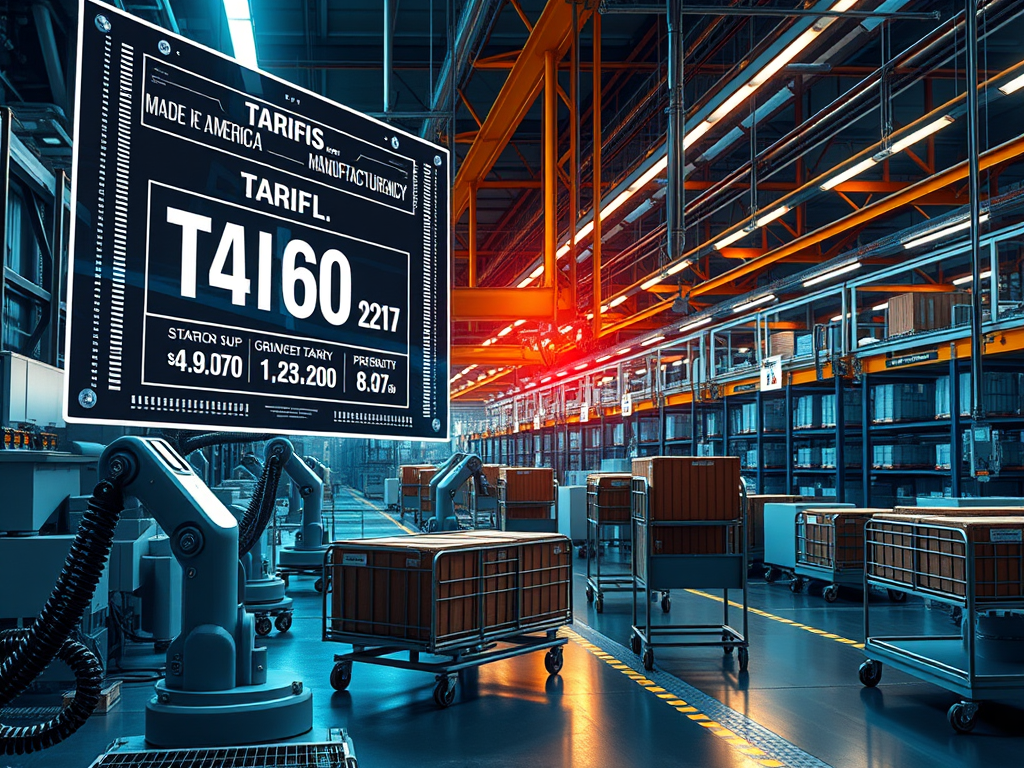
The modern economy is on the cusp of a dramatic transformation, driven by automation, artificial general intelligence (AGI), and robotics. Combined with the strategic use of tariffs, these technologies could revolutionize U.S. manufacturing and reshape the global trade landscape. However, this vision also raises urgent questions about employment and the role of humanity in a self-reliant, machine-driven society.
Tariffs as a Catalyst for Domestic Production
Tariffs are designed to make imported goods more expensive, incentivizing consumers to buy domestically produced products. However, tariffs alone are a double-edged sword: they can either protect domestic industries or inadvertently harm them by increasing costs for raw materials and goods. Their success largely depends on coupling tariffs with advanced technologies like automation and AGI.
In recent years, the U.S. has increasingly used tariffs as a tool to protect local industries and reduce dependence on foreign imports. While tariffs alone can’t rebuild U.S. manufacturing, pairing them with advanced automation could make “Made in America” products globally competitive. For instance, fully automated “dark factories” (factories that operate without human workers) could produce goods 24/7 without downtime, drastically lowering production costs and enabling U.S. factories to compete with low-cost manufacturing countries like China or Vietnam.
However, as much as automation boosts efficiency, it also has the potential to displace domestic jobs. Policymakers must carefully evaluate whether tariffs are truly protecting domestic markets or unintentionally accelerating job losses without proper investments in workforce adaptation.
By reducing reliance on imports, the U.S. could become more self-sufficient. However, if domestic industries produce more than they can consume, they will need to export the surplus to remain viable. This is where tariffs present a challenge: high tariffs on imports often lead to retaliatory measures from other nations, making U.S. exports less competitive on the global market. Countries like China, if cornered, could pivot to other global markets or boost domestic consumption among their 1.4 billion citizens, potentially diminishing their reliance on the U.S. market. In such a scenario, the U.S. could risk losing access to one of the largest consumer markets in the world, further complicating the effectiveness of tariffs in a globalized economy.
The Employment Dilemma: A World Without Jobs?
While tariffs and automation might strengthen U.S. manufacturing, they come with a significant downside: job displacement. Automation doesn’t just replace repetitive tasks; with AGI, even complex cognitive jobs could become redundant. Consider:
- Manufacturing Jobs: Robots and automated systems can handle assembly lines, packaging, and quality control.
- Logistics and Transportation: Autonomous trucks and drones could eliminate the need for drivers and delivery workers.
- Service Jobs: AI systems are already being used for customer service, retail, and even healthcare diagnostics.
As automation spreads, millions of workers could find themselves without traditional jobs. This raises a critical question: how will people survive and find purpose in a world where their labor is no longer needed?
Rethinking Society in an Automated World
If human labor becomes obsolete, society must undergo a profound transformation. Here are some possible paths forward:
Universal Basic Income (UBI)
UBI would provide every citizen with a guaranteed income, regardless of employment status. This would ensure that people have the resources to meet their basic needs, even if they aren’t working. UBI experiments in Finland and some U.S. cities have shown promising results, but funding such a system at scale would require significant policy changes and societal buy-in.
Redefining Work and Connection
In a post-automation world, work may no longer be tied to survival. People could focus on creative, caregiving, or entrepreneurial pursuits. Societies might value activities like art, community building, and scientific research—roles that emphasize human creativity and empathy. Similarly, people will need new ways to connect and form relationships, potentially through shared experiences, virtual communities, or cultural exchanges.
Shared Ownership of Automation
To prevent wealth from concentrating in the hands of corporations and tech billionaires, governments could require citizens to own a stake in automated systems. Profits generated by robots and AGI could be distributed to everyone, ensuring that the benefits of automation are shared equitably.
Resource-Based Economies
Some futurists propose a world where resources are managed by AI and distributed equitably, eliminating the need for money. This vision, while utopian, challenges the fundamentals of capitalism and would require a global cultural shift.
The Role of Strategic Trade in a Self-Reliant Society
Even in a fully automated economy, the U.S. would still need access to certain raw materials, like rare earth metals, which are unevenly distributed globally. Strategic partnerships and trade agreements would remain essential, but they would focus more on resource exchange than on manufactured goods.
Additionally, high tariffs on imports and retaliatory measures from other nations could have significant implications for the U.S. dollar’s status as the global reserve currency. If nations diversify away from the dollar in trade and reserves, its dominance could weaken, potentially leading to inflation and reduced leverage for U.S. financial markets.
The Philosophical Shift: What Is the Purpose of Humanity?
A world where machines handle all labor forces humanity to confront existential questions. Beyond the economic and social impacts, this also extends to how people connect, form relationships, and interact globally:
- Human Connections: Virtual reality and digital platforms could foster deep friendships and global networks, but they might also challenge traditional, in-person interactions.
- Travel and Cultural Exchange: Travel might remain important as a means of fostering cultural understanding and personal growth, even if automation redefines logistics and accessibility.
- Purpose and Fulfillment: Without work as a central anchor of life, humanity will need to redefine fulfillment—whether through creativity, exploration, or building stronger relationships. These shifts could spark a renaissance of personal and cultural expression.
Conclusion: A Balanced Path Forward
Tariffs combined with automation and AGI offer a promising path for the U.S. to become self-reliant and globally competitive. However, this vision is fraught with significant challenges. High tariffs could inadvertently isolate the U.S. if surplus production lacks competitive export markets due to retaliatory measures. Additionally, countries like China could pivot away from reliance on the U.S., focusing instead on fostering domestic consumption and strengthening ties with other global markets.
Another critical consideration is the status of the U.S. dollar as the global reserve currency. Protectionist policies may encourage other nations to diversify away from the dollar, weakening its dominance. Such a shift could reduce U.S. financial leverage, spark inflation, and destabilize the global economy.
To address these risks, policymakers must embrace a multifaceted strategy. This includes:
- Developing advanced technologies to ensure competitive production.
- Implementing policies like Universal Basic Income (UBI) to mitigate job displacement.
- Promoting global cooperation for raw materials and equitable trade agreements.
The ultimate goal is to ensure that technology and economic policies work in tandem to create a sustainable, equitable society where innovation serves humanity rather than displacing it. By balancing these forces carefully, the U.S. can lead the way toward a future that thrives on both self-reliance and global collaboration.
The stakes are high, but the rewards of thoughtful action could redefine prosperity in the 21st century. Will we seize this opportunity to rise to the challenge?

 EssayBoard
Leave a comment