
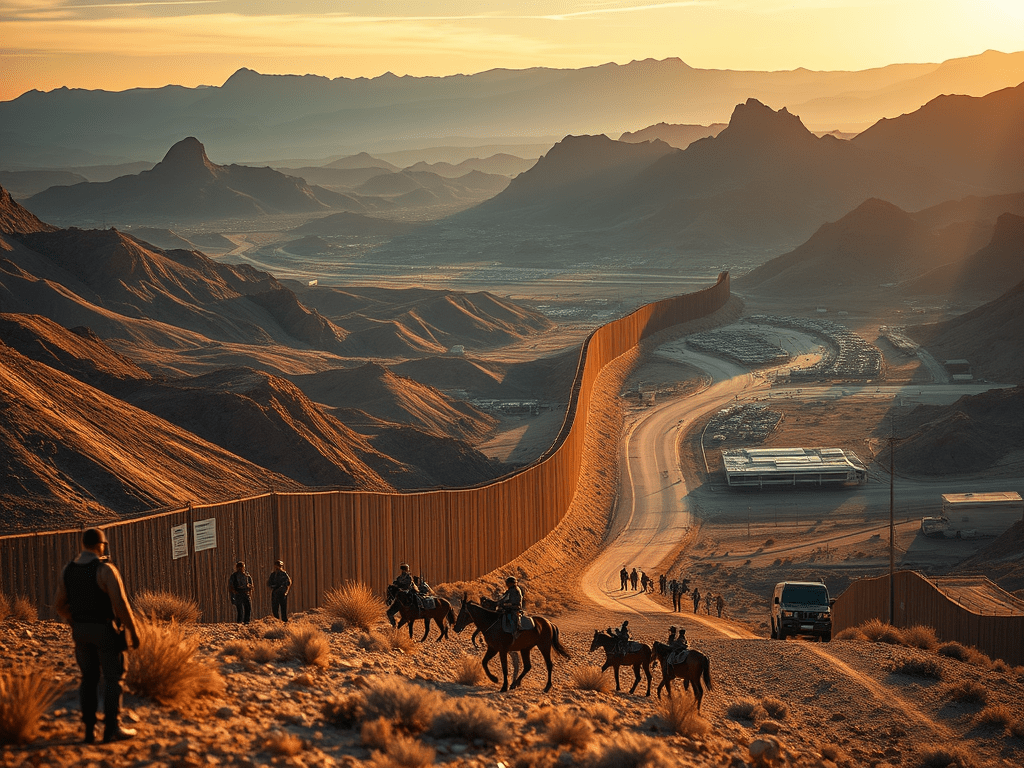
The U.S.-Mexico border is one of the most complex and contentious zones in global geopolitics. Spanning roughly 2,000 miles across diverse terrains, it is both a gateway and a battleground—where humanitarian crises, national security, and political debates collide. As of now, a wave of approximately 2,000 migrants is attempting to cross the border, a situation complicated by the inauguration of President Trump and his renewed focus on strict immigration policies.
While migration is driven by deeply human motivations—the search for safety, opportunity, and a better life—it’s also a space that bad actors exploit. Human traffickers, drug cartels, and other criminal organizations often use coordinated tactics to infiltrate the U.S., making the border both a humanitarian challenge and a national security concern.
Coordinated Tactics: A Playbook for Crossing
Bad actors and organized groups often use strategic methods to stretch border security thin. Here are some of the most common tactics:
- Decoy Groups: Large groups of migrants—sometimes including families and children—attempt to cross in highly visible areas. These groups engage border agents, drawing their attention and resources to a single point.
- Secondary Crossings: While agents focus on decoy groups, smaller, stealthier groups exploit less-patrolled sections of the border, using remote terrain to bypass detection.
- Technology and Camouflage: Modern smuggling operations have adapted to use advanced tools, such as tunnels with lighting and ventilation, drones for surveillance, and vehicles equipped with stealthy camouflage.
- Timing and Diversion: Crossing attempts are often timed during shifts in patrols, holidays, or extreme weather conditions when security coverage may be reduced. These distractions are carefully orchestrated to maximize success.
The Border Security Conundrum
The sheer size and diversity of the U.S.-Mexico border make complete security an unrealistic goal. Here are some of the key challenges:
- Resource Constraints: Border Patrol agents and technology are finite resources. Coordinated tactics that stretch these resources thin expose vulnerabilities along less-patrolled sections.
- Advanced Criminal Networks: Drug cartels and human trafficking organizations are highly organized, well-funded, and adaptive, often staying a step ahead of enforcement strategies.
- Humanitarian Considerations: Many migrants are fleeing violence, poverty, or political instability. Treating every crossing attempt as a security threat risks dehumanizing those who are genuinely seeking asylum.
- Political Polarization: Border security is a hot-button issue, with debates often centered on physical barriers versus technological solutions. These political divides can delay meaningful action.
Modern Solutions for a Complex Problem
Addressing the challenges at the border requires a multifaceted approach that combines enforcement, technology, and international cooperation. Here are some potential solutions:
- Enhanced Surveillance: Advanced technologies such as drones, ground sensors, and AI-powered analytics can improve detection capabilities and allow for better resource allocation.
- Rapid Response Teams: Mobile units that can quickly adapt to emerging situations are crucial for addressing large, coordinated crossing attempts.
- International Collaboration: Working closely with Mexico and Central American countries to address the root causes of migration—poverty, violence, and corruption—can reduce the flow of migrants and diminish the influence of bad actors.
- Balanced Policies: Effective border management must balance security with compassion. Streamlining asylum processes and providing resources for vulnerable populations can help separate genuine migrants from those exploiting the system.
The Broader Perspective
The U.S.-Mexico border is more than a physical line; it’s a reflection of global inequalities, geopolitical dynamics, and the universal human drive for survival and opportunity. While bad actors do exploit migration movements, most migrants are driven by desperation and hope—a reality that demands a nuanced and balanced response.
As history has shown, no wall or barrier can completely prevent movement. Instead, a combination of innovation, collaboration, and compassion is needed to manage the border effectively while upholding the values that define a nation. The question isn’t just how to secure the border but how to address the deeper forces that compel people to cross it in the first place.

 EssayBoard
Leave a comment