
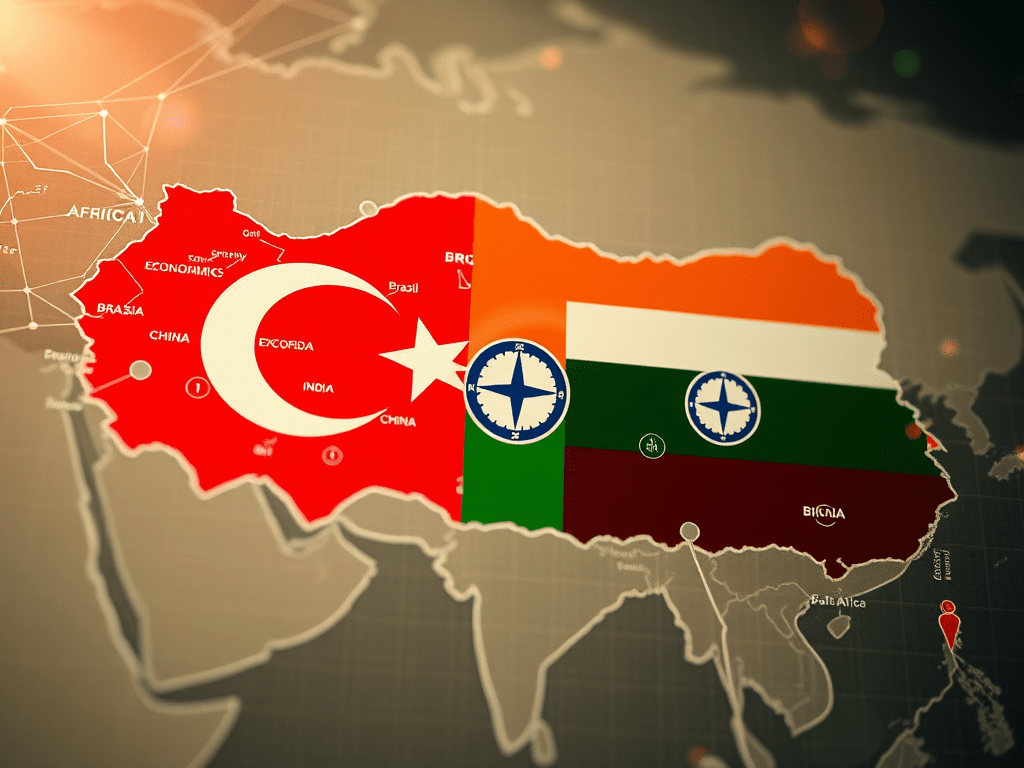
Turkey’s official request to join the BRICS economic bloc marks a significant geopolitical shift with profound implications for the Western alliance, particularly NATO. As Turkey is still a NATO member, this development raises complex questions about the future of Turkey’s relations with its Western allies, its role within NATO, and the broader global order.
Turkey’s Strategic Rationale
Turkey’s decision to apply for BRICS membership can be viewed as part of a broader strategy to diversify its foreign policy and economic partnerships. This move reflects Ankara’s desire to assert greater independence on the global stage and to navigate the complex relationships it has with both the West and other global powers, such as Russia and China.
For years, Turkey has been at the crossroads of East and West, both geographically and politically. Its strategic location has made it a crucial member of NATO, yet its foreign policy has increasingly diverged from that of its Western allies. The deterioration of Turkey’s relations with the European Union and the United States over issues such as defense procurement, human rights, and regional conflicts has accelerated this shift.
By aligning more closely with BRICS, Turkey seeks to bolster its economic ties with some of the world’s largest emerging markets, gaining access to new opportunities in infrastructure, technology, and energy. Additionally, Turkey’s interest in BRICS aligns with its goal of playing a more significant role in shaping a multipolar world order, one that challenges the dominance of Western-led institutions.
Impact on Turkey-NATO Relations
Turkey’s bid to join BRICS poses a dilemma for NATO, as it raises questions about the cohesion and future of the alliance. NATO has traditionally been a cornerstone of Turkey’s security policy, providing it with a security umbrella and a platform to project influence in its volatile neighborhood. However, Turkey’s relationship with NATO has been strained in recent years, particularly following its acquisition of the Russian S-400 missile defense system, which led to sanctions and its exclusion from the F-35 fighter jet program.
While Turkey’s NATO membership is unlikely to be immediately threatened by its BRICS application, the move signals a potential realignment of Turkey’s strategic priorities. NATO members may question Turkey’s commitment to the alliance, especially if it deepens its ties with BRICS members like Russia and China, which are viewed as strategic competitors by NATO.
The potential for conflicting interests between Turkey and other NATO members could complicate decision-making within the alliance. For instance, NATO’s collective defense principle, enshrined in Article 5, could be tested if Turkey’s actions within BRICS were perceived as undermining NATO’s strategic interests.
Western Economic and Geopolitical Implications
Turkey’s integration into BRICS could have significant economic and geopolitical implications for the Western alliance. Economically, BRICS membership would provide Turkey with access to alternative financial systems, potentially reducing its reliance on Western-dominated institutions like the International Monetary Fund (IMF) and the World Bank. This could diminish Western leverage over Turkey, particularly in terms of economic sanctions and conditional aid.
Geopolitically, Turkey’s BRICS membership could embolden it to pursue a more independent and assertive foreign policy, especially in regions where Western and BRICS interests collide. For example, Turkey could leverage its BRICS membership to strengthen its influence in Africa, the Middle East, and Central Asia, regions where it has already been actively expanding its diplomatic and economic footprint.
Moreover, Turkey’s alignment with BRICS could have broader implications for the global order. BRICS has been advocating for a multipolar world, challenging the dominance of the U.S. and its allies in global governance. Turkey’s inclusion in BRICS could strengthen this bloc’s influence in international institutions and contribute to the erosion of Western-led global governance structures.
Russia and China’s Role
Turkey’s bid to join BRICS is also significant in the context of its relationships with Russia and China. Both countries have been key partners for Turkey in recent years, particularly in the fields of energy and defense. Russia’s role in Turkey’s decision to join BRICS is particularly noteworthy, given the complex relationship between the two countries. While they have collaborated on issues like energy and regional conflicts, they have also been on opposite sides in conflicts such as Syria.
For Russia, Turkey’s inclusion in BRICS could be seen as a diplomatic victory, potentially driving a wedge between Turkey and its Western allies. China, on the other hand, may view Turkey’s BRICS membership as an opportunity to expand its Belt and Road Initiative (BRI) through Turkey, enhancing its strategic foothold in Europe and the Middle East.
However, Turkey’s BRICS membership could also introduce new dynamics within the bloc. Unlike Russia and China, Turkey remains a NATO member, which could lead to tensions within BRICS, particularly if Turkey’s actions are perceived as being influenced by its NATO commitments.
Challenges and Opportunities for the Western Alliance
The Western alliance faces a complex set of challenges in responding to Turkey’s BRICS bid. On one hand, the alliance must recognize Turkey’s legitimate interests in diversifying its partnerships and asserting its sovereignty. On the other hand, the West must be wary of the potential for Turkey’s BRICS membership to undermine the cohesion and effectiveness of NATO.
One potential approach for the Western alliance is to engage Turkey diplomatically, seeking to address its concerns and to explore avenues for cooperation within the framework of NATO. This could involve greater flexibility in addressing Turkey’s security needs, as well as efforts to strengthen economic ties and support Turkey’s role in regional stability.
Additionally, the Western alliance could explore ways to engage with BRICS as a whole, recognizing the bloc’s growing influence in global affairs. By seeking areas of common interest, such as climate change, counterterrorism, and global health, the West could mitigate the risk of a zero-sum competition with BRICS and instead promote a more collaborative global order.
Conclusion
Turkey’s formal request to join BRICS represents a pivotal moment in global geopolitics, with far-reaching implications for the Western alliance. As a NATO member, Turkey’s alignment with BRICS raises complex questions about the future of its relationship with the West and its role within the global order.
While this move reflects Turkey’s desire to assert greater independence and diversify its partnerships, it also poses significant challenges for the Western alliance. How the West responds to Turkey’s BRICS bid will have profound implications for the future of NATO, the global balance of power, and the prospects for a multipolar world.
Ultimately, the outcome of Turkey’s BRICS bid will depend on a complex interplay of factors, including the reactions of current BRICS members, the strategic calculations of Western powers, and the broader dynamics of global geopolitics. As the world watches this development unfold, the stakes for both Turkey and the Western alliance could not be higher.

 EssayBoard
Leave a comment