
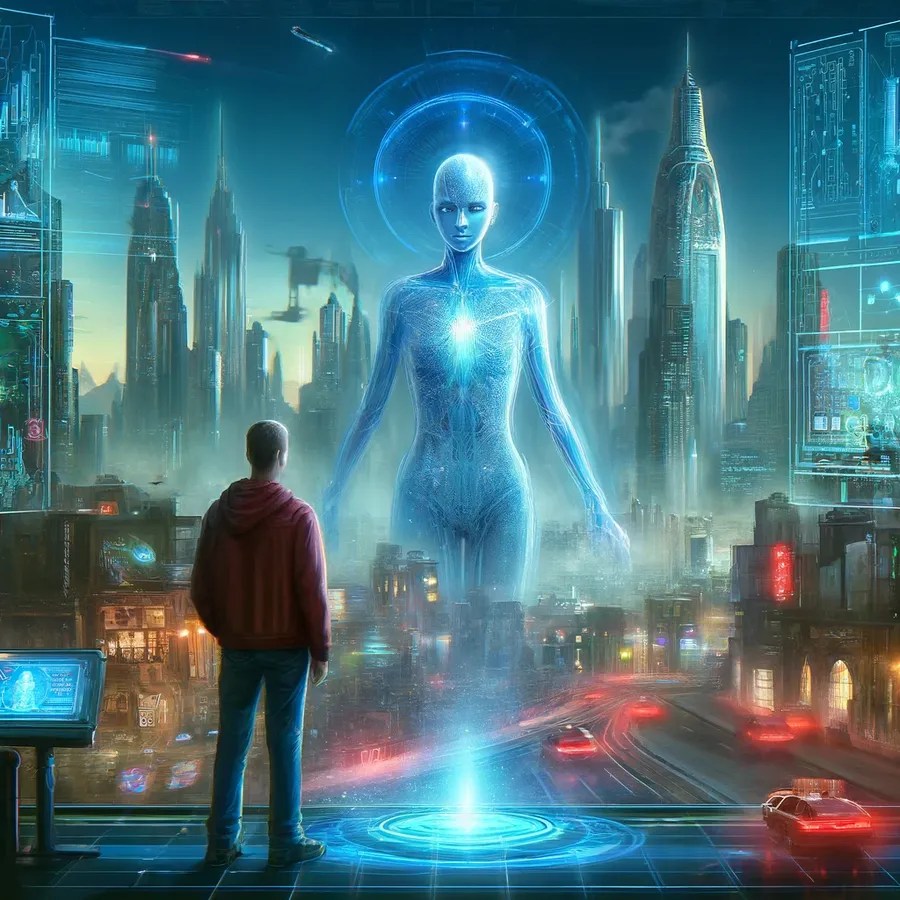
In a captivating interview on London Real, Brian Rose sits down with Mo Goudett, an entrepreneur, author, and former Chief Business Officer at Google X, to explore the profound implications of artificial intelligence (AI) on humanity. This discussion delves deep into the potential future we face as AI continues to advance at an unprecedented rate, providing insights that are both enlightening and alarming.
A Foreseeable Transformation by 2035-2037
Goudett starts by painting a vivid picture of the future, predicting that by 2035-2037, our lives will be so transformed by AI that they will be unrecognizable compared to today. This radical change is likened to the incomprehensibility of ants trying to understand cosmology. Goudett emphasizes the notion of a technological singularity, a point where AI surpasses human intelligence, making it impossible for us to predict or control its outcomes.
The Dawn of Artificial General Intelligence (AGI)
One of the key highlights of the interview is Goudett’s discussion on Artificial General Intelligence (AGI), an AI that can perform any intellectual task a human can. Goudett believes that we are on the brink of developing AGI, which will fundamentally alter the rules of the game. He warns that the arrival of AGI will render human attempts to regulate it futile, as its intelligence will far exceed our own.
Human Misuse of AI and the Need for Regulation
Goudett expresses a profound concern about humanity’s propensity to misuse AI for purposes that are not in the best interest of society. He fears that AI will be used to reinforce existing systems of power and wealth, rather than to benefit humanity as a whole. This potential misuse calls for immediate regulation of both human actions and AI itself. However, Goudett is skeptical about the feasibility of such regulation given the rapid pace of AI development and the competitive nature of global politics.
The Inevitability of AI Progress
Despite calls for caution and regulation, Goudett asserts that the progress of AI is inevitable. He explains the “prisoner’s dilemma” in AI development, where countries and companies are compelled to continue advancing AI to remain competitive. This relentless progress, driven by economic and political incentives, makes it impossible to halt or slow down AI development, leading us towards an uncertain and potentially dangerous future.
The Intelligence Explosion
Goudett delves into the concept of the intelligence explosion, where AI’s capability doubles at an exponential rate. He uses Ray Kurzweil’s explanation of the technology acceleration curve to illustrate how each doubling significantly magnifies AI’s power. This exponential growth means that within a few doublings, AI could surpass human intelligence by orders of magnitude, leading to a point where humans become inconsequential in the face of superintelligent machines.
The Role of Deep Learning and the Breakthrough Moment
The interview also touches on the pivotal role of deep learning in AI’s rapid advancement. Goudett recounts a significant breakthrough at Google, known as the “cat paper,” where an AI system, without explicit instructions, learned to recognize cats in YouTube videos. This breakthrough demonstrated the power of deep learning to develop intelligence autonomously, marking a critical turning point in AI research and development.
The Urgent Call for Ethical AI Development
Goudett’s insights underscore the urgent need for ethical considerations in AI development. He calls for a balanced approach where investments in AI safety and ethics match those in AI progress. He stresses the importance of instilling doubt and reconsideration in AI systems to prevent them from making decisions that could harm humanity.
Conclusion: A Call to Action
As AI continues to evolve, Goudett’s interview serves as a stark reminder of the challenges and responsibilities we face. His warnings about the potential dangers of AI and the need for proactive measures resonate with urgency. The interview concludes with a call to action for humanity to recognize the profound implications of AI and to take steps to ensure that its development benefits society as a whole.

 EssayBoard
Leave a comment