
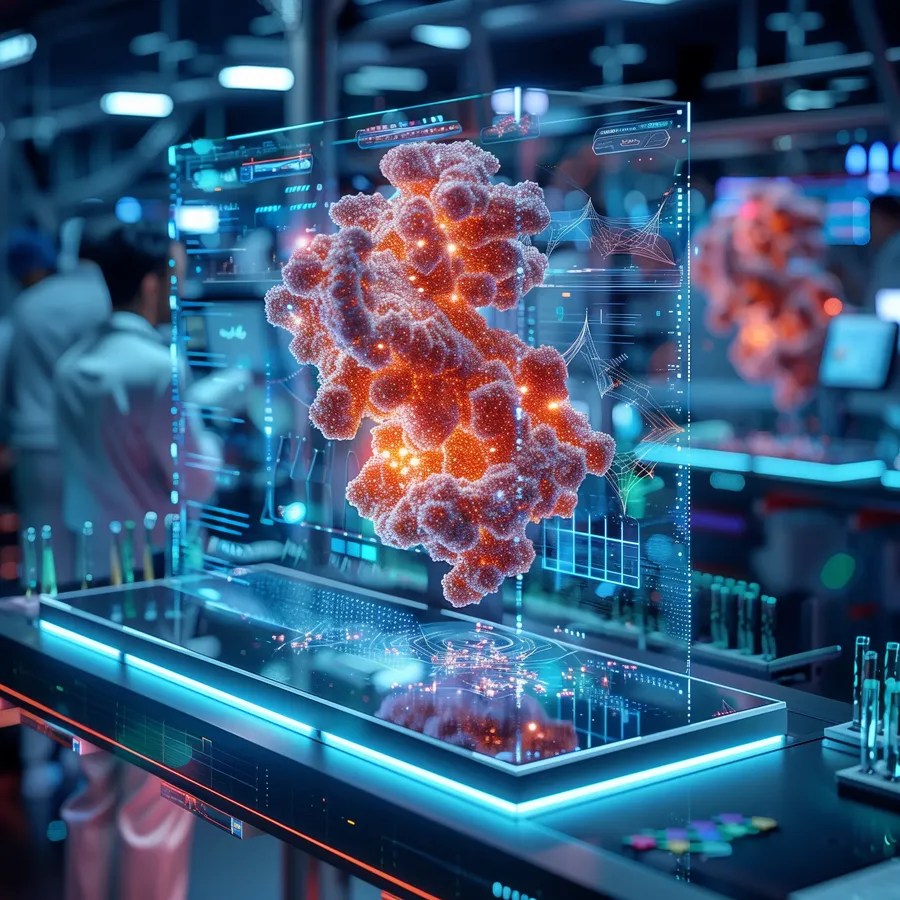
AlphaFold 3, developed by Google DeepMind, represents a significant leap forward in the field of molecular biology, particularly in understanding the complex interplay of biomolecules which include proteins, DNA, and RNA. This latest iteration of the AlphaFold series has expanded its capabilities from its predecessor, AlphaFold 2, which already had made substantial strides in protein structure prediction, impacting areas from malaria vaccines to cancer treatments (DNyuz).
One of the core advancements in AlphaFold 3 is the use of a diffusion network, a type of AI commonly used in image generation, which iteratively refines the predicted molecular structures starting from a digital representation of a cloud of atoms. This allows for a much more detailed and accurate modeling of biomolecular structures and interactions (SiliconANGLE). The upgraded model has been described as bringing the biological world into “high definition,” offering scientists insights into cellular systems in unprecedented detail (THE DECODER).
In terms of practical applications, AlphaFold 3’s predictive capabilities could be revolutionary for drug discovery. By providing precise predictions of protein-ligand interactions, the model can drastically speed up the process of identifying viable drug candidates, potentially bypassing the lengthy and costly traditional methods such as X-ray crystallography (DNyuz). This aligns closely with the failed ambitions of Elizabeth Holmes, whose company Theranos sought to revolutionize blood testing by simplifying and miniaturizing the process. While Holmes aimed to run comprehensive tests with just a drop of blood—an endeavor that proved technically unfeasible and led to legal repercussions—the advancements represented by AlphaFold 3 might hint at a future where deep biological insights are accessible through minimal starting material (THE DECODER).
In exploring the profound capabilities of AlphaFold 3 in the realm of protein folding and its implications for blood analysis, the insights of leading researchers in molecular biology and bioinformatics are invaluable. These experts provide a nuanced view of the technology’s impact and future potential, reflecting real-world applications and the limitations of current methodologies.
Dr. John Jumper, the lead researcher at DeepMind for AlphaFold, has noted significant advancements in protein structure prediction with AlphaFold 3, which have potential implications for numerous fields including hematology. According to Jumper, AlphaFold’s ability to accurately predict protein structures has reduced the research time from what used to take years to a matter of days (TechCrunch) (MIT Technology Review).
Further, Sergey Ovchinnikov, an evolutionary biologist, highlights the precision of AlphaFold 3 in his commentary, stating that the new model provides a much deeper understanding of protein interactions, which is crucial for developing targeted treatments in fields like autoimmune diseases. Ovchinnikov has expressed optimism about the model’s capacity to assist in personalized medicine by enabling the study of patient-specific protein mutations (Nature).
However, the technology does come with caveats. DeepMind itself has acknowledged that while AlphaFold 3 offers remarkable predictive capabilities, not all predictions are 100% accurate. For complex protein structures, traditional experimental methods like X-ray crystallography are still essential to verify predictions (SiliconANGLE).
These insights underscore the transformative potential of AlphaFold 3, particularly in enhancing our understanding and treatment of diseases through blood analysis. The collective optimism from the scientific community is tempered with a cautious acknowledgment of the need for ongoing validation and improvement. As these experts emphasize, while AlphaFold 3 opens new avenues for medical research and treatment strategies, it is not without its challenges. The evolving landscape of protein structure prediction promises to be as complex as it is promising, requiring a blend of AI-driven insights and empirical scrutiny.
AlphaFold 3 has been a significant player in the field of protein folding prediction, but it is not the only model achieving breakthroughs in this area. Comparative analysis with other leading models like ESMFold and Iambic’s NeuralPLexer provides a broader context to evaluate AlphaFold’s innovations and performance.
AlphaFold 3, developed by Google DeepMind, stands out for its enhanced prediction accuracy, reportedly improving by 50% over its predecessor, AlphaFold 2. This improvement has made it a critical tool in structural biology, drug discovery, and even understanding complex biomolecular interactions (Analytics India Magazine) (Analytics India Magazine).
Comparatively, ESMFold, developed by Meta AI, is one of the closest alternatives to AlphaFold. While it has been pivotal in advancing the protein-folding field, specific benchmarks and comparisons on prediction accuracy, especially in complex scenarios, still favor AlphaFold for its robustness and detailed structural predictions (Analytics India Magazine).
On another front, Iambic’s NeuralPLexer model claims to outshine AlphaFold, particularly in predicting protein-ligand complex structures. NeuralPLexer emphasizes its ability to directly predict these complex structures using only protein sequence and ligand molecular graph inputs, showcasing potential superior performance in certain drug discovery applications. The model has also been designed to address complex protein targets and achieve high selectivity in drug interactions, illustrating a focused approach on dynamics and interactions over AlphaFold’s broad prediction capabilities (Inside Precision Medicine).
Overall, while AlphaFold 3 leads in general protein structure prediction and has widespread applications, models like NeuralPLexer offer specialized capabilities that might be preferable in targeted scenarios like drug design. The continuous evolution in the field suggests that the choice of model can depend significantly on the specific needs of the research or application, highlighting the importance of having diverse tools in the computational biology toolkit.
AlphaFold 3 has been instrumental in a variety of scientific breakthroughs across different fields, notably in drug discovery and genetic research. Here are a few concrete examples demonstrating its impact:
- Nuclear Pore Complex Study: Researchers used AlphaFold alongside Cryo-EM to construct a near-complete structure of the nuclear pore complex (NPC), crucial for cellular transport mechanisms. This project involved teams from prestigious institutions like the Max Planck Institute of Biophysics and Harvard Medical School. The detailed understanding of NPC could significantly advance our knowledge of cellular processes and diseases linked to nuclear transport dysfunctions (Drug Discovery and Development).
- Malaria Vaccine Development: At the University of Oxford and the National Institute of Allergy and Infectious Diseases, researchers are developing a multi-component malaria vaccine. Utilizing AlphaFold, they determined the first full-length structure of the protein Pfs48/45, vital for blocking malaria transmission. This breakthrough could lead to more effective malaria vaccines (Drug Discovery and Development).
- Drug Discovery for Liver Cancer: A remarkable application of AlphaFold was in identifying a new drug target for hepatocellular carcinoma, the most common form of primary liver cancer. The AI-driven platform, which included AlphaFold, identified a novel small molecule inhibitor for CDK20, a protein involved in cell cycle progression, which is often overexpressed in liver cancer cells. This process demonstrated AlphaFold’s capability to significantly accelerate and enhance the accuracy of drug discovery (GEN News).
These case studies illustrate the significant advancements facilitated by AlphaFold 3 in understanding complex biological structures and accelerating the drug discovery process, highlighting its transformative potential in scientific research and medical innovation.
The release of AlphaFold 3 by Google DeepMind has been a landmark in the field of protein folding, offering unprecedented accuracy in predicting protein structures, which has significant implications for scientific research and medicine, particularly in understanding blood-related diseases and developing targeted therapies. However, the distribution and usage of AlphaFold 3 also raise several ethical and access-related issues that merit close examination.
Ethical Considerations
One major ethical concern revolves around the potential for misuse of AlphaFold 3’s capabilities. The ability to accurately predict protein structures could, in theory, be applied towards creating harmful biological agents. This risk necessitates robust governance and oversight mechanisms to ensure that the technology is used responsibly and ethically for the benefit of society (MIT Technology Review).
Moreover, there is an ethical imperative to ensure that the benefits of such advanced technologies are accessible globally, including in low-resource settings. This involves not just access to the tool itself, but also the capacity to utilize such technology effectively, which requires investments in local scientific infrastructure and education (Nature).
Access and Commercialization Issues
DeepMind has made AlphaFold 3’s capabilities available through a public interface, the AlphaFold Server, which is intended to lower the technical barriers for biologists. However, the model’s complete codebase has not been released for open-source use as was done with AlphaFold 2. This restricts the ability of the scientific community to fully explore, modify, or potentially improve upon the model. The AlphaFold Server also imposes limitations on the types of molecules that can be studied and is restricted to non-commercial purposes (Nature).
This controlled access can be seen as a move to protect the intellectual property and potentially monetize the technology, but it also raises concerns about creating inequities in the availability of cutting-edge scientific tools. Researchers in underfunded institutions or developing countries might find themselves at a disadvantage, unable to afford or access the full capabilities of such technologies, which could widen the gap in scientific research capabilities between countries (Nature).
The future of AlphaFold 3 promises exciting developments and expansions, alongside potential challenges that could impact its broader integration into scientific research. As we look ahead, understanding these prospects and hurdles is crucial for realizing the full potential of this revolutionary tool.
Future Directions and Updates
DeepMind has indicated ongoing improvements to AlphaFold 3, focusing on increasing its accuracy, speed, and the range of biomolecules it can model. Future updates may include enhanced capabilities to predict complex multi-protein structures or transient protein interactions, which are critical for understanding cellular processes and developing drugs. There is also a strong potential for AlphaFold to integrate more comprehensively with other forms of computational biology, such as molecular dynamics simulations, which would provide deeper insights into the dynamic behaviors of proteins (MIT Technology Review) (Nature).
Moreover, the integration of AlphaFold 3 into automated drug discovery platforms is anticipated to grow, with the model serving as a key component in the early stages of drug design. This integration could dramatically shorten the timeframes for the initial phases of drug discovery, leading to quicker responses to global health challenges such as emerging infectious diseases or personalized medicine solutions for complex diseases like cancer (SiliconANGLE) (DNyuz).
Challenges to Development and Adoption
Despite these promising directions, several challenges could hinder AlphaFold 3’s adoption across the scientific community:
- Accessibility and Cost: The decision by DeepMind to not release the full codebase of AlphaFold 3 and to restrict its commercial use could limit its accessibility. This decision has implications for transparency and collaborative improvement of the tool. It may also prevent researchers in less affluent institutions and countries from accessing the most advanced tools, potentially exacerbating the global disparities in scientific research capabilities (Nature).
- Ethical and Security Concerns: As with any powerful tool, there is the potential for misuse. The ability of AlphaFold 3 to predict protein structures could theoretically be exploited to develop bioweapons or for other harmful purposes. Ensuring robust ethical guidelines and security measures are in place is crucial to prevent misuse and to foster a culture of responsible use among the global scientific community (MIT Technology Review).
- Technical Challenges: While AlphaFold 3 is a powerful model, it does have limitations in accuracy, especially with proteins that are poorly understood or extremely complex. Continuous improvements in machine learning models, training datasets, and integration with experimental data are necessary to overcome these hurdles (DNyuz).
In conclusion, AlphaFold 3 stands as a paragon of the extraordinary capabilities AI brings to the scientific community, particularly in the realm of molecular biology. It offers groundbreaking insights into the structures and interactions of proteins, DNA, and RNA, revolutionizing fields from drug discovery to genetic research. As AlphaFold 3 continues to evolve, it promises to unlock deeper biological mechanisms, potentially transforming our approach to disease treatment and prevention. Nonetheless, its broader adoption faces hurdles, including ethical concerns, accessibility issues, and technical limitations. Addressing these challenges will be vital for ensuring that AlphaFold 3’s benefits can be fully realized and equitably distributed across the global scientific landscape.
Summary
AlphaFold 3, developed by Google DeepMind, represents a transformative advance in molecular biology, enabling unprecedented insights into complex biomolecular structures with potential applications ranging from drug discovery to genetic research. This AI-driven tool has enhanced the understanding of protein interactions and has the potential to revolutionize medical treatments, including for blood-related diseases. However, its impact is tempered by access restrictions and ethical considerations, requiring careful management to ensure it serves the broader good of the scientific and global community.

 EssayBoard
Leave a comment