
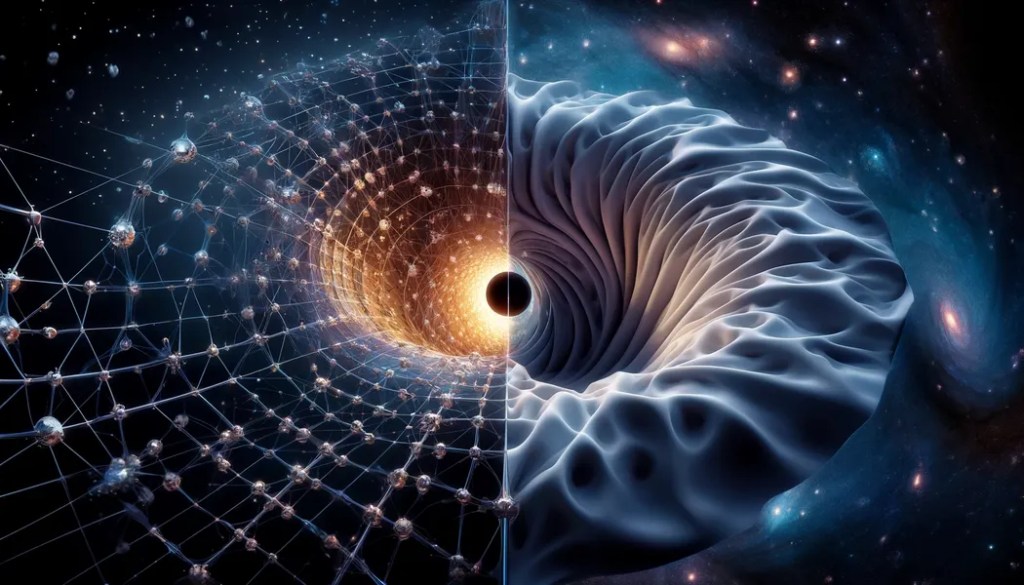
In the vast expanse of the universe, two towering figures stand at the forefront of our understanding of spacetime: Albert Einstein and Jonathan Gorard. Though separated by a century, their ideas converge to offer a profound insight into the nature of reality, painting a picture of spacetime that is both discrete and continuous. This dual perspective not only reconciles their seemingly divergent views but also provides a fresh lens to explore the wave-particle duality of light. This narrative delves into the fascinating interplay between Gorard’s discrete spacetime and Einstein’s smooth gravity, revealing them as two sides of the same coin, and in the process, shedding light on one of the most enigmatic aspects of quantum mechanics.
The Classical View: Einstein’s Smooth Fabric of Spacetime
In the early 20th century, Albert Einstein revolutionized physics with his theory of general relativity. He proposed that spacetime is a smooth, continuous fabric that can be warped and curved by the presence of mass and energy. This elegant theory replaced the Newtonian concept of gravity as a force acting at a distance with the idea that massive objects cause spacetime to curve, and this curvature guides the motion of other objects.
Imagine spacetime as a vast, elastic sheet. When a heavy ball (representing a massive object like a planet or a star) is placed on this sheet, it creates a depression. Smaller balls placed on the sheet will roll towards the larger one, not because of an invisible force pulling them, but because the shape of the sheet has changed. This analogy, though simplistic, captures the essence of Einstein’s vision: gravity is not a force but a consequence of the curvature of spacetime.
This continuous fabric model has been incredibly successful in explaining a wide range of phenomena, from the orbits of planets to the bending of light around massive objects (gravitational lensing). However, as physicists probed deeper into the quantum realm, they encountered behaviors that this smooth model struggled to explain.
The Quantum Challenge: The Need for a Discrete Model
Enter Jonathan Gorard, a modern physicist with a bold new approach. Gorard’s work is rooted in the principles of quantum mechanics, which describes the subatomic world in terms of discrete, quantized states. Unlike the continuous fabric of Einstein’s spacetime, Gorard proposes that spacetime at its most fundamental level is composed of tiny, discrete units connected in a complex network known as a hypergraph.
A hypergraph is a generalization of a graph where edges can connect multiple vertices, forming a web of relationships that can capture the intricacies of spacetime at the smallest scales. This discrete model aligns with the quantum view, where particles and interactions are inherently quantized, and offers a new way to understand how spacetime and gravity emerge from these fundamental units.
In Gorard’s model, spacetime is not a smooth expanse but a dynamic, evolving structure composed of interconnected nodes. These nodes represent the smallest units of spacetime, and the edges connecting them capture the relationships between these units. By applying specific rules to these hypergraphs, Gorard can simulate the evolution of spacetime, providing a computable foundation for both classical and quantum gravity.
Hypergraphs and Causal Graphs: Building Blocks of Discrete Spacetime
To understand Gorard’s approach, we must delve into the concepts of hypergraphs and causal graphs. Hypergraphs are used to represent space-like hypersurfaces in this discrete spacetime model. Unlike ordinary graphs, where edges connect pairs of vertices, hypergraphs can connect multiple vertices simultaneously, creating a rich tapestry of connections.
But how do these hypergraphs evolve? Gorard introduces hypergraph-rewriting rules, which specify how sub-hypergraphs are replaced over time. These rules govern the dynamics of the system, much like the laws of physics govern the behavior of the universe. By iterating these rules, Gorard can simulate the evolution of spacetime from a simple initial configuration to a complex structure.
The causal relationships between events in this discrete spacetime are captured by causal graphs. Derived from hypergraphs, causal graphs have directed edges that indicate the temporal order of events. These graphs map out how different points in spacetime are connected through time, providing a way to track the flow of causality in the system.
Simulating the Universe: Insights from Discrete Spacetime
One of the most exciting aspects of Gorard’s work is the ability to simulate complex physical phenomena using this discrete spacetime model. Using a software framework called Gravitas, Gorard and his team have produced simulations of phenomena such as binary black hole mergers and the accretion of matter onto spinning black holes.
These simulations are not just theoretical exercises; they produce results that can be compared to real-world observations. For example, Gorard’s simulations suggest that if spacetime is discrete, gravitational waves emitted during black hole mergers might exhibit slight phase shifts or other anomalies. These mesoscale effects, as they are known, could provide the first hints of the discrete structure of spacetime.
Another intriguing finding from the simulations involves black holes spinning at near-extremal speeds. In Gorard’s model, as these black holes spin faster and approach the theoretical limit of their rotational speed, the discrete nature of spacetime becomes more pronounced. This could lead to observable differences in how these black holes interact with their surroundings, particularly in the way they accrete matter.
Bridging the Gap: Wave-Particle Duality and Discrete Spacetime
Gorard’s discrete spacetime model does more than provide a new perspective on gravity; it also offers insights into the wave-particle duality of light. Wave-particle duality refers to the fact that quantum particles, like photons, exhibit both wave-like and particle-like properties. This duality has long puzzled scientists, as it seems to defy classical intuition.
In Gorard’s model, the wave-like behavior of photons can be understood as the result of complex interactions within the hypergraph. Just as waves propagate through a medium, the connections and relationships between the discrete units of spacetime can give rise to wave-like phenomena. On the other hand, the particle-like behavior is a natural consequence of the discrete, quantized nature of these units.
This perspective suggests that the wave-particle duality is not an inherent paradox but a reflection of the dual nature of spacetime itself. When we measure photons in a way that emphasizes their interactions with the discrete units of spacetime (such as in particle detectors), they appear as particles. When we set up experiments that reveal the collective behavior of these units (such as interference patterns), photons exhibit wave-like properties.
Unifying the Classical and Quantum Worlds
By viewing Einstein’s continuous spacetime and Gorard’s discrete model as complementary, we gain a unified vision that helps explain the dual nature of light. This unified approach not only enhances our understanding of fundamental physics but also opens up new avenues for exploring the quantum nature of the universe.
Gorard’s work suggests that the discrete structure of spacetime can accommodate both the smooth, continuous behavior described by Einstein and the discrete, quantized interactions central to quantum mechanics. This dual perspective provides a powerful framework for exploring the mysteries of the universe, from the behavior of black holes to the fundamental nature of light.
Conclusion: Two Sides of the Same Coin
In the grand tapestry of physics, Jonathan Gorard’s discrete spacetime model and Albert Einstein’s smooth gravity represent two sides of the same coin. By combining these perspectives, we can gain a deeper understanding of the universe and uncover new insights into the nature of reality.
Gorard’s simulations of black holes and gravitational waves provide compelling evidence for the discrete nature of spacetime, while his work on wave-particle duality offers a fresh perspective on one of the most fundamental questions in quantum mechanics. As physicists continue to explore these ideas, we may find ourselves on the brink of a new era in theoretical physics, where the mysteries of spacetime and quantum gravity are finally unraveled.
Whether through subtle shifts in gravitational waves or the intricate dance of hypergraph dynamics, the universe is revealing its secrets, one discrete step at a time. And in this dance, we see the harmonious interplay of Einstein’s smooth fabric and Gorard’s discrete web, illuminating the path to a deeper understanding of the cosmos.

 EssayBoard
Leave a comment