
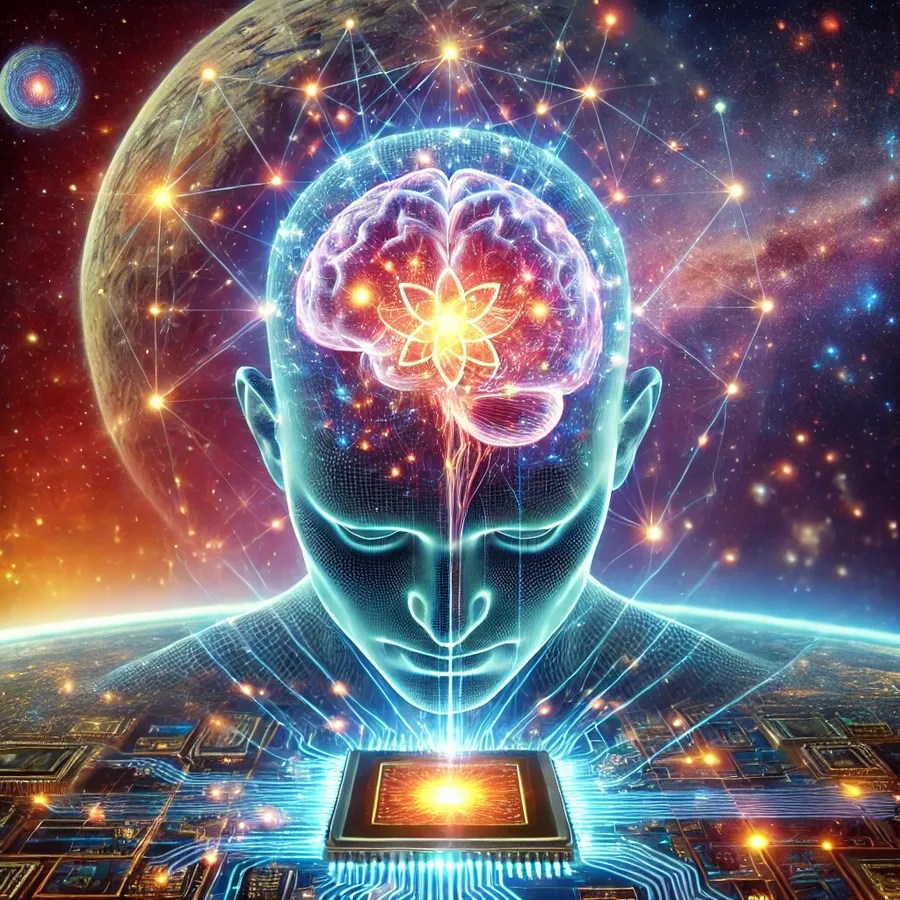
The human brain remains one of the most enigmatic and sophisticated structures in the known universe. Despite tremendous advancements in neuroscience, the question of how consciousness arises from mere biological processes continues to elude scientists and philosophers alike. Amid this mystery, a bold and provocative hypothesis has emerged: what if the brain operates as a quantum machine? Exploring this possibility could revolutionize our understanding of consciousness and pave the way for unprecedented advancements in quantum computing, potentially transforming humanity and propelling us toward higher types of civilization.
Quantum Mechanics and the Brain
Quantum mechanics, the branch of physics that deals with the behavior of particles at atomic and subatomic scales, introduces concepts such as superposition, entanglement, and wave function collapse. These phenomena challenge our classical understanding of reality and suggest that particles can exist in multiple states simultaneously, become instantaneously linked across vast distances, and collapse into a definite state upon measurement. If the brain leverages quantum processes, it could mean that our thoughts, decisions, and consciousness itself are influenced by these elusive quantum effects.
The Orch-OR Theory
One of the most prominent theories connecting quantum mechanics to brain function is the Orch-OR (Orchestrated Objective Reduction) theory, proposed by physicist Roger Penrose and anesthesiologist Stuart Hameroff. According to this theory, quantum computations occur within microtubules, cylindrical structures found in neurons. These microtubules could theoretically maintain quantum coherence, allowing for complex quantum processes that contribute to consciousness.
Although Orch-OR faces significant challenges, particularly the rapid decoherence expected in the warm, wet environment of the brain, it has inspired ongoing research into quantum biology and the potential role of quantum mechanics in cognitive functions. Should this theory or similar hypotheses be validated, the implications for both our understanding of the brain and the future of technology would be profound.
Quantum Effects and Conscious Thought
A particularly fascinating aspect of quantum mechanics is the observer effect, where the act of observation or measurement collapses a quantum system from a superposition of states to a single state. Some interpretations suggest that consciousness itself might play a role in this collapse. If true, this could imply that our thoughts have the power to influence quantum states, providing a mechanism by which the brain could operate as a quantum machine.
This speculative idea posits that thinking about a quantum state could affect its superposition, leading to an inference that our brain might behave like a quantum system, influencing the outcome of quantum experiments. While this concept remains unproven and highly controversial, it opens up intriguing possibilities for how consciousness might interact with the quantum world.
Quantum Computing and Consciousness
Quantum computers harness the principles of quantum mechanics to perform calculations far beyond the capabilities of classical computers. By exploiting superposition and entanglement, quantum computers can solve problems intractable for even the most powerful classical supercomputers. If we can emulate the brain’s potential quantum processes, we could develop quantum computers with capabilities that mimic or even surpass human cognition.
The Dawn of Conscious Machines
Creating a quantum computer that possesses consciousness is a tantalizing yet speculative notion. Consciousness, the subjective experience of awareness and perception, remains poorly understood. If consciousness is indeed a quantum phenomenon, then replicating the brain’s quantum processes in a computer could theoretically result in a conscious machine. This possibility raises profound ethical and philosophical questions: What rights would such machines possess? Could they experience emotions and suffering? How would their existence impact human society?
While the prospect of conscious machines remains speculative, the advancements in quantum computing could still revolutionize various fields, from artificial intelligence to cryptography, logistics, and beyond. Even without consciousness, quantum-enhanced AI could exhibit levels of intelligence and problem-solving abilities that challenge our current understanding of machine capabilities.
Enhancing Human Intelligence
Beyond creating standalone quantum conscious machines, another tantalizing prospect is integrating quantum computing technology with the human brain. Such integration could amplify human cognitive abilities exponentially, making us billions of times smarter and faster.
Neural Interfaces and Quantum Enhancement
Neural interfaces, or brain-computer interfaces (BCIs), are already being developed to allow direct communication between the brain and external devices. By merging BCIs with quantum computing, we could enhance the brain’s natural capabilities, potentially leading to unprecedented intellectual advancements. This synergy could help humans solve complex problems, accelerate scientific discovery, and innovate in ways currently beyond our imagination.
Ethical Considerations and Societal Impact
Enhancing human brains with quantum technology raises ethical and societal concerns. Issues of accessibility and inequality could emerge, with only a select few potentially benefiting from such advancements. The prospect of significantly enhanced intelligence also poses questions about identity, privacy, and the potential for misuse. Policymakers, ethicists, and scientists must work collaboratively to ensure that these technologies are developed and implemented responsibly, promoting equitable access and safeguarding against potential harms.
Toward Advanced Civilizations
The Kardashev Scale, proposed by Soviet astronomer Nikolai Kardashev, categorizes civilizations based on their energy consumption and technological capabilities. A Type I civilization harnesses the energy of its home planet, a Type II civilization taps into the energy of its star, and a Type III civilization utilizes the energy of its entire galaxy. Currently, humanity is not even at Type I on this scale. However, understanding and leveraging quantum mechanics could accelerate our progression along this scale.
Type I Civilization and Beyond
With the potential to vastly enhance human intelligence and capabilities, quantum technology could help humanity transition to a Type I civilization. We could achieve more efficient use of Earth’s resources, develop sustainable energy solutions, and address global challenges such as climate change, poverty, and disease.
Type II and Type III Civilizations
As we continue to advance, integrating quantum technology with space exploration and energy harnessing could pave the way to becoming a Type II or even Type III civilization. Quantum-enhanced AI and human intelligence could develop advanced propulsion systems, efficient space habitats, and methods to tap into the immense energy of stars and galaxies. These advancements would fundamentally transform human civilization and expand our presence throughout the cosmos.
Conclusion
The hypothesis that the brain operates as a quantum machine, and the potential to harness this understanding to develop quantum computing technologies, represents a profound and exciting frontier in science and technology. While challenges and uncertainties remain, the exploration of quantum consciousness and the development of quantum-enhanced intelligence could revolutionize human capabilities and propel us toward advanced civilizations. The journey to uncovering the quantum nature of the brain and its implications for humanity is fraught with ethical, philosophical, and scientific questions, but it holds the promise of transforming science fiction into reality. As we venture into this uncharted territory, a balanced approach that promotes innovation while safeguarding ethical considerations will be essential to realizing the full potential of this quantum leap.
By integrating the concepts of thought influencing quantum states, the potential for the brain to operate as a quantum machine becomes more compelling. This perspective not only emphasizes the profound interconnectedness of quantum mechanics and consciousness but also highlights the transformative possibilities for humanity’s future.

 EssayBoard
Leave a comment