
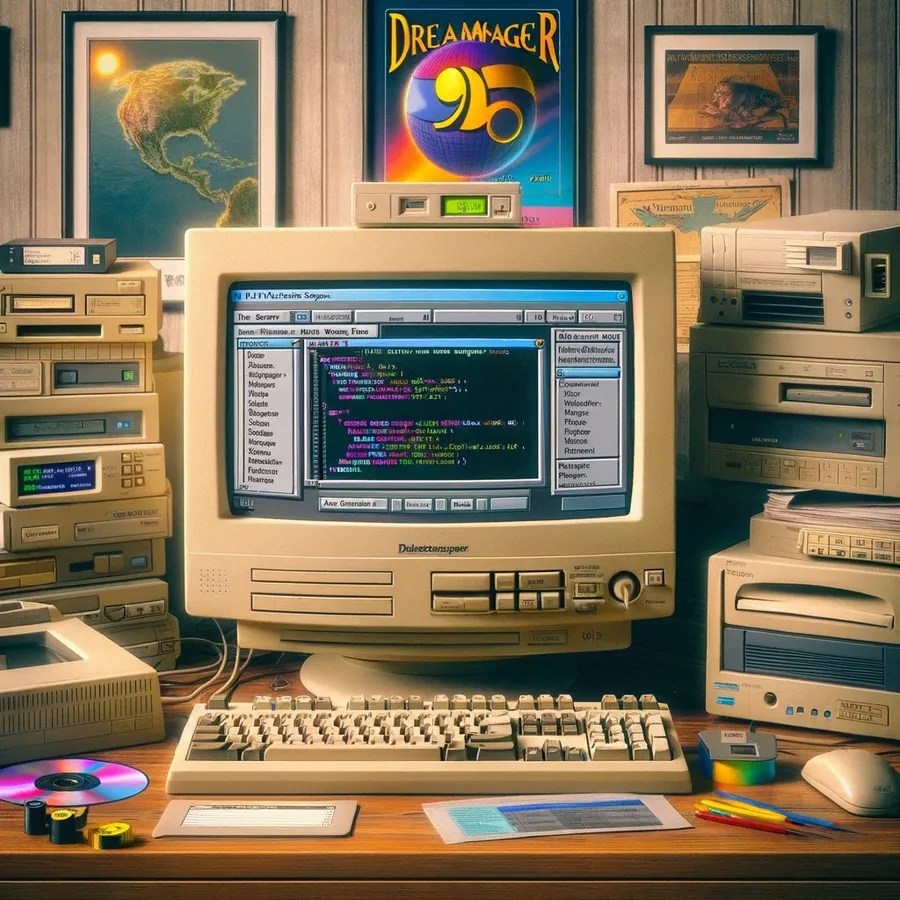
In the mid-1990s, as the internet began to expand beyond academic and government use into the public sphere, the tools available for web development were rudimentary but innovative for their time. Among these, Microsoft FrontPage stands out as a significant milestone in the democratization of web design.
The Birth of FrontPage
In November 1995, a small company named Vermeer Technologies developed FrontPage 1.0, a WYSIWYG (What You See Is What You Get) HTML editor. This tool allowed users to create web pages without needing to write code manually, which was a revolutionary concept at the time. Just a few months later, in January 1996, Microsoft acquired Vermeer for $130 million, integrating FrontPage into its software suite by June of the same year. The acquisition was part of Microsoft’s broader strategy to dominate the nascent web development market, positioning FrontPage against competitors like Netscape Navigator’s Composer (Wikipedia) (Web Design Museum) (Tedium).
Features and Evolution
FrontPage quickly evolved, with subsequent versions adding more sophisticated features. FrontPage 97 introduced enhanced WYSIWYG capabilities, including table support, HTML frames, and image alignment. By the time FrontPage 98 was released, it included over 50 professionally designed themes, integration with Microsoft Office, and direct publishing capabilities. These features made web design more accessible to a broader audience, from small businesses to hobbyists who wanted to establish an online presence (Wikipedia) (Web Design Museum).
However, FrontPage’s ease of use came with a downside: the HTML code it generated was often cluttered and proprietary, designed to work best with Microsoft’s Internet Explorer. This made websites created with FrontPage less compatible with other browsers, a significant issue during the “browser wars” of the late 1990s (Tedium).
The Rise and Fall
FrontPage enjoyed widespread use throughout the late 1990s and early 2000s. It was included in several editions of Microsoft Office and became a go-to tool for many aspiring web developers. Despite its popularity, criticisms regarding the quality of the generated code persisted. By the time FrontPage 2003 was released, Microsoft had to assure users that the software would produce cleaner, more standards-compliant HTML (Tedium).
The web development landscape was changing rapidly, with new tools and frameworks emerging that offered more flexibility and better code quality. Macromedia Dreamweaver, released in 1997, became a strong competitor by combining WYSIWYG design with powerful code-editing features. The open-source movement also gained momentum, with editors like Bluefish and Aptana Studio providing free, robust alternatives (Online HTML Editing and Cleaner).
Modern Web Development
The complexity and scope of web development have grown immensely since the days of FrontPage. Modern frameworks and libraries such as Bootstrap, Tailwind CSS, React, and Angular provide developers with powerful tools to create responsive, dynamic websites. These tools are often integrated into sophisticated code editors like Visual Studio Code, which supports a wide range of extensions and functionalities, making the development process more efficient and collaborative (Online HTML Editing and Cleaner).
The rise of content management systems (CMS) like WordPress further reduced the need for standalone HTML editors. CMS platforms offer built-in editors that allow users to create and manage web content without touching a single line of code. This shift towards more user-friendly, integrated solutions marked the end of an era for tools like FrontPage and even its successor, Expression Web (Online HTML Editing and Cleaner).
Competitors and Their Fates
During FrontPage’s peak, it faced significant competition from other web development tools:
- Macromedia Dreamweaver: Released in 1997, Dreamweaver quickly became a favorite among professional web developers due to its combination of WYSIWYG editing and powerful code editing features. Dreamweaver supported a wide range of web technologies, including JavaScript, CSS, and server-side scripting, making it a versatile tool for both designers and developers. Adobe acquired Macromedia in 2005, and Dreamweaver is still in use today as part of Adobe Creative Cloud, offering features such as live view editing and multi-device preview (Tedium) (Online HTML Editing and Cleaner).
- Netscape Composer: Part of the Netscape Communicator suite, Netscape Composer was a WYSIWYG HTML editor that allowed users to create and edit web pages visually. While not as feature-rich as Dreamweaver, Composer was free and accessible, making it a popular choice for beginners and those who needed a simple tool for web development. After Netscape Navigator ceased development, Composer did not continue as a standalone product. Its legacy lives on in the form of SeaMonkey, an open-source project that includes a web browser, email client, and HTML editor (Web Design Museum) (Online HTML Editing and Cleaner).
- Adobe PageMill: Another early competitor, Adobe PageMill, was released in 1995. PageMill was one of the first WYSIWYG HTML editors, allowing users to design web pages visually without needing to write code. However, it lacked the advanced features of Dreamweaver and did not gain the same level of popularity. PageMill was eventually replaced by Adobe GoLive, which was also later discontinued in favor of Dreamweaver (Online HTML Editing and Cleaner).
Legacy and Impact
While Microsoft discontinued FrontPage in 2006, replacing it with Expression Web and later focusing on more advanced tools like Visual Studio, its impact on early web development is undeniable. FrontPage played a crucial role in lowering the barrier to entry for web design, allowing countless individuals and small businesses to establish their online presence during the early days of the internet (Web Design Museum) (Web Design Museum).
Today, as we look back on the evolution of web development tools, it’s clear that FrontPage was a product of its time, embodying both the promise and limitations of early web design software. Its legacy lives on in the user-friendly design philosophies that continue to shape modern web development tools and platforms.
The story of FrontPage reminds us of the rapid pace of technological change and the continuous evolution of web development practices. From the simple WYSIWYG editors of the 1990s to the sophisticated integrated development environments (IDEs) of today, the tools we use to build the web are constantly improving, making it easier and more exciting to create and innovate online.

 EssayBoard
Leave a comment