
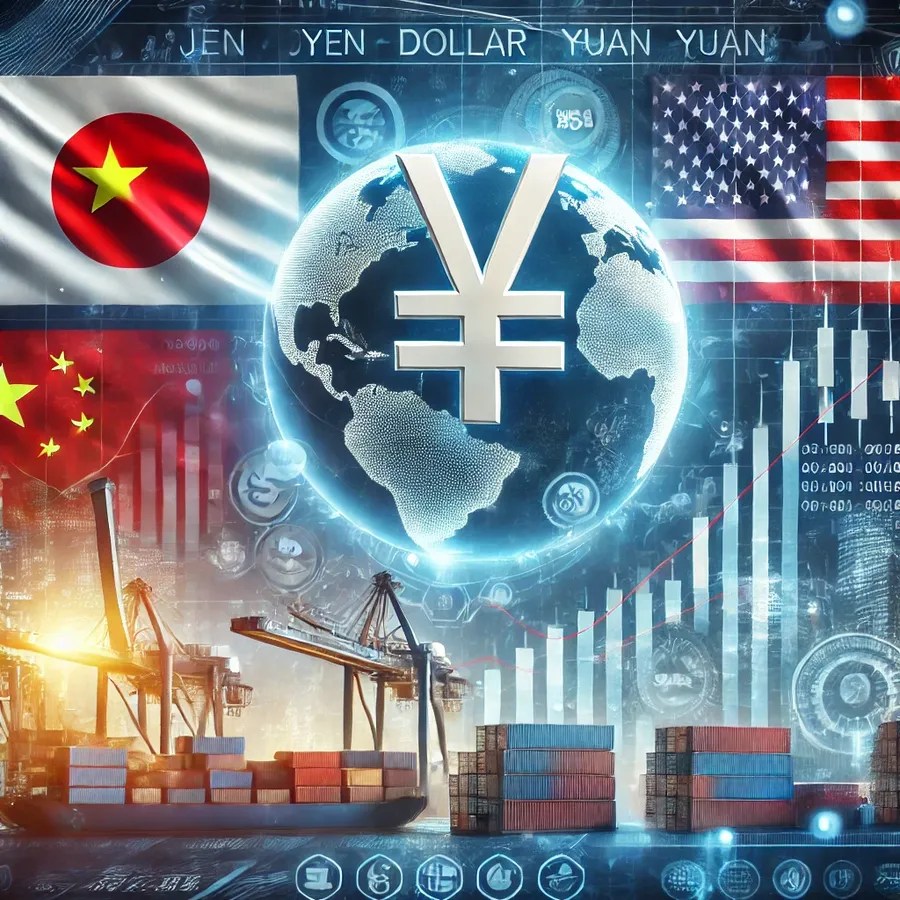
Japan’s recent addition to the United States’ currency watchlist alongside countries like China, Vietnam, Singapore, India, and Taiwan highlights ongoing concerns over currency practices among major trading partners. This inclusion prompts a closer examination of Japan’s current economic health, its approach to trade, particularly its strategy regarding U.S. Treasury holdings, and the broader implications for its relationships with the U.S. and China.
Economic Health of Japan
Japan’s economy has shown resilience amidst global uncertainties. In 2024, Japan’s real GDP growth is projected at around 1.0%, with expectations to rise to 1.4% in 2025 (Dir Co Jp) (Site homepage). This moderate growth is driven by several factors, including wage increases, government fiscal measures, and a recovery in private consumption and business investment.
Wage increases from the 2024 spring negotiations have been significant, with regular salary increases expected to reach around 3%, compared to 1.8% in the previous year (Dir Co Jp). These wage hikes are likely to boost household incomes and consumer spending, providing a much-needed stimulus to the economy. Additionally, government measures such as tax cuts and cash handouts are supporting this recovery.
Despite these positive developments, Japan faces challenges such as weak external demand for exports, demographic issues, and potential supply constraints. Industrial production and exports experienced a temporary drop in early 2024 due to supply chain issues, but business investment is picking up, supported by high corporate profits and robust future investment plans (Site homepage).
Currency Watchlist and U.S. Treasury Holdings
The U.S. Treasury’s decision to add Japan to the currency watchlist underscores concerns over currency manipulation practices. This move is part of a broader strategy to monitor and address unfair trade practices. For Japan, this inclusion is a reminder of the delicate balance it must maintain in its foreign exchange policies.
One of the key factors influencing Japan’s economic strategy is its approach to U.S. Treasury holdings. Japan, the largest foreign holder of U.S. Treasuries, has been reducing its holdings. In November 2023, Japanese holdings of U.S. Treasuries fell by 18.5% year-over-year to $1.082 trillion (S&P Global). This reduction is driven by rising yields on Japanese government bonds and increased hedging costs due to the Federal Reserve’s rate hikes.
Japanese investors have been repatriating capital as domestic bonds become more attractive, a trend likely to continue if the Bank of Japan (BOJ) further relaxes its yield curve control policy (S&P Global). This shift in investment strategy underscores Japan’s focus on stabilizing its own economy amidst global financial volatility.
Trade Strategies and Relations with China
Unlike the United States, Japan has not imposed new tariffs specifically targeting Chinese imports. Japan’s tariff policies remain relatively low, with the average applied tariff rate around 4.3% for all products and 2.5% for non-agricultural products (Trade.gov). This approach reflects Japan’s strategy to maintain stable trade relations with China, its largest trading partner.
Japan’s decision to avoid imposing tariffs on Chinese imports contrasts with the U.S. strategy, which has seen increased tariffs on Chinese goods as part of a broader trade conflict. This difference in approach highlights Japan’s intent to preserve economic ties with China while managing its own economic challenges.
Implications for Future Relations
The inclusion of Japan on the U.S. currency watchlist and its strategy towards U.S. Treasury holdings and trade policies have significant implications for its future relations with both the U.S. and China.
With the U.S.: The currency watchlist inclusion signals increased scrutiny from the U.S., which could lead to heightened economic tensions. However, Japan’s strategic reduction in U.S. Treasury holdings reflects a shift towards stabilizing its own economy rather than directly confronting U.S. policies. This cautious approach aims to avoid escalating tensions while ensuring economic stability.
With China: Japan’s decision not to impose tariffs on Chinese imports indicates a desire to maintain strong trade relations with China. This strategy helps Japan navigate the complex dynamics of U.S.-China trade tensions, positioning itself as a stable trading partner for both nations. Maintaining this balance is crucial for Japan’s economic health, given its reliance on both markets.
Conclusion
Japan’s inclusion on the currency watchlist alongside other major trading partners highlights ongoing concerns over currency practices and economic policies. Despite this scrutiny, Japan’s economy shows signs of moderate growth, driven by wage increases, government measures, and a strategic approach to managing its U.S. Treasury holdings.
By avoiding new tariffs on Chinese imports, Japan distinguishes its trade strategy from that of the U.S., aiming to preserve stable economic relations with both nations. This approach underscores Japan’s focus on navigating global economic challenges while maintaining its own economic stability.
As Japan continues to balance its relationships with the U.S. and China, its strategies and policies will play a critical role in shaping future economic and geopolitical dynamics. The implications of these relationships extend beyond trade, influencing global economic stability and cooperation in addressing shared challenges.
In summary, Japan’s inclusion on the currency watchlist is a significant development, reflecting broader concerns over global economic practices. Japan’s response, characterized by strategic economic policies and careful management of international relations, will be crucial in navigating the complexities of global trade and finance in the years to come.

 EssayBoard
Leave a comment