
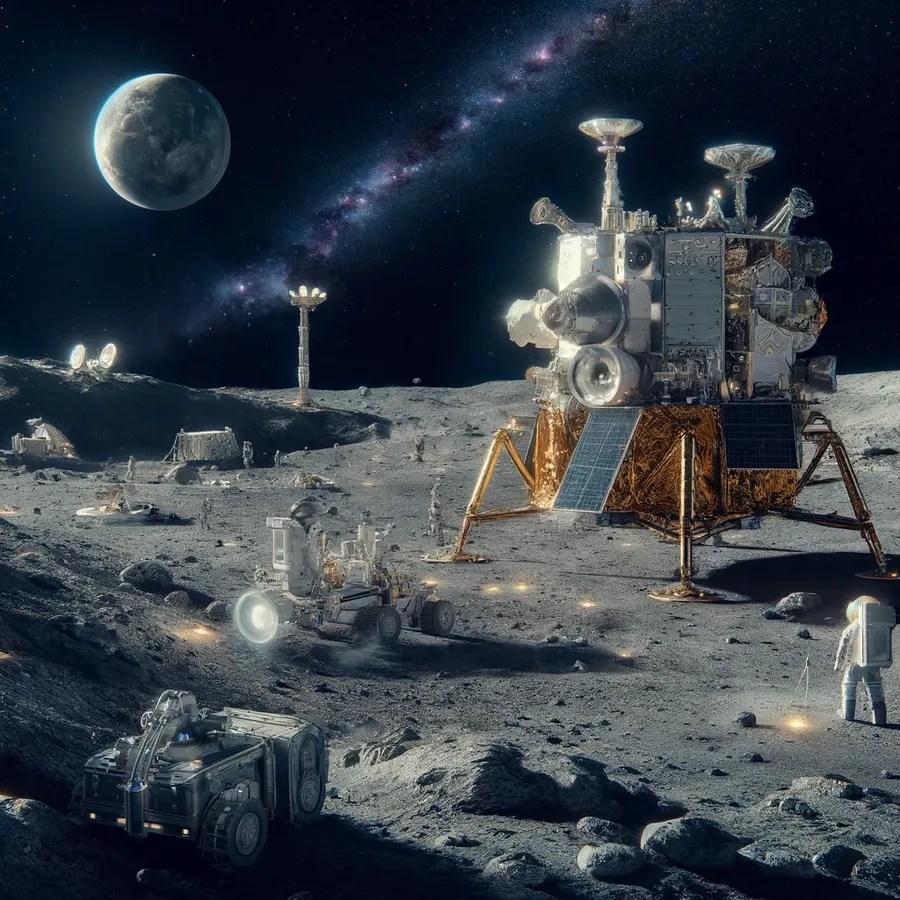
In an era where the race to the stars has reignited global interest, China’s Chang’e 6 mission stands as a significant milestone, not just for the nation but for the entire world. This article delves into the complexities and broader implications of China’s recent accomplishments in space exploration, focusing on the Chang’e 6 mission to the far side of the moon. Through a detailed analysis of the geopolitical, scientific, and technological aspects, we aim to uncover the potential impacts and future directions this mission may herald.
A Historical Context: The Moon’s Far Side
The moon’s far side, often referred to as the “dark side” due to its permanent orientation away from Earth, has long been a subject of intrigue and scientific curiosity. Historically, most lunar missions have focused on the near side, with its relatively flat and accessible terrain. However, the far side presents a more rugged and scientifically rich landscape, offering unique opportunities for exploration.
China’s decision to focus on this uncharted territory highlights its ambitious goals and technological prowess. The Chang’e 4 mission, which successfully landed on the far side in 2019, set the stage for Chang’e 6. This mission aims to bring back rock samples and conduct a series of sophisticated experiments, further pushing the boundaries of what we know about our celestial neighbor.
The Chang’e 6 Mission: An Overview
Launched in early May 2024, Chang’e 6 is equipped with European instruments and has successfully reached the far side of the moon. The mission’s primary objectives include collecting rock samples and conducting experiments that could provide new insights into the moon’s geology and potential resources. This collaborative effort features contributions from France, Sweden, Italy, and Pakistan, showcasing a rare instance of international cooperation amidst growing geopolitical tensions.
The mission’s scientific equipment includes a radon detector developed by the French Institute for Astrophysics and Planetology, along with instruments from Sweden and Italy. This cooperation underscores the importance of shared scientific endeavors, even as political relations between participating nations remain complex.
Geopolitical Ramifications: The New Space Race
China’s lunar ambitions are not just about scientific exploration; they are deeply intertwined with geopolitical strategies. The Chang’e 6 mission exemplifies China’s methodical approach to space exploration, building upon each success to achieve more complex and ambitious goals. This progressive strategy is evident in China’s plans to establish a permanent human presence on the moon, which could serve as a springboard for further solar system exploration.
From a geopolitical perspective, China’s achievements challenge the long-standing dominance of the United States in space exploration. While the U.S. has relied heavily on its commercial sector, with companies like SpaceX leading the charge, China’s state-driven approach ensures a steady stream of resources and long-term planning, free from the fluctuations of political cycles.
The implications of China’s advancements are profound. As noted by David Arreosto, co-author of “Open Space: The Races Behind a Space-Born Renaissance,” the establishment of cis-lunar infrastructure by China represents a strategic move to dominate the ultimate high ground. Control over lunar resources, such as water ice at the moon’s south pole, could be pivotal for future missions to Mars and beyond. This resource, essential for producing rocket fuel, positions the moon as a potential “gas station” for deeper space exploration.
The Science and Technology Behind Chang’e 6
The scientific goals of Chang’e 6 extend beyond mere sample collection. The mission’s success could provide critical data on the moon’s geological differences between its near and far sides, offering clues about the early solar system’s history. Additionally, the inclusion of advanced European instruments on the mission highlights the importance of international scientific collaboration.
One notable piece of equipment on Chang’e 6 is the radon detector from the French Institute for Astrophysics and Planetology. This instrument will help scientists understand the moon’s internal processes and its potential for future habitability. The successful operation of such complex instruments in the harsh lunar environment demonstrates significant technological advancements and opens new avenues for future missions.
Challenges and Opportunities in International Collaboration
While Chang’e 6 showcases successful international cooperation, it also brings to light the challenges posed by geopolitical tensions. The European Space Agency’s involvement with China, despite increasing geopolitical frictions, underscores the complicated nature of space exploration. Scientists and engineers often find themselves at the intersection of collaboration and competition, navigating a landscape where political decisions can drastically impact scientific progress.
As Keith Cowing, editor of NASAWatch.com, points out, space exploration has historically been an arena where geopolitical adversaries find common ground. The cooperation between the U.S. and Russia on the International Space Station (ISS) during the Cold War is a testament to this potential. However, the exclusion of China from the ISS and the imposition of the Wolf Amendment, which prohibits NASA from engaging in direct cooperation with the Chinese space agency, reflect current geopolitical realities that complicate such collaboration.
The Future of Lunar Exploration: Prospects and Predictions
Looking ahead, the future of lunar exploration appears to be a complex interplay of cooperation and competition. China’s advancements, coupled with its long-term planning and resource commitment, position it as a formidable player in the new space race. However, the involvement of private companies and other nations will likely diversify the field, leading to a multi-polar space exploration environment.
The potential for lunar resource extraction, particularly water ice and helium-3, a non-radioactive isotope that could be used in future nuclear fusion reactors, adds an economic dimension to lunar exploration. These resources could provide the necessary fuel for sustained human presence and further exploration of the solar system.
As space technology continues to advance, the concept of a space-to-space economy becomes increasingly plausible. Companies like SpaceX and Blue Origin are pioneering reusable rocket technology, significantly reducing the cost of space travel. The development of lunar infrastructure by both governmental and private entities could pave the way for a permanent human presence on the moon, serving as a launchpad for missions to Mars and beyond.
Conclusion: The Broader Impact of Chang’e 6
China’s Chang’e 6 mission represents a significant milestone in lunar exploration, blending scientific inquiry with geopolitical strategy. The mission’s success highlights China’s methodical and ambitious approach, setting the stage for future lunar and Martian missions. As nations and private companies continue to push the boundaries of space exploration, the lessons learned from Chang’e 6 will undoubtedly inform the next steps in humanity’s journey to the stars.
The Chang’e 6 mission is not just about exploring the moon; it is about shaping the future of space exploration. By fostering international cooperation amidst geopolitical challenges, advancing scientific knowledge, and paving the way for future resource extraction, Chang’e 6 is a testament to the potential of human ingenuity and collaboration. As we look to the stars, missions like Chang’e 6 remind us of the vast possibilities that lie ahead, urging us to continue exploring, innovating, and reaching for the unknown.

 EssayBoard
Leave a comment