
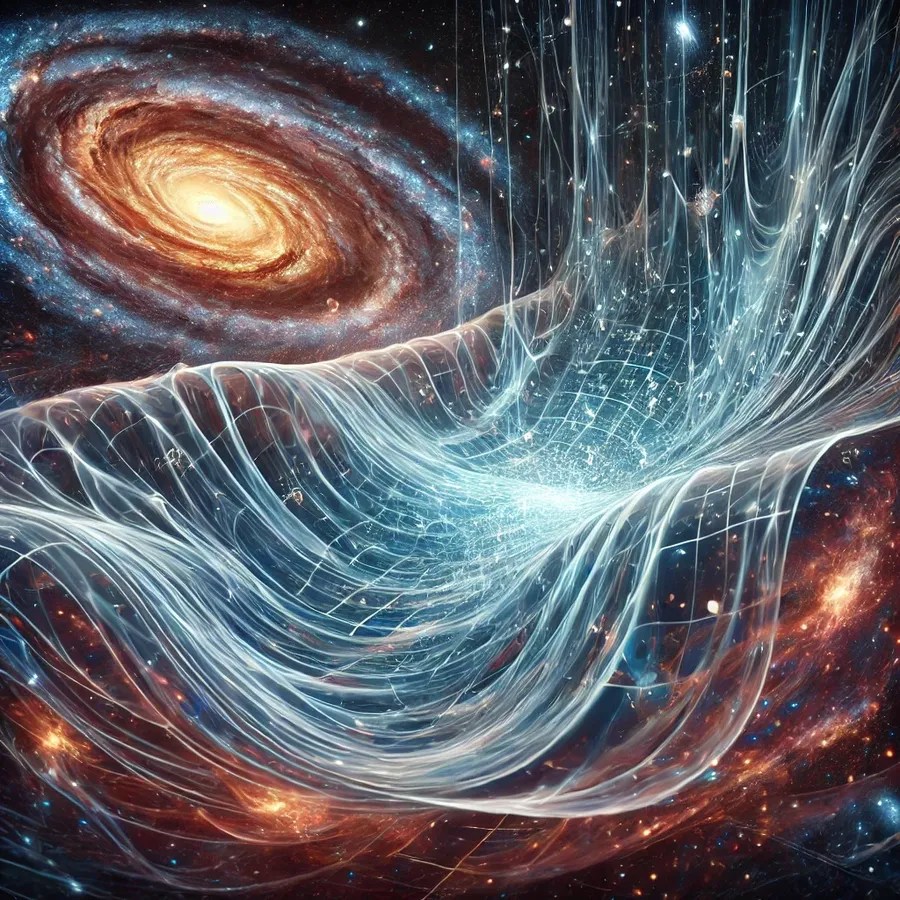
For decades, the standard model of cosmology, often referred to as the ΛCDM model (Lambda Cold Dark Matter), has been the cornerstone of our understanding of the universe. This model posits that the universe is composed of roughly 68% dark energy, 27% dark matter, and only about 5% ordinary matter. Dark energy is believed to be responsible for the accelerated expansion of the universe, while dark matter accounts for the missing mass that influences the gravitational behavior of galaxies. However, recent studies are shaking the foundations of this model, suggesting that the true nature of the universe might be far more complex—and that concepts like brane tension and local expansion might offer alternative explanations that could challenge the need for dark energy and dark matter altogether.
The Standard Model: A Brief Overview
Before delving into the new challenges, it’s important to understand the standard model’s framework. The ΛCDM model is built on two pillars: the cosmological constant (Λ) and cold dark matter (CDM). The cosmological constant represents dark energy, a mysterious force driving the accelerated expansion of the universe. Cold dark matter, on the other hand, is a form of matter that doesn’t interact with electromagnetic forces but exerts gravitational influence, helping to explain the observed rotation curves of galaxies and the large-scale structure of the cosmos.
Despite its successes, the ΛCDM model has always been somewhat of a placeholder. Dark energy and dark matter are concepts introduced to fill gaps in our observations, but they remain poorly understood. This has led some physicists to explore alternative models that might explain the same observations without relying on these enigmatic entities.
Enter the Braneworld: A Higher-Dimensional Perspective
One of the most intriguing challenges to the ΛCDM model comes from the Braneworld scenario, a concept rooted in string theory and higher-dimensional physics. According to this idea, our universe is a “brane”—a lower-dimensional object—embedded within a higher-dimensional “bulk.” In this context, the forces and dynamics that we observe in our universe could be the result of interactions between our brane and the surrounding bulk.
Brane Tension and Cosmic Acceleration
A recent study has proposed that the accelerated expansion of the universe, traditionally attributed to dark energy, could instead be explained by brane tension. In this model, the tension within the brane (our universe) isn’t constant. Instead, it varies due to interactions with the bulk, causing the brane to stretch or compress in certain regions. This stretching could mimic the effects of dark energy, driving the accelerated expansion we observe without the need for a separate, mysterious force.
The idea of brane tension adds a new layer of complexity to our understanding of cosmic expansion. Instead of being a uniform process driven by a single force (dark energy), expansion might be a dynamic, variable phenomenon influenced by the higher-dimensional bulk. This would mean that different regions of the universe could expand at different rates, depending on local interactions with the bulk—an idea that challenges the notion of a universally uniform expansion.
Gravitational Waves on a Cosmic Scale
An extension of this idea is that brane tension in distant parts of the universe could generate gravitational waves on an enormous scale. These waves might propagate through the higher-dimensional bulk and influence regions of the brane far removed from their origin. Just as traditional gravitational waves ripple through space-time due to massive objects like colliding black holes, these brane-induced waves could ripple through the fabric of our universe, potentially creating localized expansions or contractions.
The scale of these waves could be so vast that we are currently unable to detect them, much like how an ant on a basketball cannot perceive the full curvature of the ball. Our instruments might be too localized or fine-tuned to pick up these large-scale waves, meaning that much of the cosmic activity influencing our universe could be happening beyond our observational capabilities.
The Role of Interference in Cosmic Expansion
Another intriguing aspect of these cosmic-scale gravitational waves is the potential for interference. In physics, when waves meet, they can either amplify each other (constructive interference) or cancel each other out (destructive interference). If brane-induced gravitational waves interact in this way on a large scale, the resulting interference patterns could significantly impact the universe’s expansion. Constructive interference might amplify the expansion in certain regions, contributing to the observed acceleration. Conversely, destructive interference could dampen expansion in other areas, leading to a more complex and variable cosmic expansion than previously thought.
Local Expansion: A New Perspective on Cosmic Growth
The concept of local expansion further complicates the picture. In the traditional view, the universe’s expansion is considered to be homogeneous and isotropic, meaning it occurs uniformly in all directions. However, if brane tension and higher-dimensional forces are at play, it’s possible that expansion could be a local phenomenon, varying from one region to another.
Imagine the universe as a rubber sheet. If you place a heavy object on the sheet, it creates a depression, causing the sheet to stretch more in that area. Similarly, in the Braneworld model, massive objects in the bulk could exert gravitational forces on the brane, creating localized expansions or contractions. This could lead to regions of the universe that expand at different rates, much like waves propagating across a pond.
Interference and Local Expansion Phenomena
The possibility of interference between cosmic-scale gravitational waves adds another layer of complexity to the concept of local expansion. If multiple waves generated by distant brane tension converge in our region of the universe, their interference could create areas where expansion is either enhanced or suppressed. In regions of constructive interference, we might observe localized acceleration, contributing to the faster-than-expected expansion rates in certain parts of the cosmos. This interaction could explain why expansion rates vary across different regions, hinting that the universe’s growth is not as uniform as the standard model suggests.
The Implications for Cosmology
The introduction of brane tension and local expansion has profound implications for our understanding of the universe. If these concepts are correct, they could provide alternative explanations for some of the most puzzling observations in cosmology—potentially eliminating the need for dark energy and dark matter.
Rethinking Dark Energy
Dark energy has always been a mysterious concept, introduced primarily to explain the observed acceleration of the universe’s expansion. However, if brane tension and interactions with the bulk can account for this acceleration, dark energy might be unnecessary. This would radically alter the ΛCDM model, reducing its reliance on poorly understood entities and offering a more unified explanation rooted in higher-dimensional physics.
Questioning Dark Matter
Dark matter, too, might come under scrutiny. In the Braneworld scenario, the gravitational effects attributed to dark matter could be explained by the warping of the brane due to interactions with the bulk. This warping could influence the motion of galaxies and other cosmic structures, potentially accounting for the “missing mass” without the need for an invisible form of matter.
However, this remains speculative. While the Braneworld model offers exciting possibilities, it still requires further development and, crucially, observational evidence. Current models of dark matter are based on extensive observations, including galaxy rotation curves, gravitational lensing, and the cosmic microwave background (CMB). Any new theory would need to match or exceed these observations to be considered viable.
Cosmic Interconnectedness and the Ripple Effect
The idea that gravitational waves generated by brane tension elsewhere in the universe could create local expansions here underscores the interconnectedness of the cosmos. It suggests that the universe is not just a collection of isolated regions but a dynamic, interconnected system where events in one part can influence another. This ripple effect could mean that the forces shaping our local universe are the result of distant events in the higher-dimensional bulk, far beyond our current observational reach.
This interconnected view of the universe challenges our current models and invites us to think of the cosmos not as a static entity, but as a constantly evolving network of interactions. If proven, this could revolutionize our understanding of how the universe works and how its different parts are related.
Challenges and Opportunities
The challenges presented by the Braneworld model and the concept of local expansion highlight the complexity of the universe and the limitations of our current models. They also underscore the importance of being open to new ideas in cosmology, even when they challenge long-held assumptions.
The Need for Observational Evidence
One of the biggest hurdles for these new ideas is the lack of direct observational evidence. While the standard model is supported by a vast array of data, including measurements from the CMB and large-scale structure surveys, the Braneworld model is still largely theoretical. To gain traction, it would need to make predictions that can be tested and observed, either through new astronomical observations or experiments in particle physics.
Revising Our Understanding of the Universe
If these new models are validated, they could lead to a profound revision of our understanding of the universe. The idea that cosmic expansion might be a local phenomenon, driven by brane tension and higher-dimensional forces, challenges the very foundations of cosmology. It suggests that the universe is far more dynamic and complex than the standard model implies, with regions of space potentially expanding at different rates depending on local conditions.
This also opens up new avenues for exploring the nature of the bulk and the forces at play in higher dimensions. Understanding these forces could provide insights into the fundamental nature of reality, potentially leading to a new, more comprehensive theory of everything.
Could Interference Explain the Accelerated Expansion?
If large-scale gravitational wave interference is occurring throughout the universe, it might offer an alternative explanation for the accelerated expansion traditionally attributed to dark energy. Constructive interference, where waves amplify each other, could enhance the rate of cosmic expansion, particularly in regions where these waves are prevalent. This could suggest that the forces driving the universe’s accelerated growth are more complex, involving both the influence of brane tension and the dynamic effects of gravitational waves. If validated, this idea could challenge the necessity of dark energy, proposing that the universe’s acceleration is a natural consequence of higher-dimensional interactions and wave dynamics.
Conclusion: A New Era of Cosmology?
The challenges posed by brane tension and local expansion represent an exciting frontier in cosmology. While the standard model has been incredibly successful in explaining many aspects of the universe, it’s clear that there are still gaps in our understanding—gaps that might be filled by new theories that go beyond dark energy and dark matter.
As we continue to explore these ideas, it’s important to remain open to the possibility that the universe is far more complex than we currently understand. The Braneworld model and the concept of local expansion offer tantalizing hints that our current models might be just the beginning, and that a deeper, more intricate reality awaits discovery. Whether these new ideas will stand the test of time remains to be seen, but they certainly offer a compelling challenge to the established order—a challenge that could lead to a new era of cosmology, where the mysteries of dark energy and dark matter are finally unraveled, and a more complete understanding of the universe emerges.
Sources:
Braneworld Model and Brane Tension:
- A higher-dimensional model that explains cosmic acceleration without dark energy by considering variable brane tension and the interactions between our universe and a higher-dimensional bulk. This study can be referenced from a recent paper published in Europhysics Letters in August 2024, where these ideas were explored in depth (Phys.org).
Challenges to Dark Matter:
- A study that questions the existence of dark matter, proposing that the observed phenomena attributed to dark matter could instead be explained by a combination of weakening forces of nature and the “tired light” theory. This model was detailed in a publication in The Astrophysical Journal in March 2024 (Phys.org) (ScienceDaily).

 EssayBoard
Leave a comment