
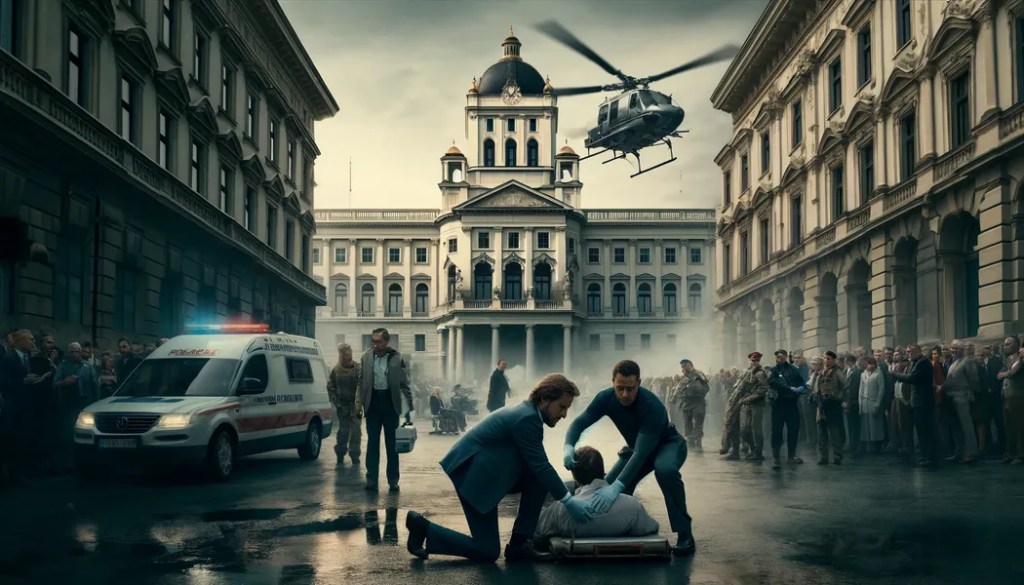
The assassination attempt on Robert Fico, Slovakia’s Prime Minister, on May 15, 2024, has shocked the nation and raised concerns across Europe. Fico was shot multiple times and remains in critical condition. The attack occurred after a government meeting outside Bratislava, and initial investigations indicate a clear political motivation behind the attempt (POLITICO) (RadioFreeEurope/RadioLiberty).
Background and Political Climate
Robert Fico is a controversial figure in Slovak politics, known for his populist and pro-Russian stance. His government has taken a hard line against non-governmental organizations (NGOs) and has been critical of Western policies, particularly regarding support for Ukraine. Fico’s administration has faced significant criticism for its attempts to weaken judicial independence and curb media freedom, drawing parallels with the authoritarian tendencies seen in Hungary under Viktor Orbán (POLITICO) (The Kyiv Independent).
Assassination Attempt
On May 15, 2024, as Fico was mingling with a small crowd following a government meeting, a 71-year-old man allegedly opened fire, striking the Prime Minister multiple times. Fico was flown by helicopter to a hospital where he underwent more than three hours of surgery. His condition remains life-threatening, and doctors are fighting to save his life (RadioFreeEurope/RadioLiberty) (Check Your Fact).
Political Motivation
Slovak officials, including Interior Minister Matus Sutaj Estok and Defense Minister Robert Kalinak, have confirmed that the attack was politically motivated. This conclusion is based on the suspect’s background and the context of recent political tensions in Slovakia. Fico’s aggressive policies against NGOs, his stance on Ukraine, and his efforts to centralize power have created a highly charged political environment, making him a target for extremist actions (POLITICO) (RadioFreeEurope/RadioLiberty).
European Implications
The assassination attempt on Fico has significant implications for Slovakia and the broader European landscape. Slovakia’s internal stability is crucial for maintaining cohesion within the European Union, especially given the ongoing war in Ukraine and the resulting geopolitical tensions. The attack highlights the risks associated with rising political polarization and the potential for violence in a climate of intense political and social divisions.
Fico’s government has been a vocal opponent of sanctions against Russia and has criticized Western support for Ukraine. This stance has strained Slovakia’s relationships with its EU and NATO partners. The assassination attempt could further complicate these dynamics, potentially leading to increased instability within the EU as member states navigate these complex geopolitical challenges (POLITICO) (The Kyiv Independent).
Slovakia’s Role in Europe
Slovakia, a member of both the European Union and NATO, holds strategic importance in Central Europe. It serves as a geographical and political bridge between Western Europe and countries further east, including Ukraine. Slovakia’s political stability and its stance on regional issues significantly impact the EU’s unified approach to broader geopolitical challenges, particularly those involving Russia and Ukraine.
European leaders have closely watched Slovakia’s political developments, especially under Fico’s leadership. His pro-Russian orientation and opposition to EU policies on sanctions and military support for Ukraine have been contentious points within the EU. The current instability in Slovakia could thus influence the EU’s cohesion and its capacity to present a unified front on critical foreign policy issues (POLITICO) (The Kyiv Independent).
Historical Context
While political violence in Slovakia is relatively rare, this incident is reminiscent of the murder of investigative journalist Ján Kuciak and his fiancée Martina Kušnírová in 2018. Their deaths, which were linked to Kuciak’s reporting on corruption involving Slovak politicians, led to massive protests and the eventual resignation of Fico from his previous term as Prime Minister. The current assassination attempt underscores the ongoing issues of corruption, political violence, and the fragility of democratic institutions in Slovakia (euronews) (RadioFreeEurope/RadioLiberty).
Conclusion
The assassination attempt on Robert Fico is a grave incident that underscores the volatile nature of Slovak and European politics in the current geopolitical climate. As Slovakia grapples with the aftermath of this attack, the broader implications for European stability and the integrity of democratic institutions cannot be understated. The situation calls for careful navigation by Slovak and European leaders to prevent further escalation and ensure the maintenance of peace and stability in the region (POLITICO) (RadioFreeEurope/RadioLiberty) (Check Your Fact).

 EssayBoard
Leave a comment